
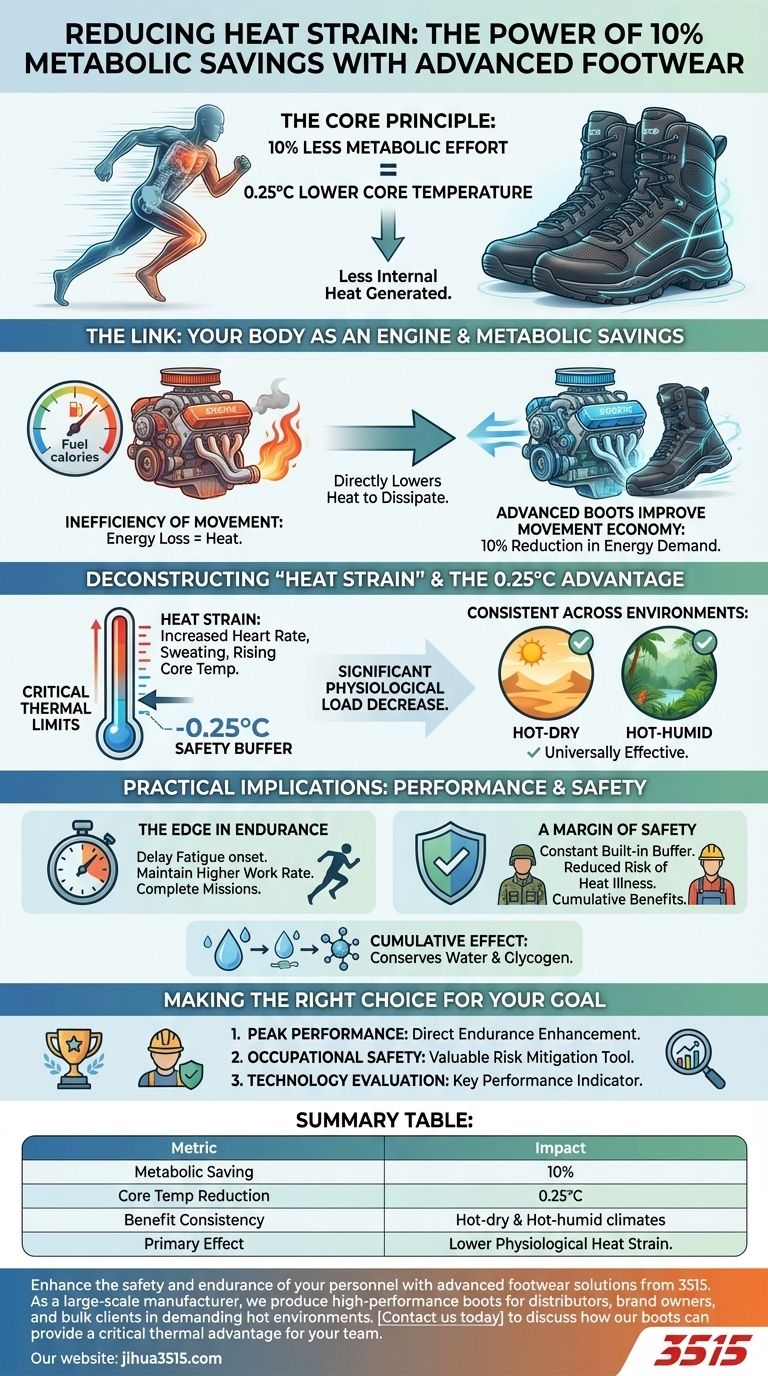
A 10% metabolic saving from advanced footwear translates directly into a measurable reduction in the body's heat strain. For most work intensities and durations, this efficiency gain results in a core body temperature that is 0.25°C lower than it would be otherwise. This benefit is consistent across both hot-dry and hot-humid climates.
The core principle is straightforward: less metabolic effort means less internal heat is generated. This 0.25°C reduction, while seemingly small, represents a significant decrease in physiological load, easing the body's cooling burden and enhancing both safety and performance in hot conditions.
The Link Between Metabolic Rate and Body Heat
Your Body as an Engine
Think of the human body as an engine. During physical activity, it consumes fuel (calories) to produce mechanical work, but a substantial portion of that energy is inevitably lost as heat. This internal heat production is the primary driver of rising core body temperature.
The Inefficiency of Movement
Human movement is not perfectly efficient. The vast majority of metabolic energy expended during an activity like walking or running is converted into heat, not forward motion. This is why strenuous exercise makes you feel hot, even in a cold room.
How Metabolic Savings Intervene
Technologies that provide a metabolic saving, such as advanced "super boots," improve your body's movement economy. They reduce the amount of energy required to perform the same task. A 10% reduction in energy demand means your internal engine runs 10% cooler, directly lowering the amount of heat your body must dissipate.
Deconstructing "Heat Strain"
More Than Just Feeling Hot
Heat strain is the total physiological response to heat stress. It encompasses increased heart rate, sweating, and, most critically, a rise in core body temperature. This internal temperature is the key objective measure of how well the body is coping.
The 0.25°C Reduction in Context
A reduction of 0.25°C keeps the body further from its critical thermal limits. Exceeding these limits can lead to a rapid decline in cognitive and physical performance, heat exhaustion, or even life-threatening heat stroke. This quarter-degree difference acts as a valuable safety buffer.
Consistent Across Environments
Crucially, this benefit is not limited to a specific type of climate. The 0.25°C reduction in heat strain holds true in both the dry heat of a desert and the oppressive humidity of a jungle. This makes metabolic savings a universally effective strategy for mitigating heat strain.
Understanding the Practical Implications
The Edge in Endurance
In performance scenarios, this small thermal advantage can be decisive. It can delay the onset of fatigue, allowing an individual to maintain a higher work rate for longer or to complete a mission that would otherwise be physiologically unsustainable.
A Margin of Safety
From an occupational health perspective, the 0.25°C reduction is a direct enhancement to safety. It provides a constant, built-in buffer against heat-related illness for anyone working in demanding hot environments, from soldiers to firefighters to industrial laborers.
Cumulative Benefits
Over extended durations, such as a multi-hour patrol or a long shift, the effect is cumulative. By consistently producing less heat, the body conserves precious resources like water and glycogen, further staving off dehydration and exhaustion.
Making the Right Choice for Your Goal
This finding provides a clear metric for evaluating the impact of efficiency-enhancing technology on human physiology.
- If your primary focus is peak performance: View this 0.25°C reduction as a direct enhancement to endurance, allowing for longer sustained effort before hitting thermal limits.
- If your primary focus is occupational safety: Recognize this as a valuable risk mitigation tool that provides a measurable safety margin against heat-related injuries for personnel.
- If your primary focus is technology evaluation: Use this 0.25°C figure as a key performance indicator when assessing the real-world physiological benefit of any equipment promising metabolic savings.
Ultimately, improving metabolic efficiency is a direct and reliable strategy for reducing the physiological burden of working in the heat.
Summary Table:
| Metric | Impact |
|---|---|
| Metabolic Saving | 10% |
| Core Temp Reduction | 0.25°C |
| Benefit Consistency | Hot-dry & hot-humid climates |
| Primary Effect | Lower physiological heat strain |
Enhance the safety and endurance of your personnel with advanced footwear solutions from 3515. As a large-scale manufacturer, we produce a comprehensive range of high-performance boots designed for distributors, brand owners, and bulk clients operating in demanding hot environments. Our production capabilities encompass all types of safety and tactical footwear engineered to deliver metabolic efficiency. Contact us today to discuss how our boots can provide a critical thermal advantage for your team.
Visual Guide
Related Products
- Premium Wholesale Tactical Style Safety Shoes Boots with Quick Lacing
- Durable High-Ankle Tactical Boots for Wholesale & Custom Manufacturing
- High-Traction Suede Tactical Boots Wholesale & Custom Manufacturing
- Premium Wholesale Waterproof Safety Boots High Performance Protection for Industrial Markets
- Wholesale Tactical Boots High-Traction & Reflective for Bulk & Brand Orders
People Also Ask
- How are gait analysis research findings applied to the functional design of safety shoes and tactical boots?
- Why is the synchronization of craftsmanship and UX development emphasized for bulk customization of safety shoes?
- How can specialized footwear mitigate safety risks? High-Volume OEM/ODM Solutions since 1951
- How do quality certification standards for safety shoes reduce perceived risk? Buy Online with Technical Certainty
- How does anthropomorphic design influence material selection? Enhance Footwear Performance through Biological Alignment


















