
Okay, here's how I'm approaching this. The user needs a clear breakdown of what makes protective footwear "good." My initial thought is to dive right in and deliver that checklist, but I need to go deeper. The real question isn't just about features; it's about why those features matter for foot health, comfort, and, above all, safety. It's about empowering this user, who clearly has technical expertise, to make an informed, proactive choice.
I'm structuring my response to provide actionable knowledge. I'll start with the essential qualities, then build on that with detailed explanations, and finally, offer specific recommendations based on different user priorities. I'll maintain a professional and authoritative tone, keeping the information concise and easy to digest, using short paragraphs and emphasizing key terms.
Here's the planned breakdown: I'll start by listing the key qualities of good protective footwear, synthesizing the information from the reference. Then, I'll provide a central "Core Takeaway" blockquote, distilling the core principle of protective footwear. After that, I will move into explaining the why behind those features in a structured manner.
First, I'll cover the foundation: Anatomical Fit and Support, addressing the importance of the shoe's shape and its interaction with the foot. This includes the importance of a straight inner border, a firm heel grip, ample toe room, and secure instep fastening.
Next, I'll delve into the Functional Design, focusing on stability and shock absorption. That means looking at the low, wide-based heel and shock-absorbing insoles.
I will then dedicate a separate section to Proper Sizing. The reference material highlights this as crucial, so I'll address any potential misconceptions, like the "breaking-in" myth, emphasizing that a shoe should fit correctly from the start.
Finally, I'll conclude with practical, actionable advice. I'll provide a bulleted list of recommendations based on goals, be it prioritizing long-term foot health, ensuring stability, or maximizing comfort. I'll end with a powerful, empowering statement reinforcing the core message of making an informed decision. I'll stick to the facts provided and structure the response cleanly and easily. The user deserves that. The essential qualities of good protective footwear combine a proper anatomical fit with functional design elements suited to your work environment. The best footwear features a straight inner side, a firm heel grip, freedom for toe movement, secure instep fastening, a low and wide heel, and appropriate shock absorption for the surfaces you work on.
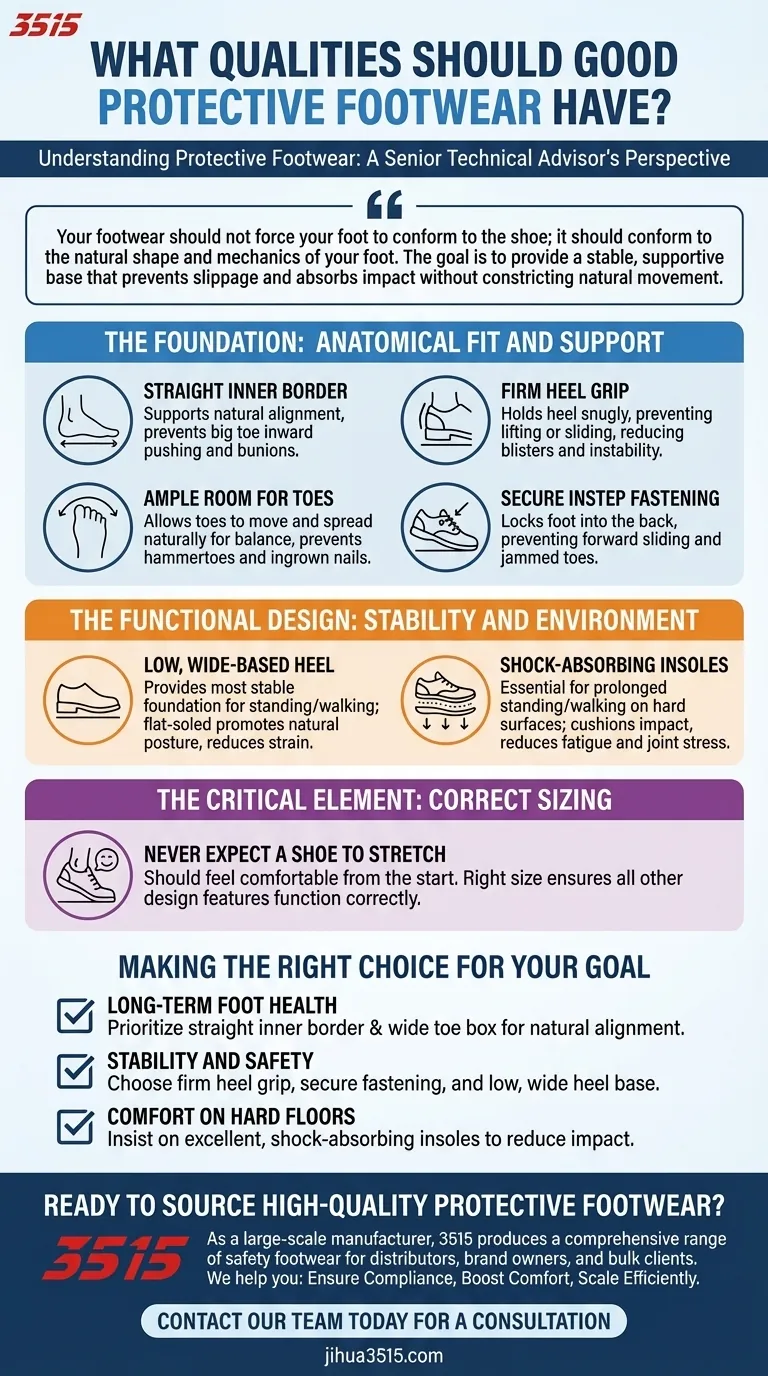
Your footwear should not force your foot to conform to the shoe; it should conform to the natural shape and mechanics of your foot. The goal is to provide a stable, supportive base that prevents slippage and absorbs impact without constricting natural movement.
The Foundation: Anatomical Fit and Support
The most critical aspect of any footwear is how it interacts with the structure of your foot. A poor fit is the primary source of discomfort and long-term health issues.
Straight Inner Border
A straight line from your heel to the tip of your big toe supports the natural alignment of your foot. This design prevents your big toe from being pushed inward, which can lead to bunions and other deformities.
Firm Heel Grip
Your heel should be held snugly and firmly in place. This prevents your foot from lifting or sliding within the shoe, which is a major cause of blisters, instability, and inefficient walking.
Ample Room for Toes
Your toes need space to move and spread out naturally, especially when bearing weight. A sufficiently wide and deep toe box allows for proper balance and prevents conditions like hammertoes or ingrown nails.
Secure Instep Fastening
Laces, straps, or other fastening systems over the instep are crucial. They lock your foot into the back of the shoe, preventing it from sliding forward and jamming your toes into the front with every step.
The Functional Design: Stability and Environment
Beyond fit, protective footwear must be designed to handle the specific demands of your tasks and workplace.
Low, Wide-Based Heel
A low heel with a wide base provides the most stable foundation for standing and walking. Flat-soled footwear is often recommended to promote natural posture and reduce strain on your lower back and legs.
Shock-Absorbing Insoles
If your job requires prolonged standing or walking, particularly on hard surfaces like concrete, shock absorption is non-negotiable. Quality insoles cushion the impact of each step, reducing fatigue and stress on your joints.
The Critical Element: Correct Sizing
Even a perfectly designed shoe will fail if it is not the right size. This factor is often overlooked but is fundamental to both comfort and safety.
Never Expect a Shoe to Stretch
You should not purchase tight footwear with the expectation that it will stretch to fit over time. A proper shoe should feel comfortable from the moment you put it on. The right size ensures all the other design features can function as intended.
Making the Right Choice for Your Goal
Select your footwear based on the most pressing needs of your daily work.
- If your primary focus is long-term foot health: Prioritize a shoe with a straight inner border and a wide toe box to maintain the natural alignment of your foot.
- If your primary focus is stability and safety: Choose footwear with a firm heel grip, secure instep fastening, and a low, wide heel base.
- If your primary focus is comfort on hard floors: Insist on footwear with excellent, shock-absorbing insoles to reduce joint impact and fatigue.
Ultimately, the right protective footwear serves as a seamless extension of your body, providing support and safety without causing pain.
Summary Table:
| Key Quality | Why It Matters | What to Look For |
|---|---|---|
| Anatomical Fit | Supports natural foot alignment, prevents deformities | Straight inner border, wide toe box, firm heel grip |
| Stable Design | Reduces risk of slips, trips, and falls | Low, wide-based heel, secure instep fastening (laces/straps) |
| Shock Absorption | Minimizes joint impact and fatigue on hard surfaces | Quality, cushioned insoles designed for prolonged standing |
| Correct Sizing | Ensures all protective features function correctly | Comfortable fit from the start; never buy tight expecting a stretch |
Ready to source high-quality protective footwear that meets all these standards?
As a large-scale manufacturer, 3515 produces a comprehensive range of safety footwear for distributors, brand owners, and bulk clients. Our production capabilities encompass all types of industrial shoes and boots, engineered with the precise anatomical fit, durable construction, and protective features your customers need.
We help you:
- Ensure Compliance: Meet and exceed industry safety standards.
- Boost Comfort: Enhance worker productivity with ergonomically designed footwear.
- Scale Efficiently: Rely on our high-volume manufacturing to meet your demand.
Let's discuss your specific requirements. Contact our team today for a consultation and see how we can support your business with reliable, high-performance protective footwear.
Visual Guide
Related Products
- Wholesale Customizable Safety Boots Durable & Protective Footwear Manufacturing
- Premium Suede Sport Safety Shoes for Wholesale & Bulk Orders
- Wholesale Anti-Smash & Puncture-Proof Safety Shoes Custom Manufacturing for Brands
- Premium Safety Shoes with Rotating Buckle Safety Sneakers
- Premium Lightweight Safety Shoes for Wholesale & Bulk Orders
People Also Ask
- Why are industrial safety boots with steel toes necessary for machine operators? Essential Foot Protection for Safety
- What is the history of steel toe work boots? From German Invention to Modern Safety Standard
- What are the different types of steel toe work boots? Choose the Right Boot for Your Job
- What are the pros and cons of steel toe work boots? A Guide to Maximum Protection vs. Comfort
- What styles can safety toe work boots come in? From Classic to Casual, Find Your Perfect Fit



















