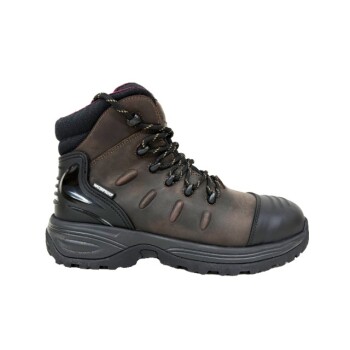
High-performance protective footwear prevents stress fractures by acting as a sophisticated interface between the ground and your skeletal system. Specifically, these materials function through energy dissipation and load distribution, reducing the concentrated mechanical stress that typically overwhelms bone tissue.
Stress fractures are the result of cumulative micro-trauma and muscle fatigue that eventually exceed a bone's structural integrity. Protective footwear mitigates this by absorbing impact energy and spreading forces, thereby delaying the point at which bone tissue reaches fatigue failure.
The Mechanics of Force Management
Energy Dissipation
The primary function of specialized shock-absorbing components, such as impact-absorbing insoles, is to manage kinetic energy.
Rather than allowing the full force of a heel strike or landing to transmit directly up the leg, the material compresses or deforms. This process consumes energy, significantly reducing the magnitude of the shock wave that reaches the skeletal structure.
Stress Redistribution
Standard footwear often allows force to concentrate in specific areas, creating "hot spots" of stress.
High-performance protective footwear creates a physical barrier that distributes these direct impact forces over a wider surface area. By spreading the load, the peak pressure on any single point of the tibia, fibula, or metatarsals is drastically lowered.
The Biological Connection: Muscle and Bone
Counteracting Muscle Fatigue
Bones rely on surrounding muscles to absorb shock; however, when muscles fatigue, they lose this protective ability.
Stress fractures often occur when tired muscles transfer the burden of impact management directly to the bone. By reducing the initial work required of the muscles to stabilize and cushion the foot, protective footwear helps maintain muscular efficiency for longer periods.
Delaying Fatigue Failure
Bones act like any other structural material; they have a limit to how many cycles of stress they can endure before cracking.
This is known as fatigue failure, which manifests biologically as localized micro-cracks. The technical goal of shock-absorbing materials is to extend the timeline of performance, delaying the onset of these micro-cracks long enough to prevent injury during high-activity intervals.
Understanding the Trade-offs
Material Lifespan
Shock-absorbing materials are sacrificial; they degrade structurally with every impact to save your bones.
Over time, these materials lose their ability to dissipate energy effectively. Using footwear past its "technical life" removes the protective barrier, leaving the user vulnerable to stress fractures despite wearing "protective" gear.
The Limits of Technology
While these mechanisms reduce impact, they cannot eliminate it entirely.
Reliance solely on footwear without addressing biomechanics or allowing for physiological recovery can lead to a false sense of security. Technology extends the time to fatigue, but it does not make the skeletal system invincible.
Making the Right Choice for Your Goal
To select the right protective gear, you must align the technical mechanism with your specific activity profile.
- If your primary focus is high-impact activity (running/jumping): Prioritize footwear with superior energy dissipation capabilities to handle the high-velocity forces acting on the tibia and fibula.
- If your primary focus is endurance (long-distance walking): Look for components that emphasize stress distribution to delay muscle fatigue and protect the metatarsals from repetitive loading.
The most effective protective footwear is one that balances shock absorption with structural support to keep your bones below their fatigue threshold.
Summary Table:
| Mechanism | Primary Function | Biological Impact |
|---|---|---|
| Energy Dissipation | Absorbs kinetic energy via material deformation | Reduces magnitude of shock waves reaching bones |
| Stress Redistribution | Spreads forces over a larger surface area | Lowers peak pressure on tibia, fibula, and metatarsals |
| Fatigue Mitigation | Supports tired muscles in shock absorption | Delays bone fatigue failure and micro-crack onset |
| Structural Interface | Acts as a barrier between ground and skeleton | Extends the structural lifespan of skeletal tissue |
Partner with 3515 for High-Performance Protective Footwear
As a large-scale manufacturer serving distributors and brand owners, 3515 offers comprehensive production capabilities for all footwear types, anchored by our flagship Safety Shoes series. Our advanced shock-absorption technology and energy dissipation materials are designed to meet the rigorous demands of professional work environments, protecting users from fatigue and stress-related injuries.
Our extensive portfolio covers work and tactical boots, outdoor shoes, training shoes, and sneakers, as well as Dress & Formal shoes to meet your diverse bulk requirements. By partnering with us, you gain access to decades of manufacturing expertise and innovative protective solutions tailored to your brand's standards.
Ready to elevate your product line with industry-leading protective technology?
Contact us today to discuss your bulk production needs
References
- Vanessa E. Ortiz-Padilla, Jorge de J. Lozoya-Santos. Survey on Video-Based Biomechanics and Biometry Tools for Fracture and Injury Assessment in Sports. DOI: 10.3390/app12083981
This article is also based on technical information from 3515 Knowledge Base .
Related Products
- Premium Suede Sport Safety Shoes for Wholesale & Bulk Orders
- Wholesale Customizable Safety Boots Durable & Protective Footwear Manufacturing
- Premium Safety Shoes with Rotating Buckle Safety Sneakers
- Wholesale Anti-Smash & Puncture-Proof Safety Shoes Custom Manufacturing for Brands
- Premium Grain Leather Safety Boots for Bulk Supply
People Also Ask
- What are the primary functions of professional safety shoes? Maximize Safety in Water Supply Confined Spaces
- What industries have specific OSHA footwear requirements? Ensure Compliance & Protect Your Workforce
- What role do specialized safety shoes play in preventing falls? Engineering Stability in Industrial Environments
- What core functions do professional safety shoes serve? Enhance Construction & Industrial Safety Standards
- What are the technical advantages of integrating sensors into safety shoes? Achieve Superior Motion Capture Precision