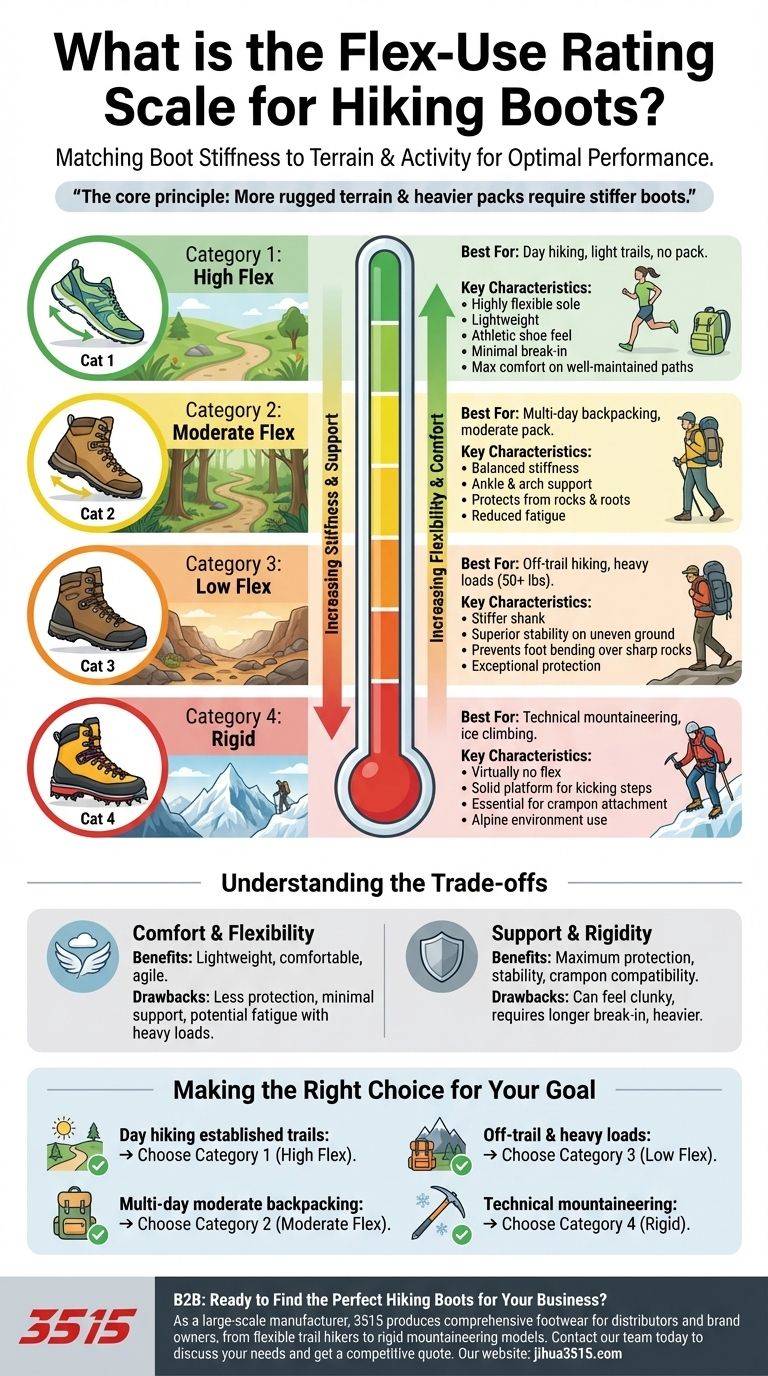
The Flex-Use Rating Scale is a system used to classify hiking boots based on their stiffness and intended purpose. It directly correlates a boot's flexibility with the type of terrain and activity for which it is best suited, ranging from highly flexible for light trails to completely rigid for technical mountaineering.
The core principle is simple: the more rugged the terrain and the heavier your pack, the stiffer and more supportive your boot needs to be. This scale provides a clear framework for matching the right level of boot rigidity to your specific hiking goals.

How the Flex-Use Rating Works
The scale helps you move beyond brand names and marketing to focus on the structural mechanics of the boot. It primarily measures longitudinal and torsional stiffness—how much the boot bends from heel to toe and how much it resists twisting.
Category 1: High Flex (Trail & Light Hiking)
Boots in this category feel more like athletic shoes. They are designed for maximum comfort and agility on well-maintained trails with a light pack or no pack at all.
This category includes trail running shoes and low-cut hiking shoes. They require almost no break-in period and are extremely comfortable for fast-paced movement and casual day hikes.
Their primary characteristic is a highly flexible sole that allows your foot to move naturally.
Category 2: Moderate Flex (General Hiking & Backpacking)
This is the most common and versatile category, covering the needs of most hikers and backpackers. These boots offer a balance of comfort and support.
They are stiff enough to protect your feet from rocks and roots underfoot but still have enough flex for a comfortable walking motion over long distances. These are the classic over-the-ankle hiking boots suitable for multi-day trips with a moderately heavy pack.
The added stiffness provides crucial arch and ankle support, reducing fatigue on varied terrain.
Category 3: Low Flex (Off-Trail & Heavy Loads)
When you move into more rugged, off-trail terrain or carry a very heavy pack (50+ lbs), you need a boot with minimal flex.
These boots have a much stiffer shank (the supportive structure between the insole and outsole), which acts as a stable platform on uneven ground. This rigidity prevents your foot from bending over sharp rocks and provides exceptional stability.
They are essential for serious backpacking and light mountaineering, offering superior protection and support.
Category 4: Rigid (Technical Mountaineering)
At the extreme end of the scale are rigid mountaineering boots. These boots have virtually no flex at all.
Their completely stiff sole is a critical feature, designed to provide a solid platform for kicking steps into snow and ice. More importantly, this rigidity is necessary for attaching crampons securely for ice climbing and glacier travel.
These are highly specialized tools for alpine environments and are unsuitable for general trail hiking due to their weight and lack of walking comfort.
Understanding the Trade-offs
Choosing a boot is always a balance between two competing needs: flexibility for comfort and rigidity for support. Understanding this trade-off is the key to making an informed decision.
The Cost of Flexibility
A highly flexible boot is comfortable and lightweight, but it offers less protection from sharp objects underfoot and provides minimal ankle support. Using a flexible shoe with a heavy pack can lead to foot fatigue and potential injury.
The Downside of Rigidity
A stiffer boot provides maximum support and protection, but it can feel clunky and restrictive on simple trails. It also requires a longer break-in period and is generally heavier, which can increase fatigue over a long day.
Making the Right Choice for Your Goal
Use the Flex-Use scale to align the boot's characteristics directly with your intended activity.
- If your primary focus is day hiking on established trails: Choose a High Flex boot (Category 1) for maximum comfort and low weight.
- If your primary focus is multi-day backpacking with a moderate pack: A Moderate Flex boot (Category 2) offers the ideal balance of support and comfort.
- If your primary focus is off-trail navigation or carrying heavy loads: You need the superior stability of a Low Flex boot (Category 3).
- If your primary focus is technical mountaineering or ice climbing: A Rigid boot (Category 4) is the only safe and effective option.
Matching your boot's stiffness to your activity is the single most important factor in ensuring comfort, safety, and performance on the trail.
Summary Table:
| Flex-Use Category | Stiffness Level | Best For | Key Characteristics |
|---|---|---|---|
| Category 1: High Flex | Highly Flexible | Day hiking, light trails, no pack | Lightweight, like athletic shoes, minimal break-in |
| Category 2: Moderate Flex | Balanced | Multi-day backpacking, moderate pack | Ankle support, protects from rocks and roots |
| Category 3: Low Flex | Stiff | Off-trail hiking, heavy loads (50+ lbs) | Rigid shank, superior stability on uneven ground |
| Category 4: Rigid | No Flex | Technical mountaineering, ice climbing | Platform for crampons, essential for alpine environments |
Ready to Find the Perfect Hiking Boots for Your Business?
As a large-scale manufacturer, 3515 produces a comprehensive range of footwear for distributors, brand owners, and bulk clients. Our production capabilities encompass all types of shoes and boots, from flexible trail hikers to rigid mountaineering models, ensuring you get the right product for your target market.
Let us help you source or manufacture the ideal hiking boots for your customers.
Contact our team today to discuss your specific needs and get a competitive quote.
Visual Guide
Related Products
- Wholesale High-Traction Camo Boots - Custom Manufacturer for Brands
- Durable Rubber Sole Outdoor Shoes Wholesale & Custom Manufacturing
- Durable Spiked Camouflage Boots Wholesale & Factory Production
- Wholesale Lightweight Tactical Boots Custom Manufacturer for Desert & Combat Use
- Wholesale Waterproof Tactical Boots Custom Suede & High-Traction Soles
People Also Ask
- What are the key features of the new line of camo boots? Built for Extreme Cold & Rugged Terrain
- Are camo boots necessary for hunting success? Prioritize Performance Over Pattern
- What is the technical logic behind using closed-eye testing for tactical boots? Unlocking Peak Footwear Stability
- How does the Rank Score Test identify the primary causes of premature failure in tactical and work boots? Key Insights
- What shoes to wear for a security job? Durable, Protective Footwear for Long Shifts