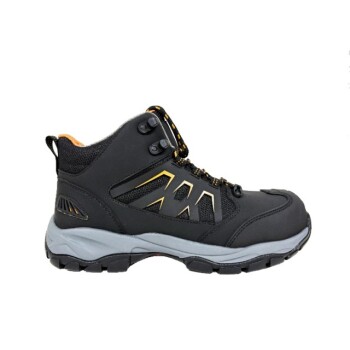
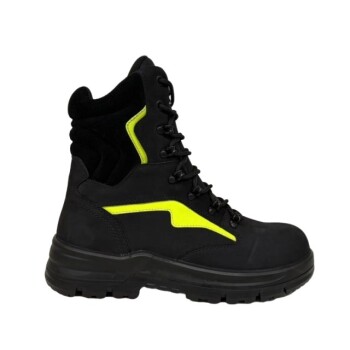
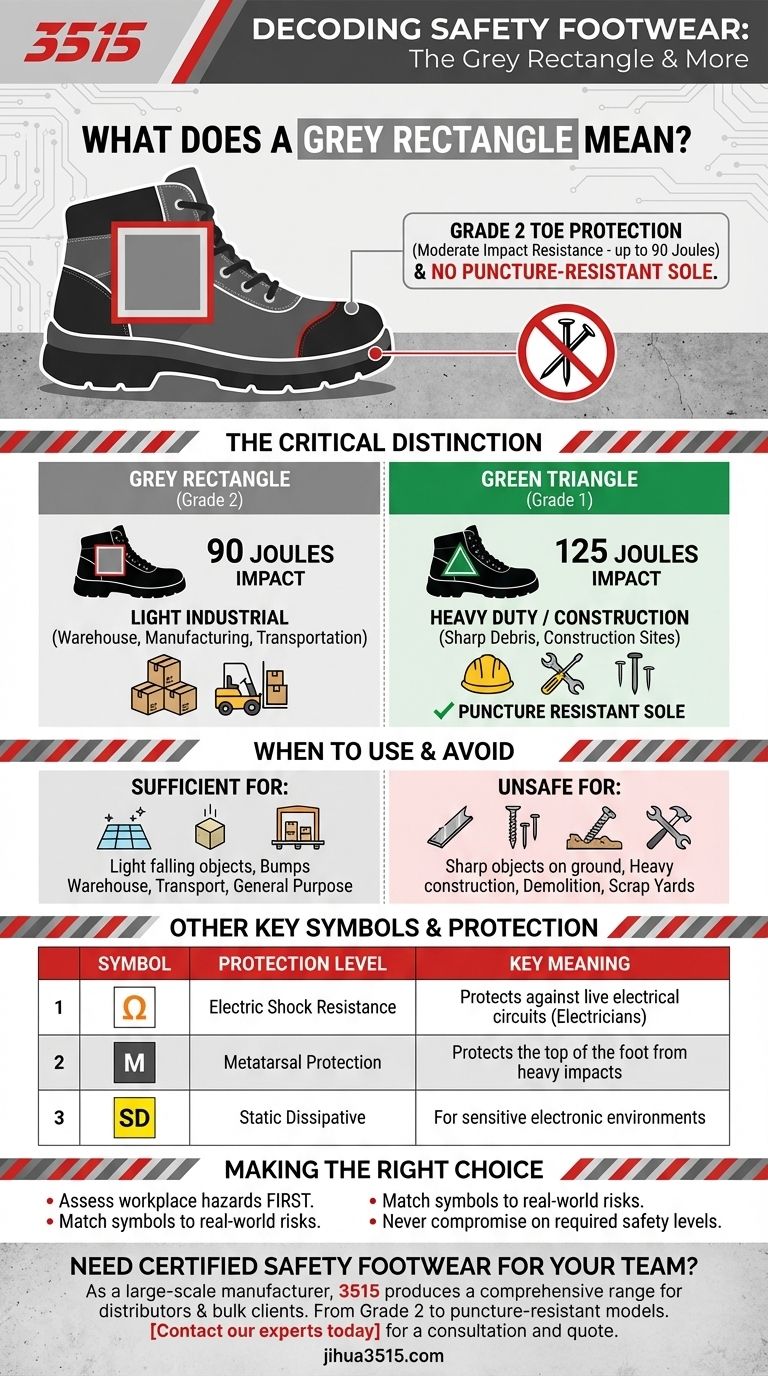
That grey rectangle on your safety footwear has a very specific meaning. It certifies that the boot or shoe is equipped with a Grade 2 protective toecap for moderate impact resistance. Critically, this symbol also signifies that the footwear has no puncture-resistant sole, making it unsuitable for environments where sharp objects on the ground are a risk.
The grey rectangle symbol means your footwear offers moderate toe protection against impacts but provides no defense against sharp objects piercing the sole. Understanding this distinction is critical for matching your gear to your specific workplace hazards.
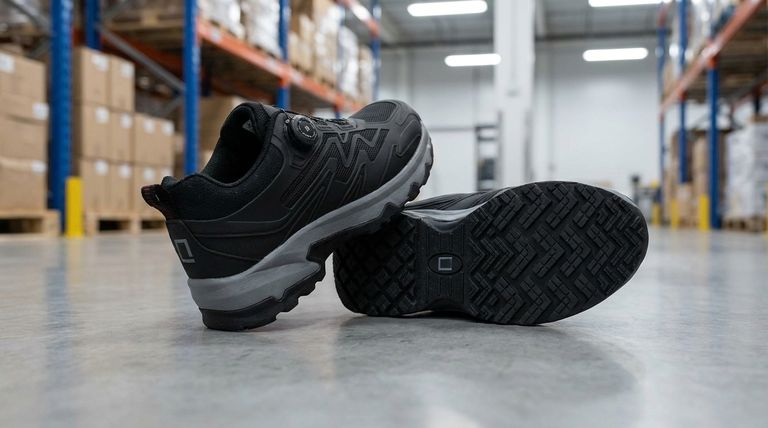
Decoding the Safety Standard
The symbols on your footwear are part of a standardized system, most notably the CSA Group standards in Canada, which are widely recognized. Each color and shape is a clear code communicating the specific protections built into the product.
What "Grade 2" Protection Means
A Grade 2 toecap, indicated by the grey rectangle, is tested to withstand impacts of up to 90 joules. This level of protection is designed for industrial and non-industrial environments where the risk comes from lighter falling objects.
It offers a moderate degree of safety, but it is a step down from Grade 1 protection (indicated by a green triangle or blue rectangle), which is rated for higher impacts of 125 joules and is required for more hazardous environments like construction sites.
The Critical Omission: No Puncture Resistance
The most important detail of the grey rectangle is what it lacks. Footwear with this symbol does not have a protective plate in the sole to stop nails, screws, sharp metal, or other debris from piercing through to your foot.
This makes it an unsafe choice for any environment where these types of ground-level hazards are present, such as active construction, demolition, or scrap yards.
Understanding the Trade-offs
Choosing safety footwear is not about finding the "best" boot, but the "right" boot for the job. A symbol that is perfectly acceptable in one context can be dangerously inadequate in another.
When a Grey Rectangle is Sufficient
Footwear with a grey rectangle is often lighter and more flexible than boots with puncture-resistant plates. It is suitable for work environments where the primary risks are bumps or light falling objects.
This includes roles in some warehouses, light manufacturing, transportation, and general-purpose work where the floors are kept clear of sharp debris.
When a Grey Rectangle is Unsafe
You must avoid footwear marked only with a grey rectangle if your work environment contains any risk of stepping on sharp objects. This is non-negotiable for safety.
Jobs in construction, renovation, emergency services, or waste management almost always require a boot with a green or yellow triangle, which indicates both toe protection and a puncture-resistant sole.
Other Critical Protections
The safety system extends beyond impacts and punctures. Symbols also indicate protection from less visible but equally dangerous hazards.
A white rectangle with an orange omega symbol indicates resistance to electric shock, essential for electricians. A yellow rectangle with "SD" indicates static dissipative properties, crucial for work in sensitive electronic environments. A dark grey rectangle with an "M" denotes metatarsal protection for the top of the foot.
Making the Right Choice for Your Work Environment
Always assess the specific hazards of your workplace before selecting footwear. The symbols are your guide to making an informed and safe decision.
- If your primary focus is light industrial work without ground hazards: A grey rectangle boot may be sufficient, offering the necessary moderate impact protection.
- If your primary focus is construction or work with sharp debris: You must have a boot with a green or yellow triangle, indicating essential puncture resistance.
- If your primary focus is working near live electrical conductors: Look for the white rectangle with the omega symbol, which is non-negotiable for that task.
- If your primary focus is protecting the top of your foot from heavy objects: A dark grey rectangle with an "M" for metatarsal protection is required.
Your safety depends on correctly matching the symbols on your footwear to the real-world hazards you face every day.
Summary Table:
| Symbol | Color/Shape | Protection Level | Key Meaning |
|---|---|---|---|
| Grey Rectangle | Grey Square | Moderate Impact (Grade 2) | Toe protection only; NO puncture-resistant sole. |
| Green Triangle | Green Triangle | High Impact (Grade 1) | High-impact toe protection AND a puncture-resistant sole. |
| White Rectangle (Ω) | White Square | Electric Shock Resistance | Protects against live electrical circuits. |
| Dark Grey Rectangle (M) | Dark Grey Square | Metatarsal Protection | Protects the top of the foot from heavy impacts. |
Need the Right Safety Footwear for Your Team?
As a large-scale manufacturer, 3515 produces a comprehensive range of certified safety footwear for distributors, brand owners, and bulk clients. We ensure your workers have the correct protection—from Grade 2 boots for light industry to puncture-resistant models for construction.
Let us help you match the right safety symbols to your workplace hazards. Contact our experts today for a consultation and quote.
Visual Guide
Related Products
- Wholesale Leather Safety Boots with Customizable Protective Toe
- Customizable Anti-Smash Safety Boots for Wholesale & Private Label Manufacturing
- Premium Sport Style Safety Boots for Bulk Orders
- Premium Wholesale Waterproof Safety Boots High Performance Protection for Industrial Markets
- Premium Wheat Nubuck Safety Shoes for Bulk Distribution
People Also Ask
- How do safety boots provide toe protection? A Guide to Steel vs. Composite Caps
- What workplace hazards do safety toe boots protect against? Comprehensive Protection Guide
- What are the OSHA and ASTM standards for safety toe boots? Ensure Your Footwear is Fully Compliant
- What do the symbols M, F, I, and C represent on safety toe boots? Decode ASTM F2413 for Maximum Protection
- What are the different types of safety toe boots available? Choose the Right Protection for Your Job