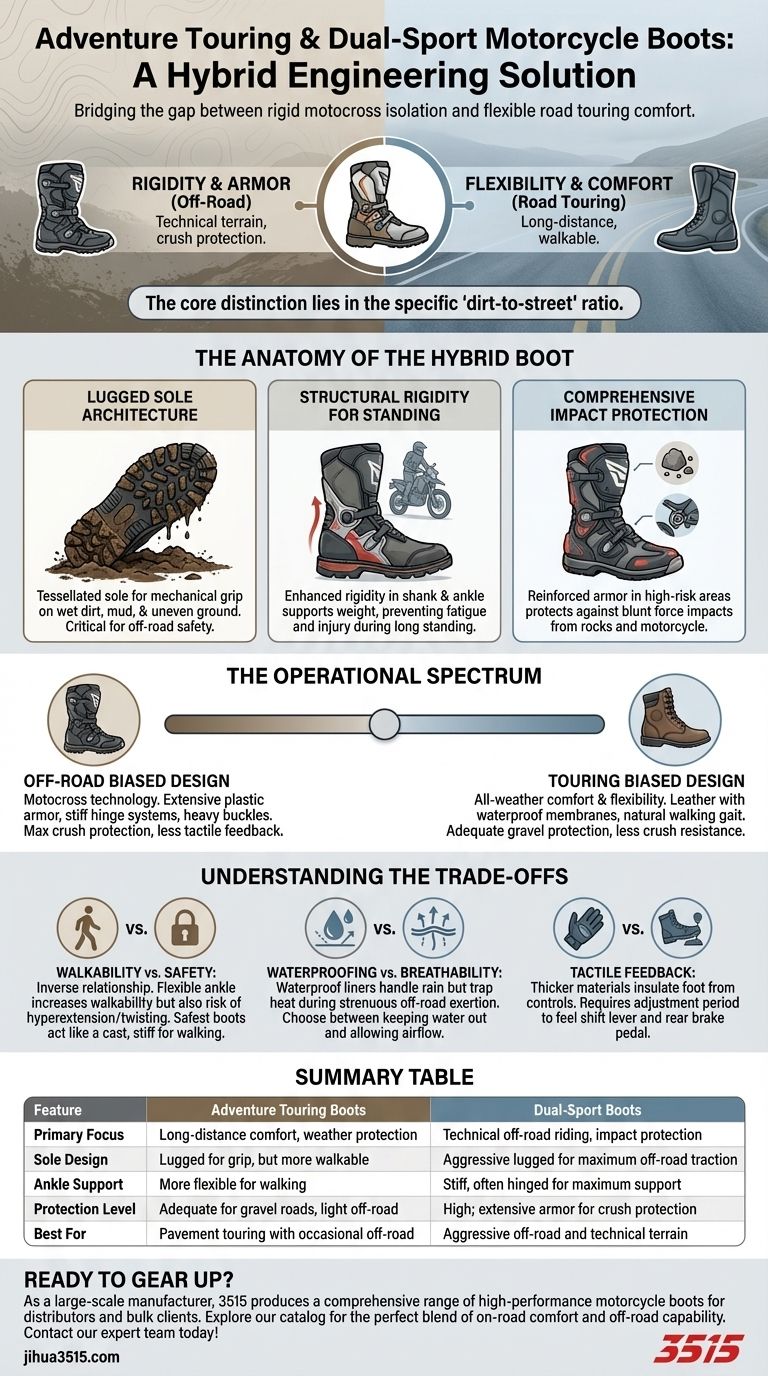
Adventure touring and dual-sport boots are a hybrid engineering solution designed to bridge the gap between the rigid isolation of a motocross boot and the flexible comfort of a road touring boot. They distinguish themselves by offering the structural stiffness and impact armor required for off-road technical riding while retaining the waterproofing, insulation, and walkable soles necessary for long-distance travel on pavement.
The core distinction lies in the specific "dirt-to-street" ratio of the boot's architecture. While all boots in this category offer enhanced protection over standard road gear, the design will lean either toward the rigidity of a dirt boot for stability on technical terrain or the flexibility of a hiking boot for all-day pavement comfort.
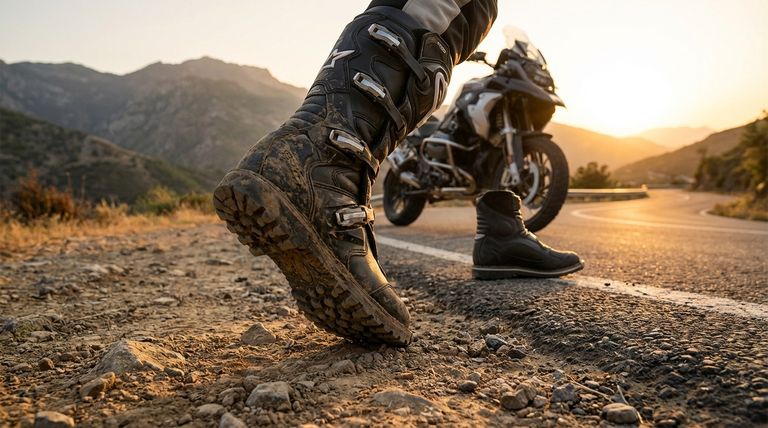
The Anatomy of the Hybrid Boot
The Lugged Sole Architecture
Unlike road touring boots, which feature smooth soles for sliding on asphalt, adventure boots utilize a tessellated or lugged sole.
This design provides mechanical grip on wet dirt, mud, and uneven terrain.
It allows the rider to push the bike out of a rut or maintain footing at a muddy stop, a critical feature for off-road safety.
Structural Rigidity for Standing
A defining feature of this category is enhanced rigidity in the shank and ankle chassis.
When riding off-road, you often stand on the footpegs, placing immense stress on your arches and ankles.
These boots are stiff enough to support your weight without collapsing, preventing fatigue and injury during long periods of standing.
Comprehensive Impact Protection
Adventure boots integrate reinforced armor in high-risk areas such as the shin, ankle, toe, and heel.
While road boots primarily protect against abrasion (sliding), dual-sport boots must also protect against blunt force impacts from rocks, stumps, and the motorcycle itself.
This often includes external plastic plating or internal heavy-duty cups that standard work boots or road boots simply do not possess.
The Operational Spectrum
The Off-Road Biased Design
Boots on this end of the spectrum borrow heavily from motocross technology.
They feature extensive plastic exterior armor, stiff hinge systems for ankle support, and heavy buckle closures.
They maximize protection against crushing injuries but offer less tactile feedback on the shifter and brake pedal.
The Touring Biased Design
Boots on this end prioritize all-weather comfort and flexibility.
They often utilize leather construction with waterproof membranes (like Gore-Tex) and allow for a natural walking gait.
These provide adequate protection for gravel roads but may lack the crush resistance required for aggressive single-track riding.
Understanding the Trade-offs
Walkability vs. Safety
There is an inverse relationship between walkability and ankle protection.
A boot that is comfortable to hike in will generally have a flexible ankle, which increases the risk of hyperextension or twisting during a crash.
Conversely, the safest boots act like a cast, offering maximum support but making walking stiff and unnatural.
Waterproofing vs. Breathability
Many adventure boots include waterproof liners to handle stream crossings and rain.
However, these membranes can trap heat and sweat during strenuous off-road exertion.
Riders must decide if keeping water out is more valuable than allowing high-volume airflow to cool the foot.
Tactile Feedback
The thicker, stiffer materials used in dual-sport boots insulate your foot from the controls.
Riders transitioning from street boots may initially struggle to feel the shift lever or the rear brake pedal.
This requires a period of adjustment to learn the muscle memory required to operate the bike with heavier footwear.
Making the Right Choice for Your Goal
The "best" boot is not the most expensive one, but the one that aligns with your specific riding reality.
- If your primary focus is technical off-road riding: Prioritize boots with a hinged ankle system and extensive plastic armor to prevent crush injuries, accepting that walking will be difficult.
- If your primary focus is long-distance travel with occasional gravel: Choose a leather-based boot with a waterproof membrane and a flexible ankle chassis to maximize comfort and walkability.
Select the boot that protects you for the most dangerous 10% of your ride, not just the most comfortable 90%.
Summary Table:
| Feature | Adventure Touring Boots | Dual-Sport Boots |
|---|---|---|
| Primary Focus | Long-distance comfort, weather protection | Technical off-road riding, impact protection |
| Sole Design | Lugged for grip, but more walkable | Aggressive lugged for maximum off-road traction |
| Ankle Support | More flexible for walking | Stiff, often hinged for maximum support |
| Protection Level | Adequate for gravel roads, light off-road | High; extensive armor for crush protection |
| Best For | Pavement touring with occasional off-road | Aggressive off-road and technical terrain |
Ready to gear up with the right boots for your adventure?
As a large-scale manufacturer, 3515 produces a comprehensive range of high-performance motorcycle boots for distributors, brand owners, and bulk clients. Our production capabilities encompass all types of adventure and dual-sport footwear, engineered for durability, protection, and comfort.
Let us help you equip your customers with the perfect blend of on-road comfort and off-road capability. Contact our expert team today to discuss your specific needs and explore our catalog.
Visual Guide
Related Products
- Durable Spiked Camouflage Boots Wholesale & Factory Production
- Durable Mid-Cut Tactical Boots for Wholesale & Private Label
- Wholesale Tactical Boots High-Traction & Reflective for Bulk & Brand Orders
- Wholesale High-Traction Camo Boots - Custom Manufacturer for Brands
- Wholesale Lightweight Tactical Boots Custom Manufacturer for Desert & Combat Use
People Also Ask
- How does boot height affect waterproofing? Choose the Right Height for Ultimate Protection
- What are the best types of shoes for different gardening conditions? Find Your Perfect Match.
- What role does camouflage play in hunting boots? It's More Than Just a Pattern
- What should you look for to ensure boots are fully waterproof? The Essential 2-Part System
- How does boot construction affect waterproofing? The Science Behind Truly Dry Feet