The Desert Boot is far more than a simple footwear trend; it is a design icon that permanently altered the landscape of men's fashion. Historically, it acted as a pioneering bridge between rigid formal wear and utilitarian workwear, creating a new category of "smart casual." Its impact is quantified by over ten million pairs sold globally and its prestigious induction into the British Design Museum as one of the 50 shoe designs that changed the world.
The Desert Boot’s cultural longevity stems from its role as a "blank canvas" for rebellion and artistic expression. By offering a versatile middle ground between dress shoes and sneakers, it allowed subcultures—from British Mods to Hollywood elites—to define the shoe's identity, rather than the shoe defining them.

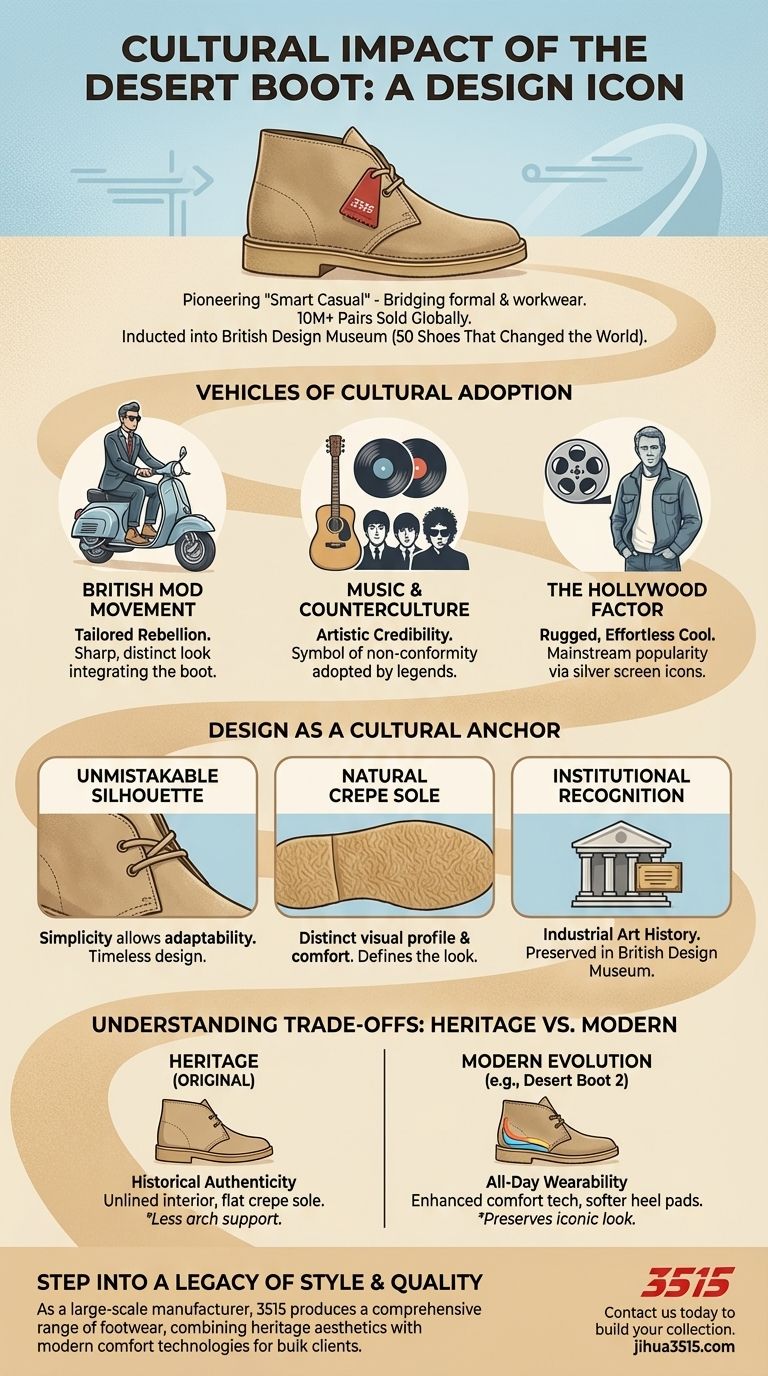
The Vehicles of Cultural Adoption
To understand the Desert Boot's impact, one must look at who wore it. The boot did not become famous through advertising alone, but through organic adoption by influential cultural movements.
The British Mod Movement
The Desert Boot was integral to the aesthetic of the British Mods. This subculture sought a look that was sharp yet distinct from the traditional establishment, integrating the boot into a uniform of tailored rebellion.
Music and Counterculture
The shoe’s reach extended deeply into the music scene. Legends like The Beatles and Bob Dylan adopted the footwear, effectively cementing it as a symbol of artistic credibility and non-conformity.
The Hollywood Factor
On the silver screen, figures like Steve McQueen popularized the boot. By pairing it with casual attire, McQueen helped transition the Desert Boot from a niche style choice to a mainstream symbol of rugged, effortless cool.
Design as a Cultural Anchor
The cultural impact of the Desert Boot is rooted in its specific design elements. It achieved "timelessness" by stripping away unnecessary ornamentation.
The Unmistakable Silhouette
The traditional design relies on a two-eyelet lacing system and a stitch-down construction. This simplicity allows the shoe to adapt to various settings without looking out of place.
The Natural Crepe Sole
A defining feature is the natural crepe sole. This component provided a distinct visual profile and a level of comfort that distinguished it from the hard-soled dress shoes of the era.
Institutional Recognition
The design is so significant that it has been preserved in the British Design Museum. This elevates the boot from a commercial product to a recognized piece of industrial art history.
Understanding the Trade-offs
While the Desert Boot is culturally significant, it is important to view its design objectively. The features that make it iconic also introduce specific limitations compared to modern footwear.
Heritage vs. Modern Support
The traditional Desert Boot features an unlined interior and a flat crepe sole. While stylish, this original construction may lack the arch support or cushioning found in contemporary performance footwear.
The Evolution of Comfort
Recognizing these limitations, manufacturers have released iterations like the Desert Boot 2. These versions introduce increased volume and enhanced comfort technologies to address the ergonomic needs of modern users while attempting to preserve the original look.
Making the Right Choice for Your Goal
The Desert Boot remains "the world's most travelled shoe" because it offers versatility. However, your choice between a heritage pair and a modern iteration should depend on your specific needs.
- If your primary focus is Historical Authenticity: Look for the traditional two-eyelet design with stitch-down construction and an unlined interior to capture the original Mod aesthetic.
- If your primary focus is All-Day Wearability: Opt for modern iterations like the Desert Boot 2, which integrate softer heel pads and enhanced comfort technologies while maintaining the iconic silhouette.
The Desert Boot proves that true cultural impact comes not from following trends, but from establishing a design language so clear that it remains relevant for over 70 years.
Summary Table:
| Key Aspect | Cultural Impact |
|---|---|
| Adoption by Subcultures | Integral to British Mods, symbol of rebellion and style. |
| Influence in Music & Film | Worn by icons like The Beatles, Bob Dylan, and Steve McQueen. |
| Design Recognition | Inducted into the British Design Museum as a world-changing design. |
| Legacy & Versatility | Pioneered 'smart casual'; remains a versatile style staple. |
Ready to Step into a Legacy of Style and Quality?
As a large-scale manufacturer, 3515 produces a comprehensive range of footwear for distributors, brand owners, and bulk clients. Our production capabilities encompass all types of shoes and boots, including timeless designs inspired by icons like the Desert Boot. We combine heritage aesthetics with modern comfort technologies to meet the demands of today's market.
Contact us today to discuss how we can help you build a successful footwear collection that resonates with quality and history.
Visual Guide
Related Products
- Wholesale Lightweight Tactical Boots Custom Manufacturer for Desert & Combat Use
- Durable Military Combat Boots with Water Drainage for Wholesale & OEM
- Wholesale High-Traction Camo Boots - Custom Manufacturer for Brands
- Durable Leather Tactical Boots Wholesale & Custom Manufacturing for Brands
- Wholesale Waterproof Tactical Boots Custom Suede & High-Traction Soles
People Also Ask
- What are the common types of combat boots? Find the Right Boot for Your Mission
- What specialized protections do tactical boots offer? Maximize Endurance with High-Performance Footwear
- What are the different types of tactical boots available? Find the Right Boot for Your Mission
- What is the role of high-frequency acquisition hardware in technical skill analysis for outdoor and tactical boots?
- How does additive manufacturing equipment reduce environmental risks? Sustainable Tactics for Modern Footwear Production