
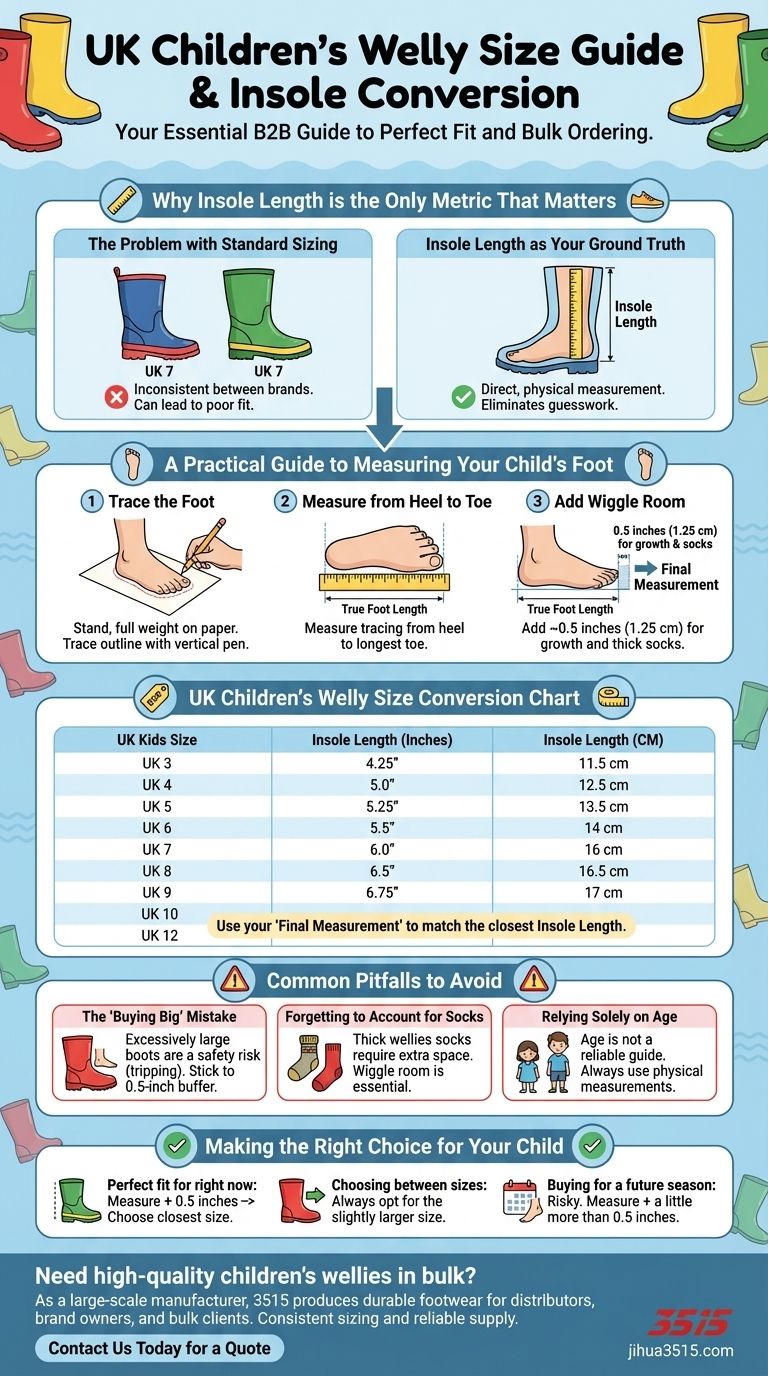
To determine the correct UK welly size, you must compare a direct measurement of your child's foot against the manufacturer's insole length. The standard conversion is as follows: UK 3 (4.25"), UK 4 (5"), UK 5 (5.25"), UK 6 (5.5"), UK 7 (6"), UK 8 (6.5"), UK 9 (6.75"), UK 10 (7"), UK 11 (7.5"), and UK 12 (8").
The key to getting the right fit is to ignore generic size labels and instead measure your child's foot. Add approximately 0.5 inches (1.25 cm) for growth and socks, then match that final number to the insole lengths provided by the brand.
Why Insole Length is the Only Metric That Matters
When buying children's shoes, especially wellies, relying on the UK size number alone can be misleading. The actual physical length of the insole is your most reliable guide to a proper fit.
The Problem with Standard Sizing
A "UK 7" from one brand can have a noticeably different internal length than a "UK 7" from another. This inconsistency is why a child might fit perfectly in one brand but find another too tight or too loose in the same listed size.
Insole Length as Your Ground Truth
The insole length is a direct, physical measurement. It eliminates the guesswork and brand variation, allowing you to compare the actual space inside the boot to the space your child's foot requires.
A Practical Guide to Measuring Your Child's Foot
To use a size chart effectively, you first need an accurate measurement of your child's foot. This simple, three-step process will give you a reliable number.
Step 1: Trace the Foot
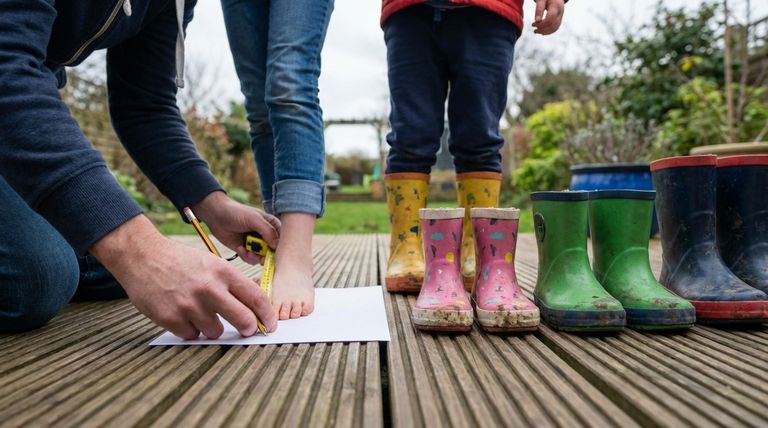
Have your child stand on a piece of paper, placing their full weight on the foot being measured. Carefully trace the outline of their foot with a pen or pencil held vertically.
Step 2: Measure from Heel to Toe
Using a ruler or tape measure, measure the tracing from the very back of the heel to the tip of the longest toe. This gives you the child's true foot length.
Step 3: Add Wiggle Room
Never buy a shoe that matches their foot length exactly. You must add room for growth and thick welly socks. A good rule of thumb is to add 0.5 inches (or about 1.25 cm) to your measurement. This is the final number you will use to find the correct size.
UK Children's Welly Size Conversion Chart
Once you have your final measurement (foot length + wiggle room), use this chart to find the corresponding UK welly size. We've included both inches and centimeters for convenience.
| UK Kids Size | Insole Length (Inches) | Insole Length (CM) |
|---|---|---|
| UK 3 | 4.25" | 11.5 cm |
| UK 4 | 5.0" | 12.5 cm |
| UK 5 | 5.25" | 13.5 cm |
| UK 6 | 5.5" | 14 cm |
| UK 7 | 6.0" | 16 cm |
| UK 8 | 6.5" | 16.5 cm |
| UK 9 | 6.75" | 17 cm |
| UK 10 | 7.0" | 18 cm |
| UK 11 | 7.5" | 20 cm |
| UK 12 | 8.0" | 21 cm |
Common Pitfalls to Avoid
Choosing the right size is straightforward, but a few common mistakes can lead to a poor fit.
The "Buying Big" Mistake
While adding wiggle room is essential, buying a size that is excessively large is a safety risk. Boots that are too big can cause a child to trip and fall, and they don't provide proper foot support. Stick to the recommended 0.5-inch buffer.
Forgetting to Account for Socks
Wellies are almost always worn with socks, which are often thicker than average. The extra half-inch you add to the foot measurement ensures there is enough space for both their foot and a comfortable sock.
Relying Solely on Age
Never use age as a primary guide for shoe size. Children's feet grow at vastly different rates, and a physical measurement is the only way to ensure accuracy.
Making the Right Choice for Your Child
Use your measurement to guide your final decision with these principles.
- If your primary focus is a perfect fit for right now: Measure the foot, add exactly 0.5 inches (1.25 cm), and choose the welly size that is closest to that final number.
- If you are choosing between two sizes: Always opt for the slightly larger size, as a boot that is too tight can be harmful and will be outgrown instantly.
- If you are buying for a future season: This is risky, but measure their current foot size, add a little more than the standard 0.5 inches, and be prepared that the fit may not be perfect.
By focusing on the actual measurement of your child's foot, you can confidently choose the right size every time.
Summary Table:
| UK Kids Size | Insole Length (Inches) | Insole Length (CM) |
|---|---|---|
| UK 3 | 4.25" | 11.5 cm |
| UK 4 | 5.0" | 12.5 cm |
| UK 5 | 5.25" | 13.5 cm |
| UK 6 | 5.5" | 14 cm |
| UK 7 | 6.0" | 16 cm |
| UK 8 | 6.5" | 16.5 cm |
| UK 9 | 6.75" | 17 cm |
| UK 10 | 7.0" | 18 cm |
| UK 11 | 7.5" | 20 cm |
| UK 12 | 8.0" | 21 cm |
Need high-quality children's wellies in bulk? As a large-scale manufacturer, 3515 produces a comprehensive range of durable and comfortable footwear for distributors, brand owners, and bulk clients. Our production capabilities encompass all types of shoes and boots, ensuring consistent sizing and reliable supply. Contact us today to discuss your requirements and get a quote!
Visual Guide
Related Products
People Also Ask
- What are the main materials for waterproof rain boots? Choose the Right Material for Durability & Comfort
- What is the overall recommendation for choosing rain boot materials? A Guide to Rubber vs. PVC
- How does boot height affect waterproofing? Choose the Right Height for Ultimate Protection
- Why are rain boots more flexible and comfortable than snow boots? The Key Differences Explained
- What are the best types of shoes for different gardening conditions? Find Your Perfect Match.
