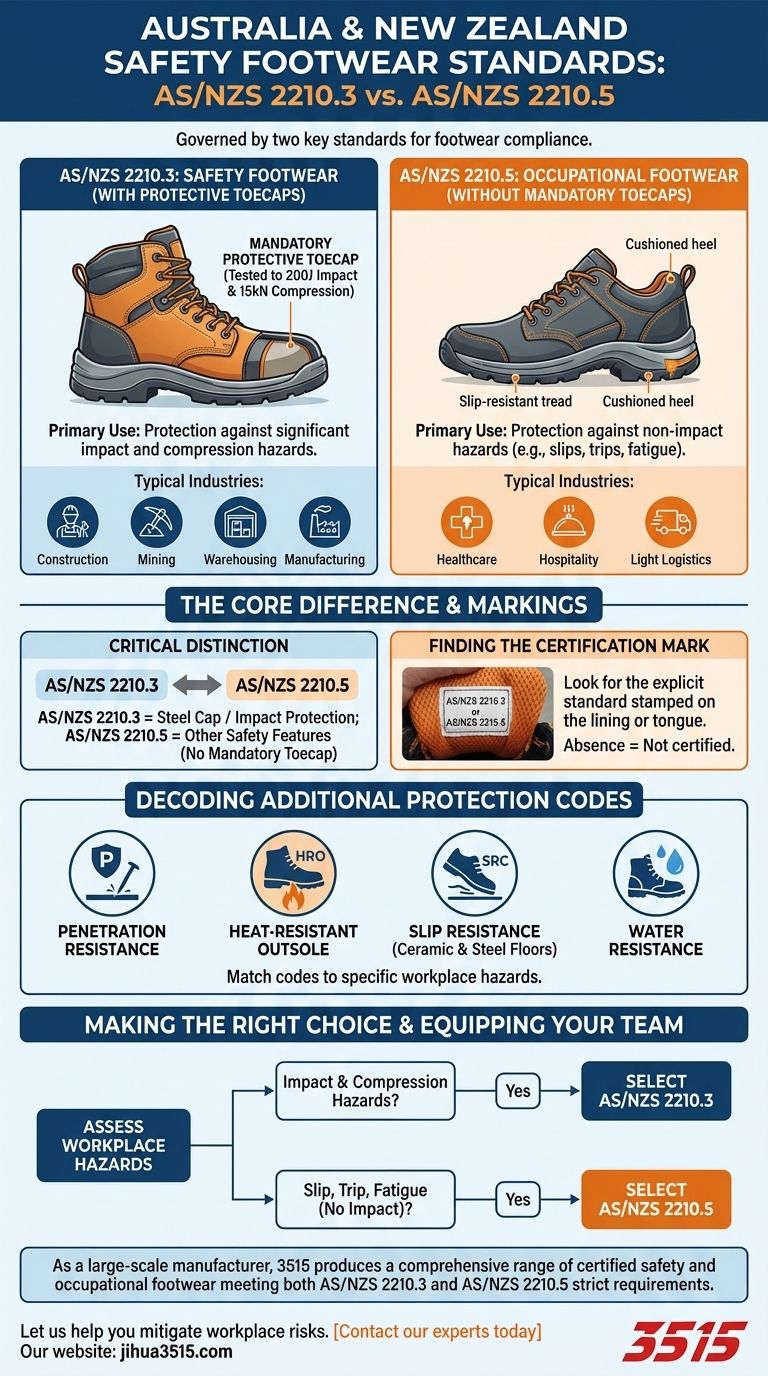
In Australia and New Zealand, safety footwear compliance is governed by two key standards. These are AS/NZS 2210.3, which covers true safety footwear with protective toecaps, and AS/NZS 2210.5, which applies to occupational footwear that may have other safety features but lacks the mandatory protective toecap.
The critical distinction is that AS/NZS 2210.3 is the standard for boots with toecaps designed to protect against impact, like traditional steel caps. AS/NZS 2210.5 is for work boots where the primary hazards are not impact-related, such as slips or static electricity.
The Core Difference: Safety vs. Occupational Footwear
Understanding the purpose behind each standard is crucial for ensuring proper Personal Protective Equipment (PPE) selection. They are not interchangeable and address fundamentally different workplace risks.
AS/NZS 2210.3: The Standard for Safety Footwear
This is the primary standard for any footwear marketed as a "safety boot," including steel, composite, or alloy cap boots.
Its main requirement is the presence of a protective toecap tested to withstand a 200-joule impact and a 15-kilonewton compression force.
This standard is essential for roles in construction, mining, manufacturing, warehousing, and any environment where there is a significant risk of objects falling on or crushing the foot.
AS/NZS 2210.5: The Standard for Occupational Footwear
This standard applies to footwear designed for professional use that may have protective features but does not include the mandatory 200-joule toecap.
Safety features under this standard can include slip resistance, penetration resistance, antistatic properties, or energy absorption around the heel.
It is intended for workplaces like healthcare, hospitality, and light-duty logistics where the primary risks are slips, trips, and long-term fatigue, rather than heavy impacts.
Understanding the Trade-offs and Markings
Simply knowing the standard number is not enough. You must be able to identify compliant footwear and understand its specific protections to avoid making a critical safety error.
Finding the Certification Mark
A compliant boot must have the standard it conforms to stamped or stitched into its lining, typically on the tongue.
Look for the explicit text AS/NZS 2210.3 or AS/NZS 2210.5. The absence of this mark is a clear indicator that the footwear is not certified for workplace use in Australia or New Zealand.
Decoding Additional Protection Codes
Beyond the main standard, boots are often marked with codes that identify their specific protective qualities. This allows you to match the boot to the exact hazards of your job.
Common codes include:
- P: Penetration resistance for the sole
- HRO: Heat-resistant outsole
- SRC: Slip resistance on both ceramic tile and steel floors
- WR: Water resistance
The Pitfall of "Work Boots"
A common mistake is assuming any sturdy-looking "work boot" is a "safety boot."
If a boot is only certified to AS/NZS 2210.5, it offers no certified protection against impact, even if it looks tough. For protection against falling objects, certification to AS/NZS 2210.3 is non-negotiable.
Making the Right Choice for Your Goal
Use this framework to select the correct footwear based on a clear assessment of your workplace hazards.
- If your primary focus is protection from impact and compression hazards (e.g., construction, warehouse): You must select boots explicitly certified to AS/NZS 2210.3.
- If your primary focus is slip resistance and comfort without impact risk (e.g., hospitality, healthcare): Footwear certified to AS/NZS 2210.5 is the appropriate choice.
- If you face multiple hazards like sharp objects, water, or heat: Ensure you check for additional protection codes (like P, WR, or HRO) beyond the basic standard certification.
Properly interpreting these standards transforms footwear selection from a guess into a critical part of your safety strategy.
Summary Table:
| Standard | Primary Use | Key Requirement | Typical Industries |
|---|---|---|---|
| AS/NZS 2210.3 | Safety Footwear | Mandatory protective toecap (200J impact) | Construction, Mining, Warehousing |
| AS/NZS 2210.5 | Occupational Footwear | No mandatory toecap; other safety features | Healthcare, Hospitality, Light Logistics |
Ensure Your Team is Equipped with the Right Safety Footwear
As a large-scale manufacturer, 3515 produces a comprehensive range of certified safety and occupational footwear for distributors, brand owners, and bulk clients. We ensure every pair meets the strict requirements of AS/NZS 2210.3 and AS/NZS 2210.5, providing the precise protection your workforce needs.
Let us help you mitigate workplace risks. Contact our experts today to discuss your requirements and explore our full product catalog.
Visual Guide
Related Products
- Wholesale Safety Footwear Manufacturer for Bulk & Custom OEM Orders
- Wholesale Durable Breathable Safety Boots Custom OEM Manufacturer
- Durable Steel Toe Safety Boots Wholesale & Custom Manufacturing
- Premium Sport Style Safety Boots for Bulk Orders
- Wholesale Customizable Safety Boots Durable & Protective Footwear Manufacturing
People Also Ask
- What type of safety shoe is recommended for workers exposed to heavy machinery? Steel Toe Boots for Ultimate Protection
- Why are industrial safety boots with steel toes necessary for machine operators? Essential Foot Protection for Safety
- Why are steel toes popular in safety footwear? The Ultimate Guide to Heavy-Duty Protection
- What are the recommended uses for steel toe safety shoes? Essential Protection for High-Risk Industries
- Is the myth about steel toe shoes cutting off toes true? Debunking the Safety Footwear Myth