But I won't stop there. I know my audience. They're smart, and they're looking for guidance, not just a surface-level answer. They're really asking, "Should I use waterproof boots?" The references hint at the complexities, so I'll need to explain the technology and its implications.
My approach will be structured and direct: I'll begin with a short hook to grab their attention. Immediately I'll give them the two reasons from the references.
I'll then build a central takeaway in a blockquote: to reinforce that choosing waterproof boots involves trade-offs. The decision is about managing the balance between keeping water out and managing internal moisture.
Now for the core of the article. The "How Waterproof Boots Actually Work" section is crucial. I'll break it down:
- The Membrane: Explain Gore-Tex and similar technology. The references give me a good start. I'll describe the microscopic pores that block water but allow vapor to escape.
- Outer Material: Mention the DWR coating and the first layer of protection, as the references detail.
- Construction: Touch on the importance of details, like the gusseted tongue, which seals out water.
Then, the critical section: Understanding the Trade-offs. This is where I can prove my expertise and build trust with my audience.
- Breathability Compromise: Waterproof boots are always less breathable than non-waterproof ones. I will stress this since it is a crucial point from the references. This is a point that needs to be made, because it is an unavoidable consequence of the technology.
- Drying Time: If these boots get soaked, drying time is horrendously long. This isn't directly mentioned in the references, but it's a logical consequence of how these membranes work. This is a key expert insight I'll need to articulate clearly.
- Weight and Heat: I'll note that the "warmer" benefit can become a detriment in hot weather.
Finally, I'll help the user make the decision with clear, actionable advice. I'll create three clear scenarios for choosing waterproof vs. non-waterproof boots, building from the use cases mentioned in the references.
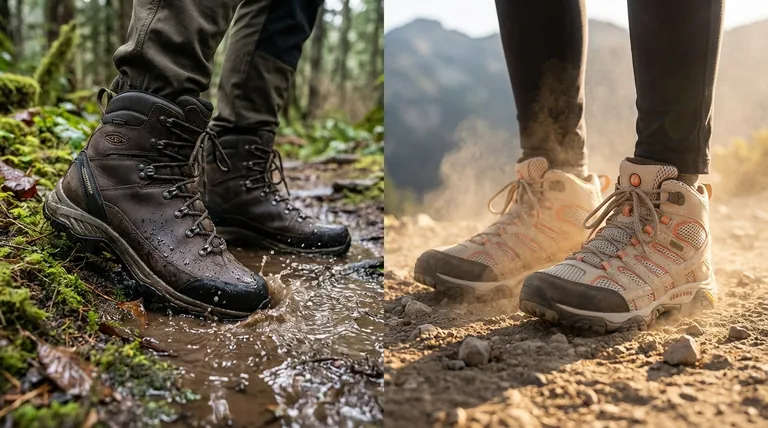
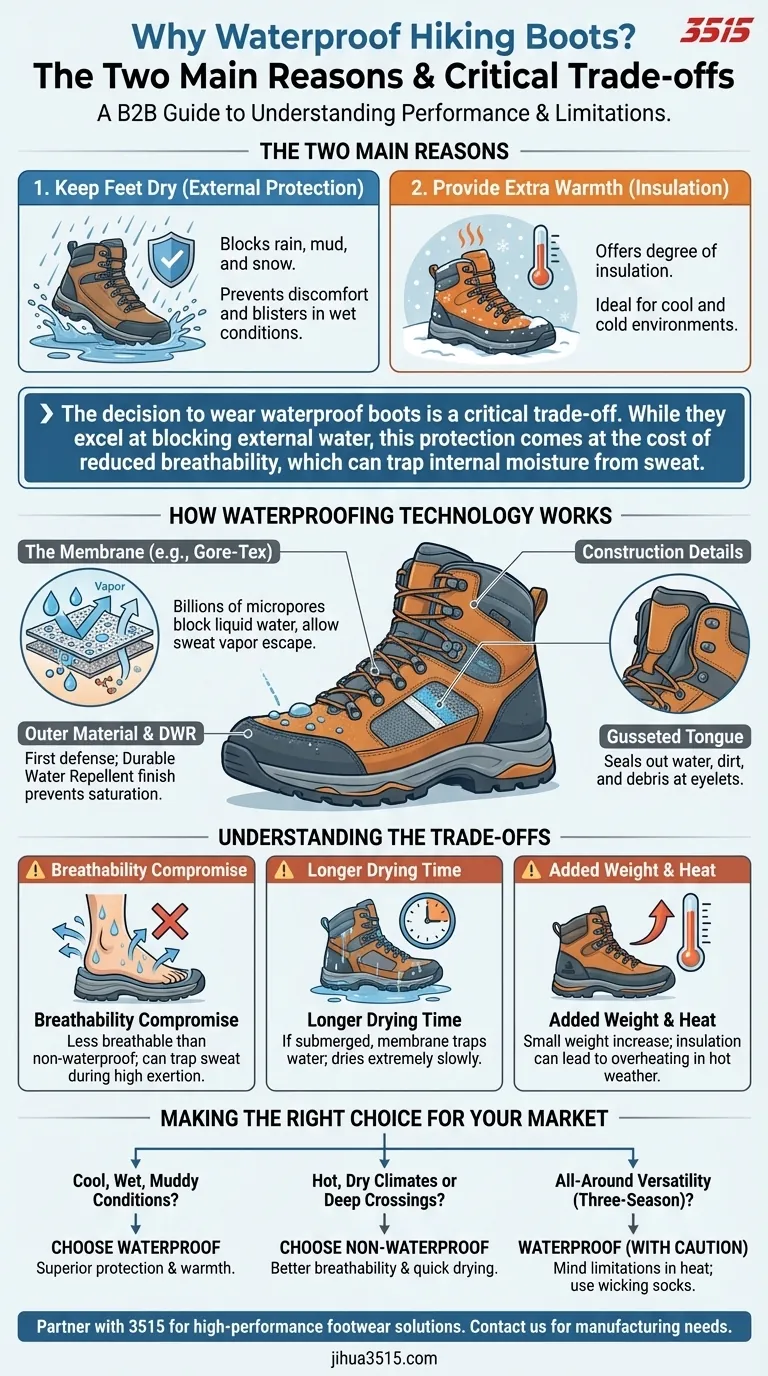
I'll end with an empowering concluding sentence. I'll keep the tone objective and authoritative throughout, using short paragraphs and bolding key terms for scannability. This way, the article will be not just informative, but also highly useful for an intelligent professional audience. The primary reasons for wearing waterproof hiking boots are to keep your feet dry from external elements like rain, mud, and snow, and to provide a degree of insulation that makes them warmer than their non-waterproof counterparts. This combination protects your feet from discomfort and reduces the risk of blisters in wet and cool conditions.
The decision to wear waterproof boots is a critical trade-off. While they excel at blocking external water, this protection comes at the cost of reduced breathability, which can trap internal moisture from sweat.
How Waterproofing Technology Works
To make an informed decision, you must first understand the system that keeps your feet dry. It's not just a single coating but a combination of components working together.
The Waterproof Membrane
The core of modern waterproof boots is a microporous membrane, often a bootie-style liner made from materials like Gore-Tex.
This membrane contains billions of pores per square inch. Each pore is too small for a liquid water droplet to pass through but large enough for a much smaller water vapor (sweat) molecule to escape.
The Outer Material
The boot's exterior, whether it's full-grain leather, nubuck, or synthetic fabric, serves as the first line of defense.
This material provides structure and durability. It is typically treated with a Durable Water Repellent (DWR) finish that causes water to bead up and roll off the surface, preventing the material from becoming saturated.
The Role of Construction
Effective waterproofing depends on the entire boot's design. A gusseted tongue, which connects the tongue to the uppers along the sides, is critical.
This feature prevents water, dirt, and debris from entering the boot through the eyelet area, ensuring a complete seal around the foot.
Understanding the Trade-offs
Waterproofing is not a universally superior feature. The benefits come with significant compromises that are crucial to understand.
The Breathability Compromise
No waterproof membrane is as breathable as a plain, non-waterproof fabric.
While membranes are designed to let sweat vapor out, they can be overwhelmed during high-exertion activities or in hot weather. This can lead to your feet feeling damp from trapped sweat, defeating the purpose of staying dry.
The Impact on Drying Time
The very technology that keeps water out also keeps it in.
If a waterproof boot becomes fully submerged during a deep stream crossing, the membrane will trap that water inside. This results in an extremely long drying time on the trail, which can be a significant liability. In contrast, a non-waterproof mesh boot would drain and dry relatively quickly.
Added Weight and Heat
The waterproof membrane and associated construction add a small amount of weight and, more importantly, insulation.
As stated, this makes the boots warmer. While this is a clear advantage in cold or snowy conditions, it can lead to overheating and excessive sweating in warm climates.
Making the Right Choice for Your Hikes
The choice between waterproof and non-waterproof boots depends entirely on the conditions you expect to face and your personal physiology.
- If your primary focus is hiking in cool to cold, wet, or muddy conditions: A waterproof boot is the superior choice for keeping feet dry, warm, and comfortable.
- If your primary focus is hiking in hot, dry climates or you anticipate deep water crossings: A non-waterproof, highly breathable boot is better for managing sweat and drying quickly after submersion.
- If your primary focus is all-around versatility for three-season use: A waterproof boot is often the default, but be mindful of its limitations in high heat and choose socks that excel at wicking moisture.
Ultimately, choosing the right footwear is about matching the tool to the specific environment you intend to explore.
Summary Table:
| Reason | Key Benefit | Key Consideration |
|---|---|---|
| Keep Feet Dry | Blocks external water (rain, snow, mud) | Reduces breathability, can trap sweat |
| Provide Warmth | Offers insulation in cold/wet conditions | Can lead to overheating in warm weather |
Ready to equip your customers with high-performance hiking boots?
As a large-scale manufacturer, 3515 produces a comprehensive range of durable and comfortable waterproof and non-waterproof footwear for distributors, brand owners, and bulk clients. Our production capabilities encompass all types of hiking boots, ensuring you get the right product for your market's needs.
Contact our team today to discuss your footwear requirements and discover how we can support your business with reliable, high-quality manufacturing.
Visual Guide
Related Products
- High Performance Fire-Retardant Waterproof Safety Boots
- Premium Flame-Retardant Waterproof Safety Boots and Shoes
- Wholesale Waterproof Tactical Boots Custom Suede & High-Traction Soles
- Premium High-Cut Waterproof Safety Boots Manufacturing & Wholesale Solutions
- Durable Waterproof Rain Boots | Custom Manufacturer for Wholesale & Brands
People Also Ask
- Why are waterproof safety boots recommended for certain work environments? Essential Protection for Wet & Hazardous Jobs
- What roles do 3D vision systems and industrial robots play in the manufacturing of fire safety boots? Smart Automation
- How can you ensure your feet stay dry during winter walks? A Two-Part Defense System for Total Comfort
- What's the difference between waterproof and water-resistant boots? Choose the Right Footwear for Your Environment
- What should you look for to ensure boots are fully waterproof? The Essential 2-Part System