
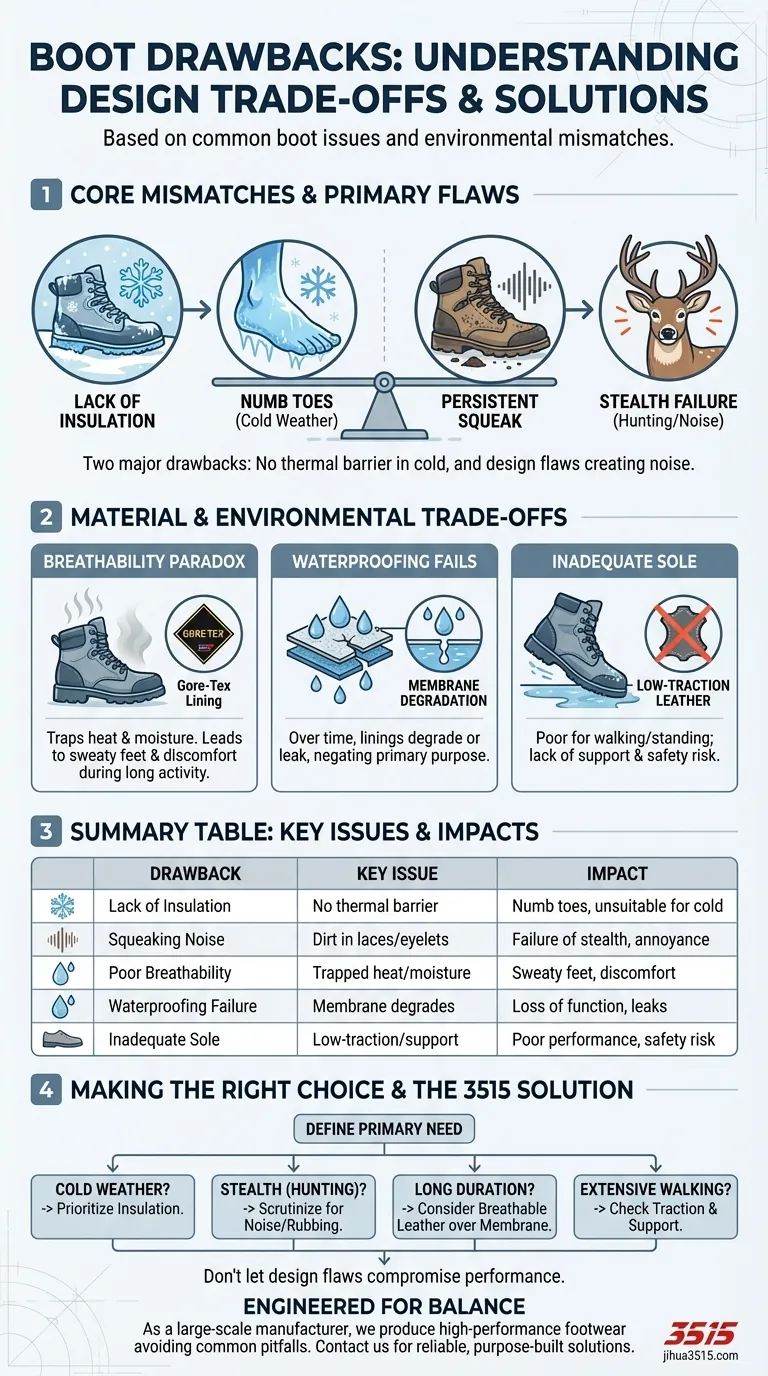
Based on the information provided, the two primary drawbacks of the boots in question are a complete lack of insulation, leading to numb toes in cold weather, and a design flaw where dirt-impregnated laces create a persistent squeaking noise as they move through the eyelets.
The core issue isn't just a list of flaws, but understanding how a boot's specific design choices create unavoidable trade-offs. A feature that works in one environment can become a significant drawback in another.
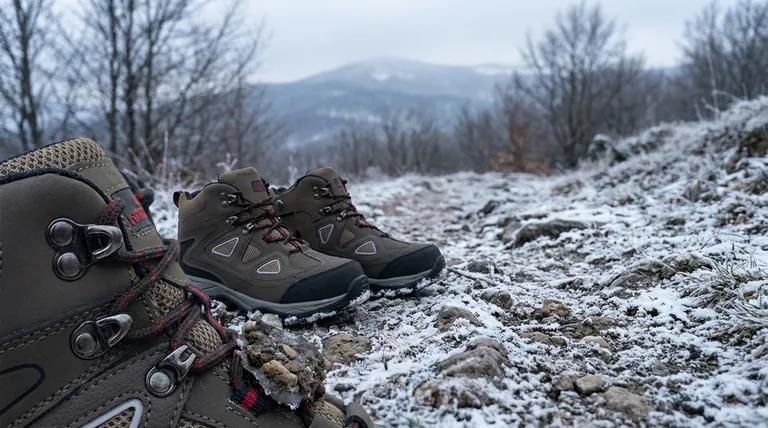
Analyzing Core Environmental Mismatches
The most significant drawbacks arise when a boot's features are poorly matched to the environment where it's used. This mismatch often involves temperature regulation and moisture management.
The Problem of Insulation (or Lack Thereof)
An uninsulated boot offers no thermal barrier. In low temperatures, this design choice directly leads to discomfort and potential safety issues like numb toes, making the boots unsuitable for cold-weather use.
The Breathability Paradox
Conversely, boots designed to be completely waterproof, such as those with a Gore-Tex lining, can create a different problem. While they keep external water out, they can also trap heat and moisture, leading to sweaty feet and discomfort during long periods of activity.
Material and Design Flaws Over Time
Some drawbacks are not immediately apparent but emerge as the boots are used, revealing weaknesses in their materials or construction.
The Persistent Squeak: A Failure of Stealth
The development of a squeaking noise is a critical failure, especially for activities like hunting that require silence. This specific issue is caused by dirt getting into the laces and eyelets, a problem inherent to the boot's design.
When Waterproofing Fails
Waterproof membranes are not infallible. Over time and with heavy wear, the lining can degrade or develop leaks, completely negating its primary purpose. This contrasts with traditional methods, like high-quality leather treated with wax, which may offer better long-term durability and breathability.
The Sole's Critical Role
The sole material and design are fundamental to a boot's function. For example, some boots use traditional low-traction leather soles that are unsuitable for anything but ideal walking surfaces. This, combined with a lack of support, makes them a poor choice for prolonged walking or standing.
Understanding the Trade-offs
Choosing a boot is an exercise in balancing competing features. Acknowledging these trade-offs is key to avoiding disappointment.
Uninsulated vs. Insulated
Uninsulated boots are lighter and more comfortable in warm weather, but they are a liability in the cold. Insulation adds weight and bulk but is non-negotiable for low-temperature environments.
Waterproof Membrane vs. Treated Leather
A waterproof membrane offers excellent protection from external moisture but often at the cost of breathability. Well-maintained treated leather can provide a superior balance of water resistance and moisture management for your feet.
Specialized vs. General-Purpose Design
A boot designed for a specific purpose will fail when used outside of it. A cowboy boot is not a hiking boot, and a boot that squeaks is not a hunting boot. The more specialized the design, the narrower its ideal use case.
Making the Right Choice for Your Goal
To select the correct footwear, you must clearly define your primary need and match the boot's features accordingly.
- If your primary focus is cold-weather activity: Prioritize properly insulated boots, as comfort and safety are paramount.
- If your primary focus is stealth (e.g., hunting): Scrutinize the design for any parts that might rub or create noise, as a squeak renders the boot useless for this purpose.
- If your primary focus is long-duration use in varied conditions: Consider that highly waterproof membrane-lined boots may trap sweat; breathable, well-treated leather could be a better long-term choice.
- If your primary focus is extensive walking or standing: Pay close attention to sole traction and overall foot support, as fashion-oriented designs often fail on these critical points.
Ultimately, the best boot is the one whose design aligns perfectly with the demands of your environment and your mission.
Summary Table:
| Drawback | Key Issue | Impact |
|---|---|---|
| Lack of Insulation | No thermal barrier | Numb toes in cold weather; unsuitable for low temperatures |
| Squeaking Noise | Dirt in laces/eyelets | Failure of stealth for hunting; general annoyance |
| Poor Breathability | Trapped heat/moisture (e.g., Gore-Tex) | Sweaty feet; discomfort during long activity |
| Waterproofing Failure | Membrane degrades over time | Loss of primary function; potential leaks |
| Inadequate Sole | Low-traction leather; lack of support | Poor performance for walking/standing; safety risk |
Don't let boot design flaws compromise your performance. As a large-scale manufacturer, 3515 produces a comprehensive range of high-performance footwear for distributors, brand owners, and bulk clients. Our expertise ensures every boot is engineered to avoid these common pitfalls, providing the perfect balance of insulation, stealth, breathability, and durability for your specific needs. Contact our team today to discuss your requirements and discover how we can deliver reliable, purpose-built footwear for your market.
Visual Guide
Related Products
- High-Traction Suede Tactical Boots Wholesale & Custom Manufacturing
- Durable Leather Work Boots Wholesale Manufacturer & Custom Factory
- Durable Leather Work Boots for Wholesale & Custom Manufacturing
- Durable Leather Work Boots for Wholesale & Custom OEM Manufacturing
- Durable Leather Tactical Boots Wholesale & Custom Manufacturing for Brands
People Also Ask
- Why is sequential analysis utilized to evaluate tactical boots? Master Dynamic Boot Development and Ergonomic Performance
- How does the material of tactical boots affect their performance? Choose the Right Material for Your Mission
- How do tactical boots differ from regular boots? Performance, Durability & Design Explained
- How do military uniforms and tactical boots impact the prediction of thermal risk? Essential Safety Insights
- What are the benefits of integrating FES and sEMG into tactical boots? Safety, Reliability & Field-Ready Performance


















