At its core, the Goodyear welt construction process is a meticulous, multi-stage method for attaching a shoe's upper to its sole. The key steps involve preparing a specialized insole, stretching the upper over a form (the "last"), stitching a leather strip called a welt to both the upper and the insole, filling the resulting cavity with cork, and finally, stitching the outsole to that same welt. This indirect attachment is what defines the entire method.
The central principle of a Goodyear welt is that the outsole is not stitched directly to the upper. Instead, the welt acts as a durable intermediary, creating a robust, water-resistant, and easily repairable shoe structure.
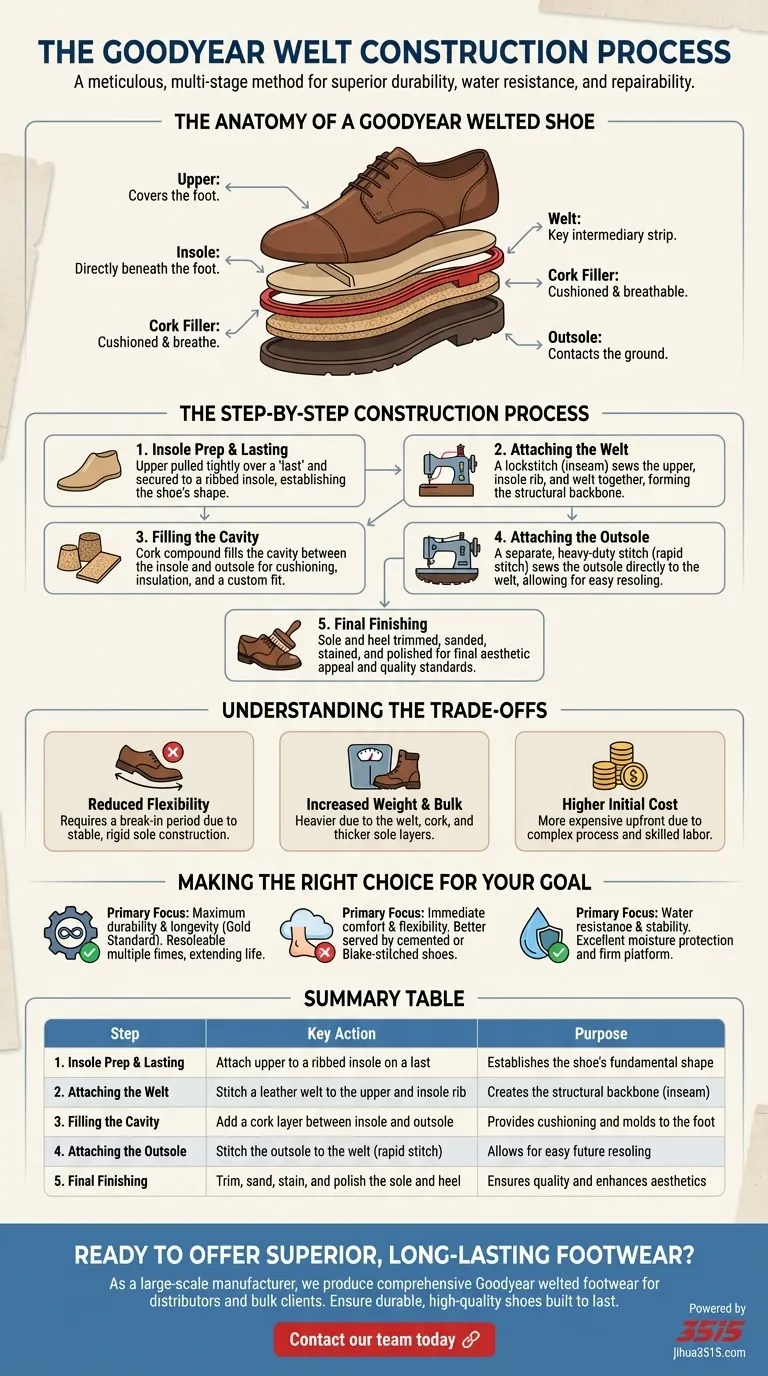
The Anatomy of a Goodyear Welted Shoe
Before examining the process, it's essential to understand the key components. This construction method fundamentally changes how these parts interact.
The Key Components
The upper is the main body of the shoe that covers your foot. The insole is the material directly beneath your foot, while the outsole is the part that contacts the ground.
The welt is the star of this method. It is a strip of material, typically leather, that runs along the perimeter of the outsole.
Finally, a cork filler is used to create a cushioned and breathable layer between the insole and the outsole.
The Step-by-Step Construction Process
Each step in the Goodyear welt process is deliberate, designed to build a shoe that is both stable and serviceable for years.
Step 1: Insole Preparation and Lasting
The process begins with the insole, which is prepared with a vertical "rib" on its underside.
The shoe's upper is then pulled tightly over a foot-shaped model called a last. It is temporarily secured to the insole's rib, giving the shoe its fundamental shape.
Step 2: Attaching the Welt
This is the defining moment. A specialized machine uses a lockstitch to sew the upper, the insole rib, and the welt together.
This first critical seam, known as the inseam, is hidden from view in the finished shoe but forms the structural backbone of the entire assembly.
Step 3: Filling the Cavity
The welt and the insole rib create a shallow cavity in the center of the shoe's bottom.
This space is filled with a layer of cork compound. The cork provides cushioning, insulation, and breathability, and over time, it will mold to the wearer's foot for a custom fit.
Step 4: Attaching the Outsole
The outsole is now placed onto the bottom of the shoe. A separate, heavy-duty stitch, called the rapid stitch, is used to sew the outsole directly to the welt.
This second seam is visible around the perimeter of the sole and is what allows a cobbler to easily remove and replace the outsole without disturbing the upper.
Step 5: Final Finishing
The final stages involve trimming the sole and heel to their final shape. Craftsmen then sand, stain, polish, and clean the shoe to meet exacting quality standards, enhancing its final aesthetic appeal.
Understanding the Trade-offs
While revered for its quality, the Goodyear welt method is not without its compromises. Acknowledging them is key to making an informed decision.
Reduced Flexibility
The multi-layer construction and dual-stitching process create a very stable but inherently rigid sole. This means Goodyear welted shoes often require a significant "break-in" period to become comfortable.
Increased Weight and Bulk
The welt itself, the cork filling, and the often thicker soles contribute to a heavier and bulkier shoe compared to more streamlined construction methods like cementing (gluing).
Higher Initial Cost
The complexity of the process, the specialized machinery, and the skilled labor required make Goodyear welted footwear significantly more expensive upfront than most other types of shoes.
Making the Right Choice for Your Goal
The decision to invest in Goodyear welted footwear depends entirely on your priorities.
- If your primary focus is maximum durability and longevity: This construction is the gold standard, as the ability to resole the shoe multiple times can extend its life for decades.
- If your primary focus is immediate, out-of-the-box comfort and flexibility: You may be better served by a cemented or Blake-stitched shoe, which is lighter and requires little to no break-in period.
- If your primary focus is water resistance and stability: The Goodyear welt provides excellent protection from moisture seeping in from below and offers a firm, supportive platform underfoot.
Ultimately, choosing a Goodyear welt is an investment in a specific philosophy of craftsmanship, longevity, and repairability.
Summary Table:
| Step | Key Action | Purpose |
|---|---|---|
| 1. Insole Prep & Lasting | Attach upper to a ribbed insole on a last | Establishes the shoe's fundamental shape |
| 2. Attaching the Welt | Stitch a leather welt to the upper and insole rib | Creates the structural backbone (inseam) |
| 3. Filling the Cavity | Add a cork layer between insole and outsole | Provides cushioning and molds to the foot |
| 4. Attaching the Outsole | Stitch the outsole to the welt (rapid stitch) | Allows for easy future resoling |
| 5. Final Finishing | Trim, sand, stain, and polish the sole and heel | Ensures quality and enhances aesthetics |
Ready to Offer Superior, Long-Lasting Footwear?
As a large-scale manufacturer, 3515 produces a comprehensive range of Goodyear welted and other constructed footwear for distributors, brand owners, and bulk clients. Our extensive production capabilities ensure you receive durable, high-quality shoes and boots built to last.
Contact our team today to discuss how we can meet your specific manufacturing needs and deliver exceptional value to your customers.
Visual Guide
Related Products
- Durable Goodyear Welt Leather Work Boots for Wholesale & Private Label
- Wholesale Durable Leather Work Boots | 8-Inch Goodyear Welt Manufacturer
- Wholesale Durable & Breathable Training Shoes for Custom Brands
- Custom OEM Training Shoes Wholesale Manufacturer Durable & Breathable
- Lightweight Breathable Training Shoes for Wholesale & Custom OEM Manufacturing
People Also Ask
- What is the difference between full-grain and top-grain leather? Premium Material Guide for Boot Manufacturers
- What are the advantages of leather as an upper material for work boots? Unmatched Durability & Custom Comfort
- Why is it important to waterproof leather work boots? Protect Your Investment and Performance
- How should new leather work boots be broken in? A Guide to Comfort and Durability
- What are the advantages of leather uppers in work boots? Unmatched Durability & Protection