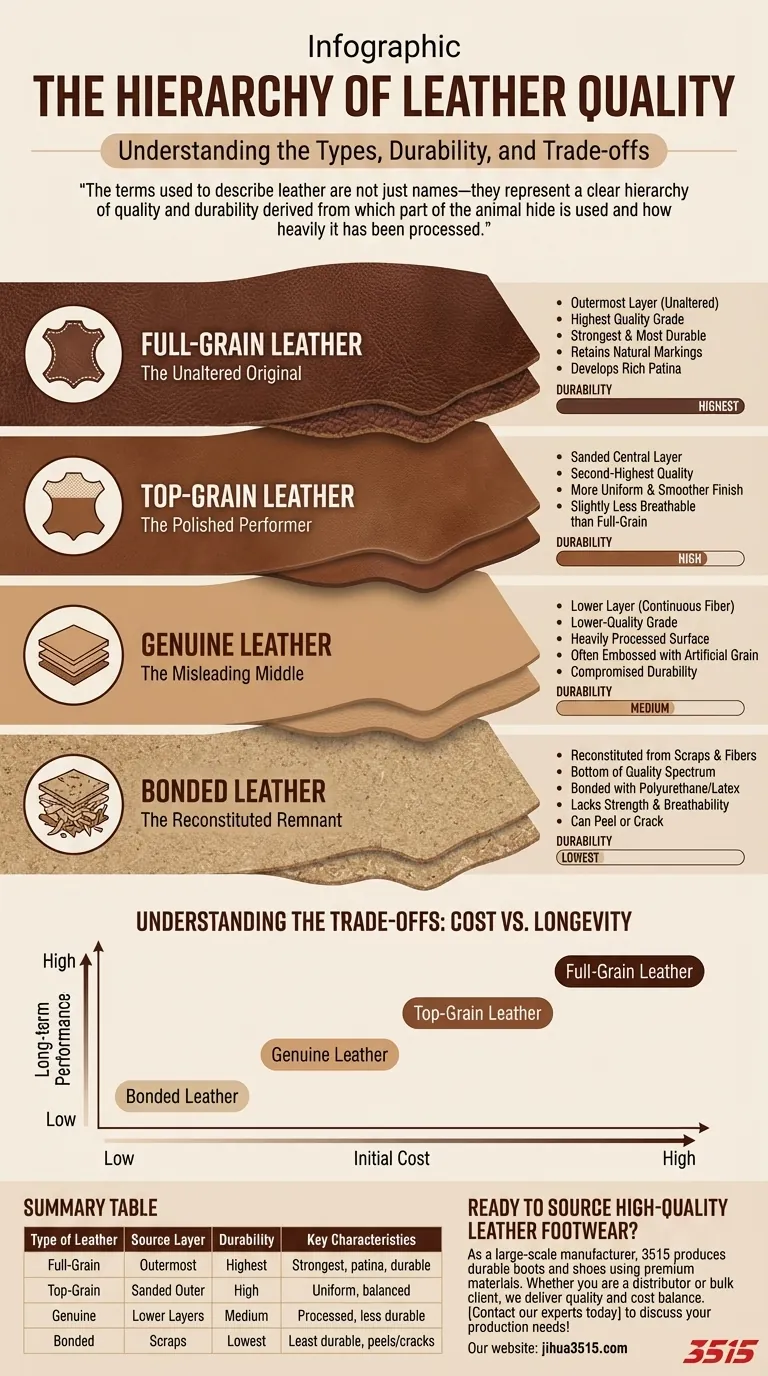
In short, the references identify four main types of leather. These are full-grain leather, the unaltered outermost layer; top-grain leather, the sanded central layer; genuine leather, a lower layer made of continuous fiber; and bonded leather, which is reconstituted from leather scraps.
The terms used to describe leather are not just names—they represent a clear hierarchy of quality and durability derived from which part of the animal hide is used and how heavily it has been processed. Understanding this hierarchy is the key to making an informed purchase.
The Hierarchy of Leather Quality
The "type" of leather directly corresponds to its quality, longevity, and price. This is determined by which layer of the hide it comes from, with the outermost layers being the most durable and valuable.
Full-Grain: The Unaltered Original
Full-grain leather is the highest quality grade available. It comes from the very top layer of the hide and includes all the natural grain.
It is the strongest and most durable type of leather because the dense, natural fiber structure is left completely intact. This leather retains natural markings and imperfections, and it develops a rich patina over time.
Top-Grain: The Polished Performer
Top-grain leather is the second-highest quality. It's made from the same layer as full-grain, but the very top surface has been sanded or buffed to remove imperfections.
This process creates a more uniform and smoother finish. While still very durable, it is slightly less breathable and strong than full-grain because the outermost fibers have been removed.
Genuine Leather: The Misleading Middle
The term "genuine leather" is often misunderstood. While it is technically real leather, it refers to a lower-quality grade.
It is typically created from the bottom layers of the hide that remain after the top layers are split off for full-grain and top-grain. The surface is often heavily processed, embossed with an artificial grain, and painted to achieve a uniform look, which compromises its durability.
Bonded Leather: The Reconstituted Remnant
Bonded leather sits at the bottom of the quality spectrum. It is not a solid piece of hide but rather an amalgamation of leather scraps, dust, and fibers.
These remnants are shredded and then bonded together with polyurethane or latex onto a backing material. Think of it as the particleboard of the leather world—it contains leather, but it lacks the strength, breathability, and longevity of a solid piece.
Understanding the Trade-offs: Cost vs. Longevity
Choosing a leather product involves a direct trade-off between its initial cost and its long-term performance. The quality grade is the single most important factor in this equation.
The Durability Spectrum
The hierarchy is simple: full-grain is the most durable, followed by top-grain, with genuine and bonded leather being significantly less resilient to wear and tear. A full-grain product can last a lifetime, while a bonded leather item may begin to peel or crack within a year or two of regular use.
The Cost Factor
Price directly reflects this durability. Full-grain leather is the most expensive to produce and purchase due to its strength and the scarcity of clean, unblemished hides. Bonded leather is the cheapest, as it efficiently uses up all the leftover material from the tanning process.
Appearance and Feel
Full-grain leather showcases character and ages gracefully. Top-grain provides a clean, consistent finish. Genuine and bonded leathers often have a more uniform, plastic-like feel due to the heavy processing and artificial coatings applied to their surfaces.
Making the Right Choice for Your Needs
Your ideal choice depends entirely on balancing your budget with your expectations for performance and longevity.
- If your primary focus is maximum durability and a product that ages beautifully: You should exclusively seek out full-grain leather.
- If your primary focus is a uniform, flawless appearance in a high-quality item: Top-grain leather offers a strong balance of durability and aesthetic consistency.
- If your primary focus is budget-friendliness for a low-wear item: Genuine leather can be a viable option, but understand that you are sacrificing long-term durability.
- If your primary focus is the absolute lowest price: Bonded leather serves this purpose, but with the clear understanding that it will not last.
Ultimately, knowing these terms empowers you to look past marketing labels and choose a product based on its true material quality.
Summary Table:
| Type of Leather | Source Layer | Durability | Key Characteristics |
|---|---|---|---|
| Full-Grain | Outermost (unaltered) | Highest | Strongest, develops a patina, most durable |
| Top-Grain | Outermost (sanded) | High | Uniform finish, balance of durability & look |
| Genuine | Lower layers | Medium | Real leather but heavily processed, less durable |
| Bonded | Reconstituted scraps | Lowest | Least durable, can peel or crack over time |
Ready to source high-quality leather footwear?
As a large-scale manufacturer, 3515 produces a comprehensive range of durable boots and shoes using premium materials. Whether you are a distributor, brand owner, or bulk client, we can deliver the right balance of quality, durability, and cost for your market.
Contact our experts today to discuss your production needs and get a quote!
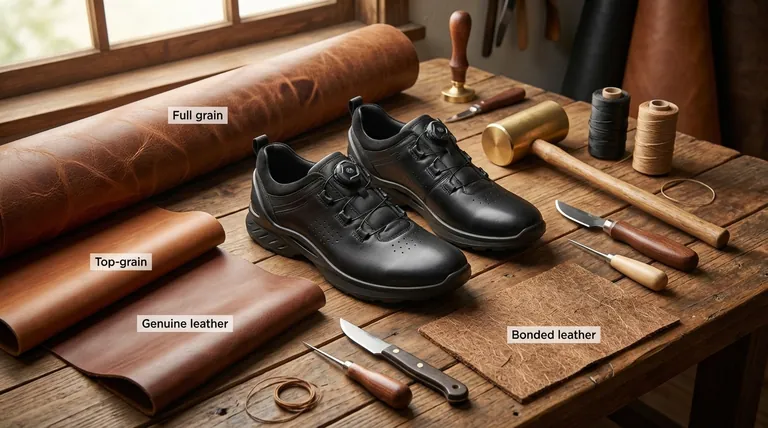
Visual Guide