
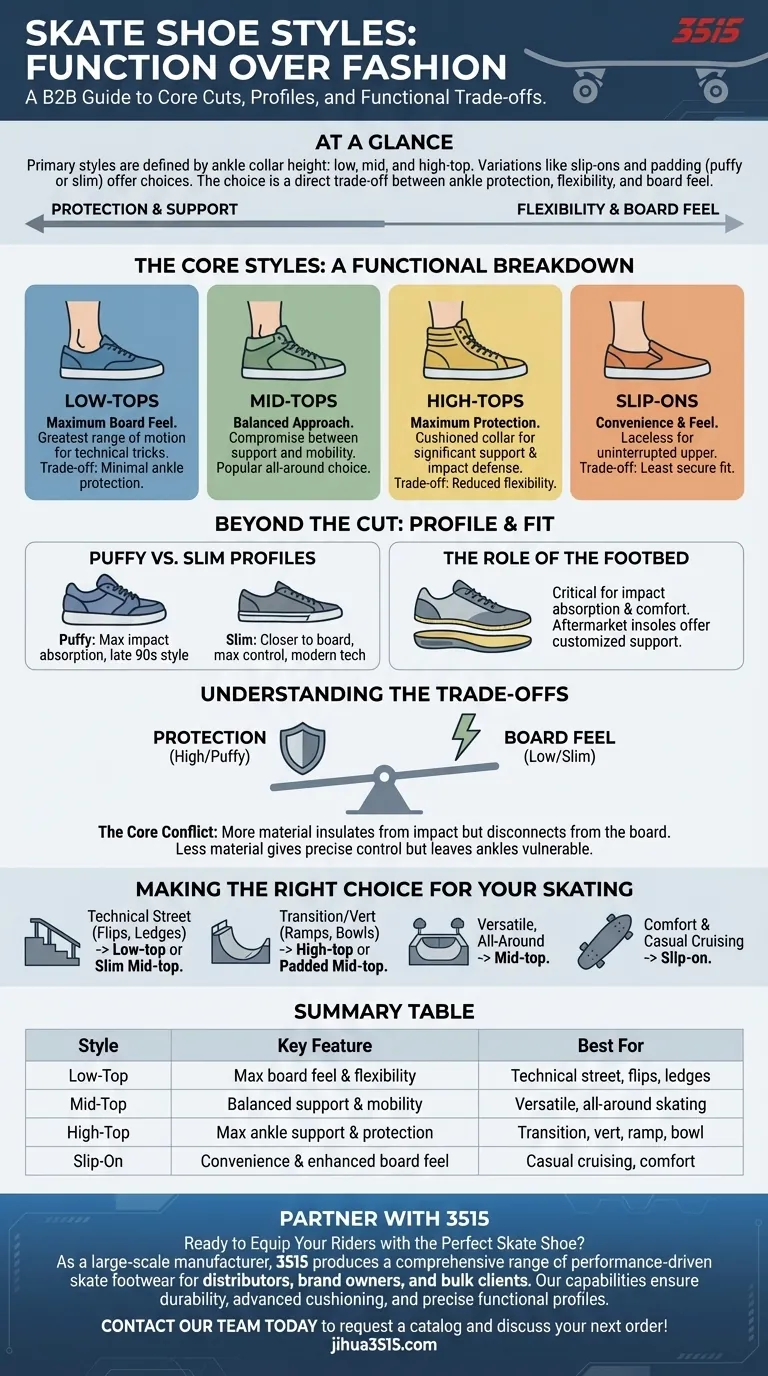
At a glance, the primary styles of skate shoes are defined by the height of their ankle collar: low-top, mid-top, and high-top. These core styles, along with variations like slip-ons and different padding profiles (puffy or slim), create a spectrum of choices. Each design represents a deliberate trade-off between ankle protection, flexibility, and the direct connection you feel with your board.
The essential difference between skate shoe styles is not fashion, but function. Your choice is a direct trade-off: you are either prioritizing ankle support and impact protection or maximizing flexibility and board feel for technical control.

The Core Styles: A Functional Breakdown
The "top" or "cut" of the shoe refers to how high it comes up on your ankle. This is the most significant factor influencing its performance characteristics.
Low-Tops: Maximum Board Feel
Low-top shoes are cut below the ankle, offering the greatest range of motion.
This unrestricted flexibility provides the best board feel, which is the skater's ability to sense the board's position and concave through their feet. This makes them ideal for technical tricks that require precise foot movements. The obvious trade-off is minimal ankle protection.
High-Tops: Maximum Protection
As the name implies, high-tops extend above the ankle, providing a cushioned collar that offers significant support.
This design helps protect against ankle rolls and direct impacts from the board. This added structure and padding, however, slightly reduces flexibility and can mute some of the nuanced board feel that low-tops provide.
Mid-Tops: The Balanced Approach
Mid-tops sit directly on the ankle, striking a deliberate compromise between the other two styles.
They offer more support and protection than a low-top without being as restrictive as a high-top. This makes them a popular all-around choice for skaters who want a blend of security and mobility.
Slip-Ons: Convenience and Feel
Slip-ons are essentially a laceless variation of a low-top shoe.
Their primary benefits are convenience and an uninterrupted upper, which can enhance the feel for certain flip tricks. While highly valued for comfort and board feel, they typically offer the least secure fit, which can be a concern for high-impact skating.
Beyond the Cut: Understanding Profile and Fit
Beyond the height of the collar, the shoe's overall construction and padding level create another layer of choice.
Puffy vs. Slim Profiles
A "puffy" shoe features generous padding throughout the tongue and collar, maximizing impact absorption and protection. This style was iconic in the late 90s and early 2000s.
A "slim" shoe uses minimal padding to reduce weight and bring the foot closer to the board, further enhancing board feel and control. This is the more common profile in modern technical skate shoes.
The Role of the Footbed
The footbed, or insole, is critical for impact absorption and comfort. Most skate shoes come with a standard, medium-arch insole.
However, many skaters swap these out for specialized aftermarket insoles that offer superior cushioning or customized arch support, tailoring the shoe's internal fit to their specific needs.
Understanding the Trade-offs
Choosing a skate shoe is a game of balancing opposing characteristics. There is no single "best" style, only the one that best serves your purpose.
The Core Conflict: Protection vs. Board Feel
This is the fundamental choice every skater makes. More material and padding (high-tops, puffy shoes) insulate you from impact but can create a disconnect from your board.
Conversely, less material (low-tops, slim shoes) gives you a precise, responsive connection for technical control but leaves your ankles more vulnerable.
Common Pitfall: Ignoring Your Primary Use
Skaters often choose a shoe based on aesthetics without considering the type of skating they do most.
A shoe designed for high-impact ramp skating will feel cumbersome and restrictive for technical ledge skating, and a minimalist technical shoe will offer inadequate protection in a bowl.
Making the Right Choice for Your Skating
Your decision should be guided by the type of skating you do most often.
- If your primary focus is technical street skating (flips, ledges): A low-top or slim mid-top will provide the superior board feel and flexibility you need for precise control.
- If your primary focus is transition or vert skating (ramps, bowls): A high-top or well-padded mid-top is essential for providing crucial ankle support and impact protection.
- If you need a versatile, all-around shoe: A mid-top offers the most balanced profile, providing moderate support without sacrificing too much board feel.
- If your primary focus is comfort and casual cruising: A slip-on provides excellent convenience and a relaxed feel perfect for low-impact riding.
Understanding these functional differences empowers you to choose a shoe that acts as a tool to complement your personal style of skating.
Summary Table:
| Style | Key Feature | Best For |
|---|---|---|
| Low-Top | Maximum board feel & flexibility | Technical street skating, flips, ledges |
| Mid-Top | Balanced support & mobility | Versatile, all-around skating |
| High-Top | Maximum ankle support & protection | Transition, vert, ramp, and bowl skating |
| Slip-On | Convenience & enhanced board feel | Casual cruising, comfort |
Ready to Equip Your Riders with the Perfect Skate Shoe?
As a large-scale manufacturer, 3515 produces a comprehensive range of performance-driven skate footwear for distributors, brand owners, and bulk clients. Our production capabilities ensure durability, advanced cushioning, and the precise functional profiles skaters demand.
Partner with us to supply footwear that enhances performance and stands up to the toughest sessions. Let's discuss your specific needs and how we can support your brand.
Contact our team today to request a catalog and discuss your next order!
Visual Guide
Related Products
- Wholesale Durable Camouflage Canvas Shoes with High-Traction Cleated Rubber Sole
- Durable High-Traction Canvas Sneakers Wholesale & Custom Manufacturing
- Premium Suede Sport Safety Shoes for Wholesale & Bulk Orders
- Wholesale Durable & Breathable Training Shoes for Custom Brands
- Lightweight Breathable Sneakers with Wet-Traction Grip for Wholesale & Private Label
People Also Ask
- Why is the selection of high-strength fabric materials necessary in the production of canvas shoes and training shoes?
- What are the properties of canvas as a shoe material? A Guide to Lightweight Comfort & Style
- Can canvas shoes be worn in rainy conditions? The Truth About Water Resistance
- What are some examples of vulcanized shoes? Discover the Flexibility and Board Feel of Classic Sneakers
- What are the characteristics of canvas as a shoe material? A Guide to Lightweight, Breathable Footwear



















