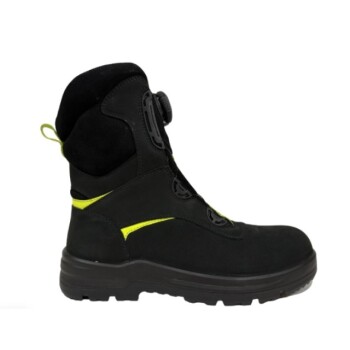
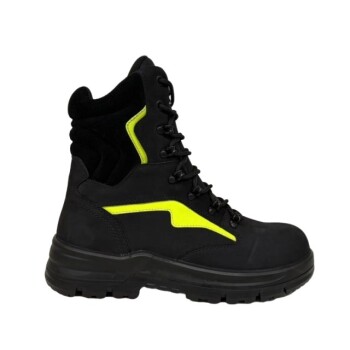
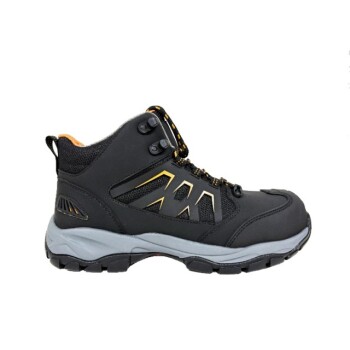
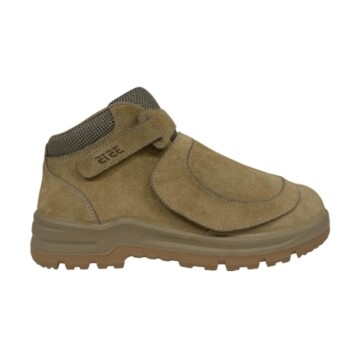
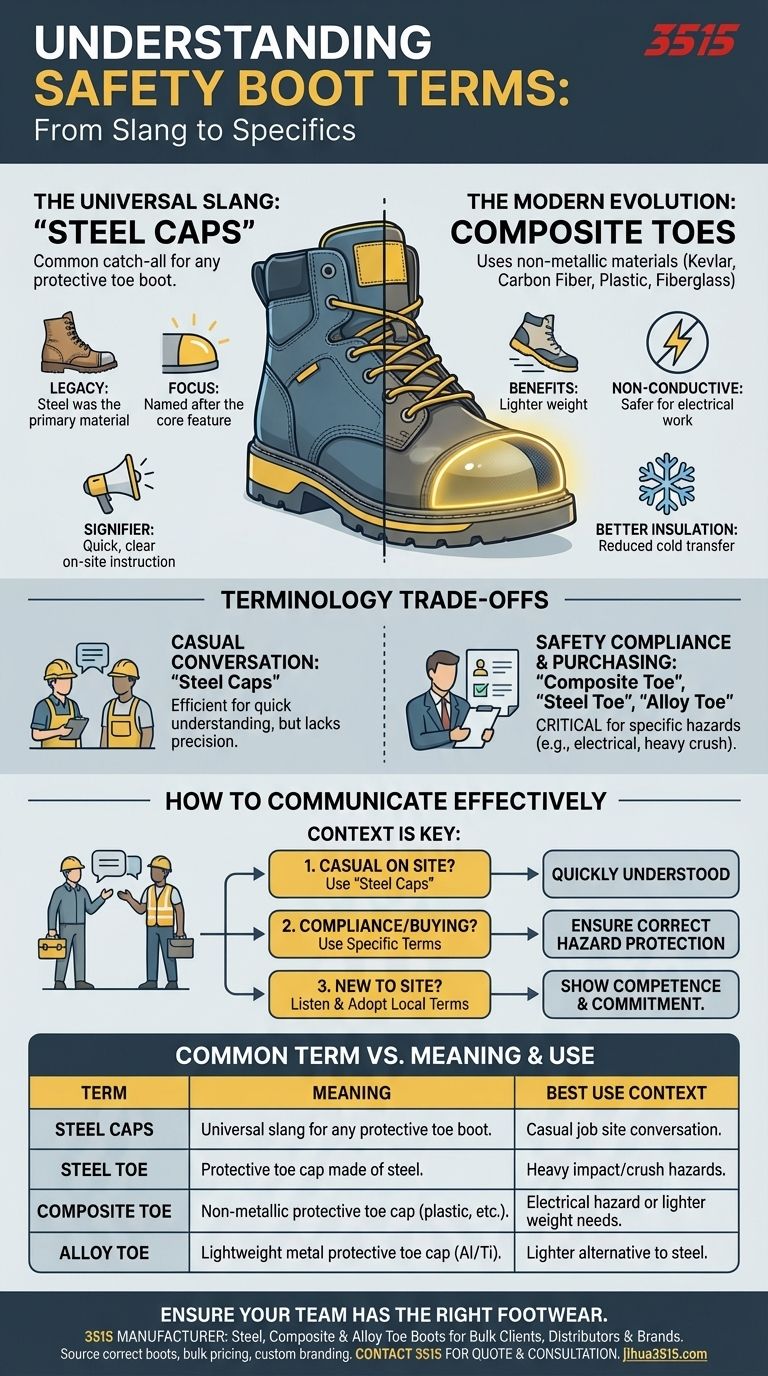
In professional and trade settings, the single most common conversational term used to refer to almost any type of safety boot is "steel caps". This term has become a universal catch-all, used even when the boots in question feature modern composite materials instead of actual steel.
While "steel caps" is the go-to slang, this term originates from the boot's most critical safety feature: the protective toe cap. Understanding this helps you grasp that the conversation is always fundamentally about foot protection, regardless of the specific material used.
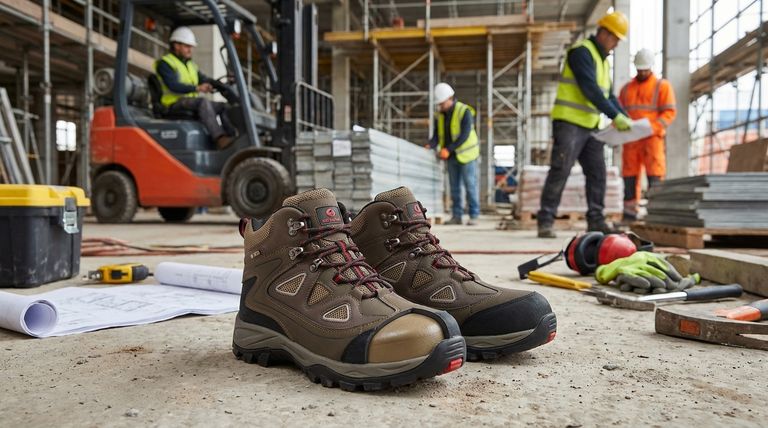
Why "Steel Caps" Became the Standard Term
The widespread use of "steel caps" is rooted in the history of safety footwear and the way people communicate on a job site. It's a term born from legacy, function, and simplicity.
A Legacy of Material
For decades, steel was the primary and often only material used to create a reinforced, protective toe in work boots. Because of this long history, the material became synonymous with the entire boot.
The Focus on a Core Feature
The protective toe cap is the most defining safety feature of the boot. People naturally name things after their most prominent or important characteristic, and in this case, it was the steel inside the toe.
A Universal Signifier
On a busy job site, clear and simple communication is essential for safety. "You need your steel caps for this area" is a quick, unambiguous instruction that everyone understands means "wear your required protective footwear."
The Evolution Beyond Steel
While the terminology has remained, the technology inside safety footwear has advanced significantly. The term "steel caps" no longer reflects the full range of modern options.
The Rise of Composite Toes
Many modern safety boots use composite toe caps. These are made from non-metallic materials like Kevlar, carbon fiber, plastic, or fiberglass.
Benefits of Modern Materials
Composite toes offer distinct advantages. They are significantly lighter than steel, do not conduct electricity (a critical feature for electricians), and don't transfer cold as readily in winter environments.
The Lingering Terminology
Despite these advances, "steel caps" persists out of habit and its universal recognition. It has become the generic trademark for the product category, much like people say "Kleenex" for any facial tissue.
Understanding the Trade-offs in Terminology
Using the common slang is efficient, but it's important to know when precision is required to ensure proper safety and compliance.
The Risk of Imprecision
While "steel caps" works for casual conversation, it can be problematic in formal safety briefings or when purchasing new boots. A job requiring work around live electricity demands a non-conductive composite toe, and simply asking for "steel caps" could lead to a dangerous choice.
When to Be Specific
In casual shop talk, "steel caps" is perfectly acceptable. However, when discussing specific job hazards, reviewing safety data sheets (SDS), or buying footwear, you must use precise terms like "composite toe," "steel toe," or "alloy toe" to ensure you have the correct protection.
How to Communicate Effectively
Choosing the right term depends entirely on your context and your goal.
- If your primary focus is casual conversation on site: Using "steel caps" is the most effective way to be understood quickly by the widest audience.
- If your primary focus is safety compliance or purchasing new gear: Use specific, technical terms like "composite toe" to ensure the footwear meets the exact requirements for the hazard.
- If you are new to a specific job site: Listen to how safety managers and senior crew members refer to the equipment and adopt their terminology.
Ultimately, speaking the language of the job site demonstrates both competence and a clear commitment to safety.
Summary Table:
| Common Term | What It Actually Means | Best Use Context |
|---|---|---|
| Steel Caps | Universal slang for any safety boot with a protective toe cap. | Casual job site conversation for quick understanding. |
| Steel Toe | Boots with a protective toe cap made of steel. | When protection from heavy impact/crush hazards is the primary need. |
| Composite Toe | Boots with a protective toe cap made of non-metallic materials (e.g., plastic, fiberglass). | When electrical hazard protection or lighter weight is required. |
| Alloy Toe | Boots with a protective toe cap made of lightweight metals like aluminum or titanium. | When seeking a lighter alternative to steel with similar protection. |
Ensure Your Team Has the Right Footwear for the Job
As a large-scale manufacturer, 3515 produces a comprehensive range of certified safety footwear for distributors, brand owners, and bulk clients. Our production capabilities encompass all types of steel toe, composite toe, and alloy toe boots, ensuring you get the precise protection your workforce needs.
Let us help you:
- Source the correct boots for specific job hazards and compliance standards.
- Benefit from bulk pricing and reliable supply chain for large orders.
- Explore custom branding options for your company or retail brand.
Ready to equip your team with high-quality, compliant safety boots? Contact 3515 today for a quote and expert consultation.
Visual Guide
Related Products
- Puncture-Resistant Velcro Safety Boots for Wholesale & Custom Manufacturing
- Wholesale Durable Safety Boots | Custom Steel Toe & Puncture-Resistant Manufacturing
- Premium Grain Leather Safety Boots for Bulk Supply
- Heavy-Duty Waterproof Nubuck Safety Boots Safety Shoes for Bulk Supply
- Premium High-Cut Waterproof Safety Boots Manufacturing & Wholesale Solutions
People Also Ask
- Why are industrial safety boots with steel toes necessary for machine operators? Essential Foot Protection for Safety
- What are the characteristics of steel toe safety boots? Maximum Protection, Key Trade-offs
- Is it true that steel toes can cause toes to get cut off? Debunking the Dangerous Myth
- What are the primary safety functions of safety boots with steel-toe designs? Essential Protection for Industry
- What do the symbols M, F, I, and C represent on safety toe boots? Decode ASTM F2413 for Maximum Protection