
To be clear, a slight heel slippage in new cowboy boots is not a cause for concern. In fact, it is a perfectly normal and expected part of the break-in process. This initial movement is a feature, not a flaw, indicating that the boot's rigid structure has not yet conformed to the unique shape and flex of your foot.
The core issue isn't the presence of slip, but its degree. A small lift is a sign of a properly sized boot with a stiff new sole, whereas excessive movement points to an incorrect fit.

Why Heel Slip Is a Normal Part of the Break-In Process
Understanding the construction of a traditional cowboy boot is key to understanding why your heel moves when the boot is new.
The Role of a Stiff Leather Sole
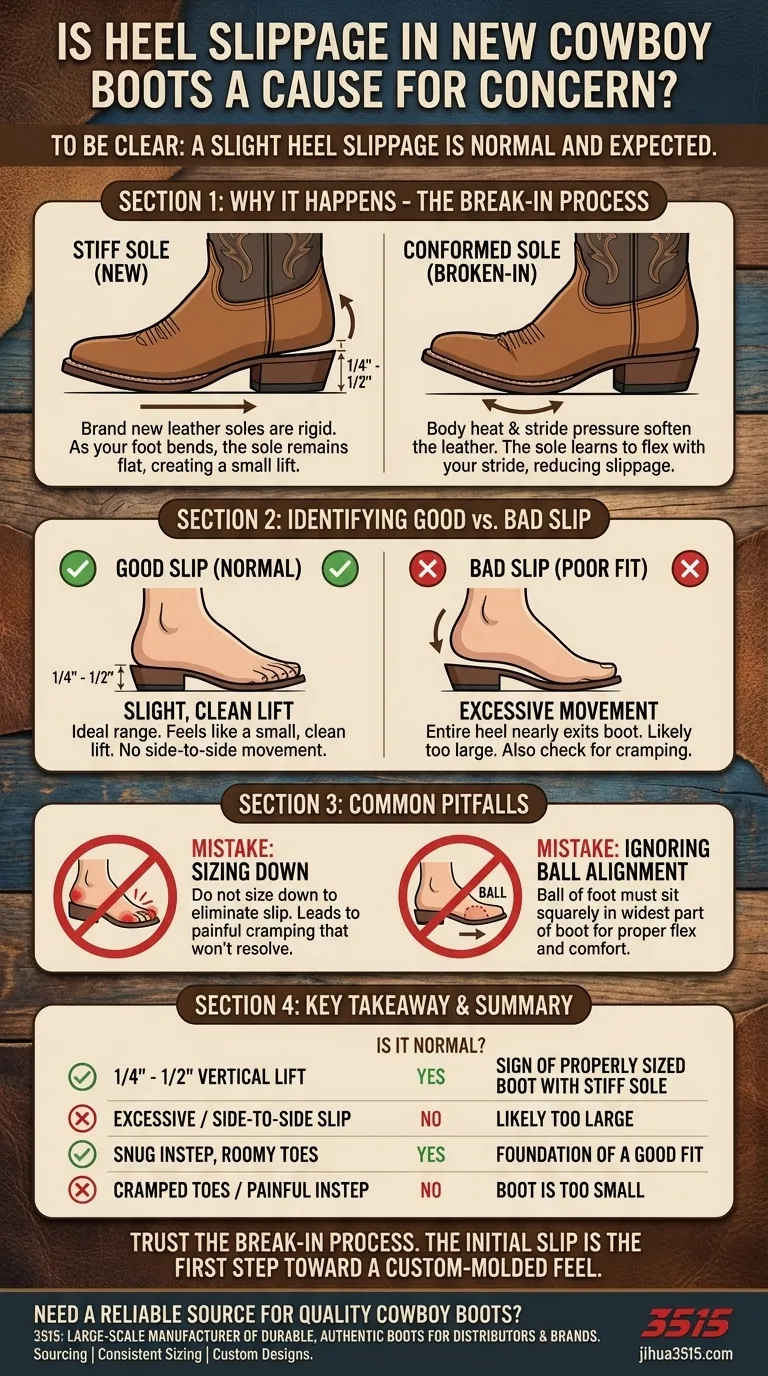
Brand new cowboy boots, especially those with high-quality leather soles, are very rigid.
When you walk, your foot bends, but the stiff sole remains flat on the ground. This difference in movement creates a small gap, causing your heel to lift slightly inside the boot.
How the Boot Conforms to Your Foot
As you wear the boots, your body heat and the pressure of your stride slowly soften the leather.
The sole will begin to flex at the ball of your foot, learning to move with your stride instead of against it. This drastically reduces the initial slippage.
The Importance of the Instep
A cowboy boot is designed to get its primary grip over your instep (the top of your foot).
This area should feel snug from the very beginning, like a firm handshake. It's this snugness that ultimately holds your foot securely in place once the rest of the boot breaks in.
Identifying Good Slip vs. a Poor Fit
While some slip is good, it's crucial to distinguish it from the signs of a boot that is simply the wrong size.
The Acceptable Range
The ideal amount of slippage is between a quarter and a half inch.
It should feel like a slight, clean lift as you step. It should not feel sloppy, and your heel should not move side-to-side.
Warning Signs of a Bad Fit
Excessive slippage where your entire heel nearly comes out of the boot means it's likely too large.
Conversely, pay close attention to the toe box. Your toes should have room to wiggle and should never feel cramped. The leather in the toe box will not stretch significantly.
A proper fit feels snug across the instep, allows for toe room, and has that characteristic minor slip in the heel.
Common Pitfalls to Avoid
Many first-time buyers make one critical mistake when trying to solve for initial heel slip.
The Mistake of Sizing Down
Do not size down to eliminate heel slip. This is the most common error.
Choosing a smaller size will lead to a cramped toe box and a painfully tight instep—problems that will not resolve with time. The minor heel slip will resolve itself; a cramped fit will not.
Ignoring the Ball of Your Foot
The widest part of your foot (the ball) should sit squarely in the widest part of the boot.
If it's too far forward or back, the boot's built-in flex point will not align with your foot's natural flex point, causing discomfort and improper wear.
Making the Right Choice for Your Foot
Focus on the overall feel, not just one isolated spot. A great fit is a balance of snugness and space in the right areas.
- If your primary focus is a perfect long-term fit: Prioritize a snug instep and adequate toe room, accepting that a half-inch of heel slip is part of the process.
- If you are concerned the boot is too big: Ensure the slippage is only vertical lift, not side-to-side motion, and that the ball of your foot is correctly positioned.
- If you are concerned the boot is too small: Check for any cramping in the toes; if they are touching the end or sides, the boot is too small, regardless of heel slip.
Trust the break-in process; that initial slip is the first step toward a boot that feels custom-molded to your foot.
Summary Table:
| Situation | Is It Normal? | Key Takeaway |
|---|---|---|
| 1/4" - 1/2" vertical lift | ✅ Yes | A sign of a properly sized boot with a stiff sole. It will decrease as the boot breaks in. |
| Excessive slip or side-to-side movement | ❌ No | Likely indicates the boot is too large. |
| Snug instep, roomy toe box | ✅ Yes | This is the foundation of a good fit. The instep holds your foot securely. |
| Cramped toes or painful instep | ❌ No | The boot is too small. These issues will not resolve with wear. |
Need a Reliable Source for Quality Cowboy Boots?
As a large-scale manufacturer, 3515 produces a comprehensive range of durable and authentic cowboy boots for distributors, brand owners, and bulk clients. We understand the importance of proper construction and fit from the very first wear.
We can help you:
- Source high-quality boots built with the right materials for a correct break-in process.
- Ensure consistent sizing across large orders for your customers.
- Customize designs to meet your specific market needs.
Let's discuss your next order. Contact our team today to explore how our manufacturing expertise can benefit your business.
Visual Guide
Related Products
- High-Traction Suede Tactical Boots Wholesale & Custom Manufacturing
- Wholesale High-Traction Camo Boots - Custom Manufacturer for Brands
- Wholesale Lightweight Tactical Boots Custom Manufacturer for Desert & Combat Use
- Durable Leather Tactical Boots Wholesale & Custom Manufacturing for Brands
- Wholesale Durable Mid-Cut Tactical Boots for Custom & Private Label Brands
People Also Ask
- Why is sequential analysis utilized to evaluate tactical boots? Master Dynamic Boot Development and Ergonomic Performance
- How does the material of tactical boots affect their performance? Choose the Right Material for Your Mission
- How do tactical boots differ from regular boots? Performance, Durability & Design Explained
- How do military uniforms and tactical boots impact the prediction of thermal risk? Essential Safety Insights
- What are the benefits of integrating FES and sEMG into tactical boots? Safety, Reliability & Field-Ready Performance


















