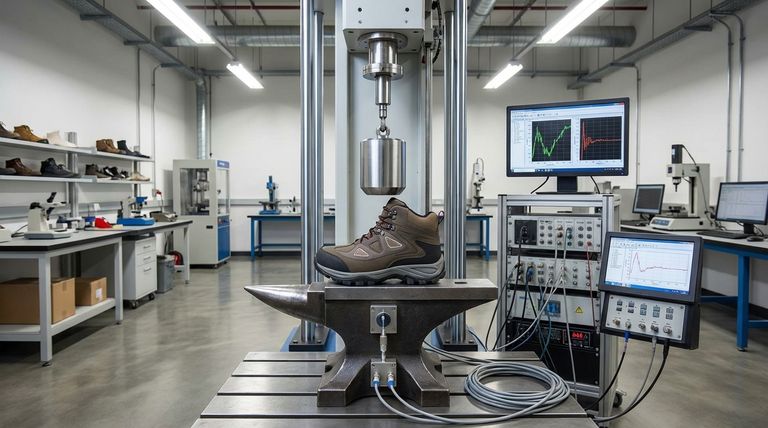
At its core, footwear impact attenuation is tested using a controlled mechanical drop test. In this procedure, a weighted impactor is repeatedly dropped from a standardized height onto a specific part of the shoe's sole, typically the heel or forefoot. Sophisticated sensors measure the peak force transmitted through the sole, providing a clear, quantitative measure of its ability to absorb shock.
The fundamental goal of impact attenuation testing is to quantify a shoe's ability to reduce peak shock forces. This data serves as a direct proxy for the shoe's protective cushioning and its effectiveness in mitigating the stress of each step or landing.
The Mechanics of the Impact Test
To understand the results, it's essential to understand the components and process of the test itself. It is a highly standardized and repeatable laboratory procedure designed to isolate the performance of the sole material.
The Impactor and the Drop
The test uses a guided metal impactor of a specific weight and shape, often resembling a simplified heel or foot form. This impactor is raised to a precise, predetermined height and dropped onto the shoe sample, ensuring that the same amount of impact energy is applied in every single test.
Measuring the Transmitted Force
The shoe or sole material is placed on a rigid base, or anvil, which is equipped with a highly sensitive load cell. As the impactor strikes the shoe, this load cell measures the exact amount of force that is not absorbed by the cushioning and is instead transmitted through to the base.
Key Data Point: Peak Force
The single most important piece of data from this test is the peak force, measured in Newtons (N) or kilonewtons (kN). This number represents the maximum shock force experienced at the instant of impact. A lower peak force reading indicates better impact attenuation, as it means the material successfully dissipated more of the initial energy.
Repetitive Strikes for Durability
As mentioned in the standards, the test involves repeatedly dropping the impactor. This is not just to get an average reading. This process simulates the long-term wear of a shoe, revealing how the cushioning material holds up over hundreds or thousands of cycles. It tests for material fatigue and "compression set"—the material's tendency to pack down and lose its cushioning properties over time.
What Does the Data Actually Tell Us?
The numbers generated by an impact attenuation test provide objective insight into how a shoe will perform and protect the wearer. It allows us to move beyond subjective feelings of "softness" to a concrete measure of safety and performance.
Translating Force into Protection
The connection is direct: a lower transmitted force means less shock is passed on to your foot, ankle, and knee. For activities involving high impact, like running or basketball, a shoe with superior impact attenuation can play a crucial role in reducing stress on joints and potentially lowering the risk of overuse injuries.
Comparing Materials and Designs
This testing allows for direct, apples-to-apples comparisons between different foam compounds (like EVA, TPU, or PEBA) and sole geometries. It can reveal which material provides better initial cushioning and which one maintains its performance characteristics for a longer lifespan.
Heel vs. Forefoot Considerations
Testing is often performed separately on the heel and forefoot because their needs are different. A running shoe designed for a heel-striker requires exceptional impact attenuation in the rear, while a shoe for a forefoot-striker needs that protection focused toward the front.
Understanding the Trade-offs
While low impact force is generally desirable, it is not the only factor in a shoe's performance. Achieving a best-in-class score on this test often involves specific design compromises.
Cushioning vs. Energy Return
There is a classic trade-off between shock absorption and energy return. Materials that are excellent at attenuating impact (absorbing energy) often do not return much of it, which can feel mushy or slow. Conversely, materials with high "rebound" or energy return often do so by being firmer and may transmit slightly higher peak forces.
The Risk of Instability
Extremely soft foams that score well on impact tests can sometimes lack inherent stability. If a material compresses too much or too unevenly, it can increase the risk of the foot rolling, leading to potential ankle sprains. Shoe design must balance soft cushioning with stable support structures.
The Limits of Lab Testing
It is crucial to remember that a mechanical drop test is a simplification of a complex biomechanical movement. It is an excellent proxy for cushioning but does not replicate the braking, rotational, and shearing forces that occur during actual human locomotion.
Making the Right Choice for Your Goal
By understanding how impact attenuation is measured and what it means, you can better interpret footwear specifications and choose a product that aligns with your specific needs.
- If your primary focus is maximum comfort and joint protection: Prioritize footwear that is tested and proven to deliver low peak impact forces, especially for activities like long-distance running or jobs that require standing all day.
- If your primary focus is athletic performance and speed: Look for a shoe that strikes an optimal balance between good impact attenuation and high energy return, as pure shock absorption may feel unresponsive.
- If your primary focus is long-term durability: Pay attention to results from repetitive impact tests, as this indicates how well the cushioning will resist breaking down over hundreds of miles or hours of use.
Ultimately, understanding this test empowers you to look beyond marketing claims and evaluate a shoe's protective capabilities based on objective, scientific data.
Summary Table:
| Test Component | Description | Key Metric |
|---|---|---|
| Impactor | Weighted metal form dropped from a set height | Applies consistent impact energy |
| Load Cell | Sensor on the base measuring transmitted force | Peak force (Newtons or kN) |
| Repetitive Strikes | Multiple drops to simulate long-term wear | Material durability and compression set |
| Test Areas | Heel and forefoot tested separately | Zone-specific cushioning performance |
Need footwear with superior impact attenuation? As a large-scale manufacturer, 3515 produces a comprehensive range of athletic, work, and safety footwear for distributors, brand owners, and bulk clients. Our advanced testing ensures every shoe delivers optimal cushioning, durability, and protection. Contact us today to discuss your custom footwear needs and benefit from our full-scale production capabilities!
Visual Guide

Related Products
- Wholesale Anti-Smash & Puncture-Proof Safety Shoes Custom Manufacturing for Brands
- Heavy-Duty Waterproof Nubuck Safety Boots Safety Shoes for Bulk Supply
- Wholesale Durable Safety Boots | Custom Steel Toe & Puncture-Resistant Manufacturing
- Premium Lightweight Safety Shoes for Wholesale & Bulk Orders
- Premium Suede Sport Safety Shoes for Wholesale & Bulk Orders
People Also Ask
- Why do operations involving heavy fruit bunches and 'gancu' require anti-smash and anti-puncture safety boots?
- What makes a safety shoe a safety shoe? Essential Protection for Hazardous Work
- What are the advantages of water-based polyurethane spray coatings for safety shoe slip resistance? Enhanced Traction
- What additional features can a good safety shoe offer? Maximize Protection and Comfort
- How do safety shoes and tactical boots support physiological maintenance? Protect Your Health in Toxic Environments