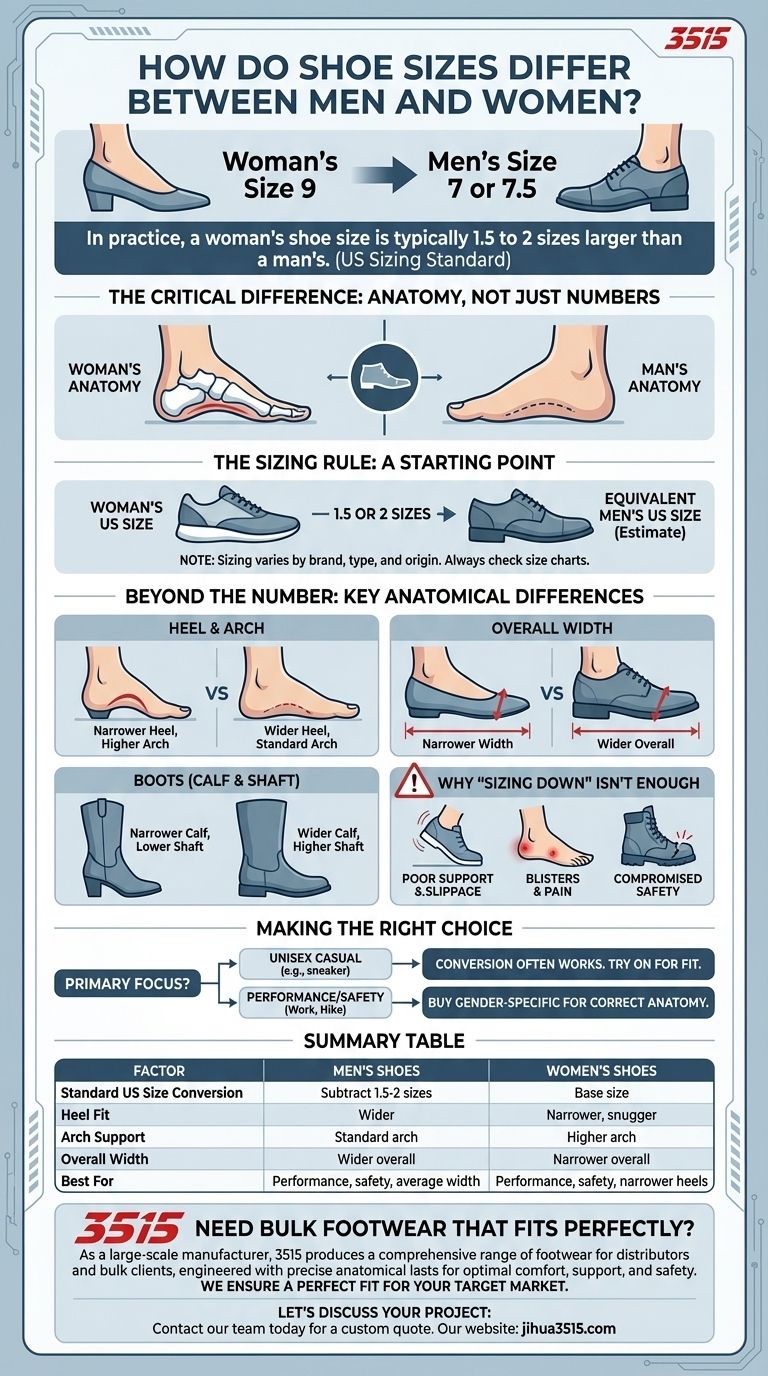
In practice, a woman's shoe size is typically 1.5 to 2 sizes larger than a man's. For example, a woman who wears a size 9 would likely fit into a men's size 7 or 7.5. This conversion is the most common industry standard for US sizing and serves as a reliable starting point.
The critical difference between men's and women's footwear is not the size number, but the anatomy. Men's shoes are built on a fundamentally different last (the foot-shaped model used for construction), impacting width, arch, and heel fit.
The Sizing Rule: A Starting Point, Not a Guarantee
Relying solely on the size number conversion can lead to a poor fit. It’s essential to understand what the numbers represent and why they are only part of the story.
The Standard Conversion Rule
The most widely accepted conversion is to subtract 1.5 or 2 sizes from a woman's US size to get the equivalent men's US size. For instance, a women's 8.5 is roughly a men's 7.
This rule exists because the numbering systems are scaled differently based on historical manufacturing standards for different average foot shapes.
Why It's Only an Estimate
This conversion is a general guideline, not a universal law. Sizing can vary between brands, shoe types (e.g., athletic vs. dress shoe), and country of origin. Always refer to a specific brand's size chart if possible.
Beyond the Number: Key Anatomical Differences
The true distinction lies in the shape and dimensions of the shoe, which are designed to accommodate the structural differences between the average man's and woman's foot.
Heel and Arch Shape
Women's feet typically have a narrower heel in proportion to the front of the foot. Women's shoes are designed to accommodate this, providing a snugger fit to prevent heel slippage.
Furthermore, women's footwear often incorporates a higher arch in the insole to provide better support and comfort.
Overall Foot Width
Men's shoes are generally wider overall. They are built with less variation in width from the heel to the toe area. A woman wearing a "sized-down" men's shoe may find it too roomy, especially in the heel and midfoot.
Calf and Shaft Fit (For Boots)
The difference is especially pronounced in boots. Women's boots, such as wellies or work boots, are designed with a narrower calf and a lower shaft to better match the average female leg shape.
Understanding the Trade-offs: Why "Sizing Down" Isn't Enough
Choosing a shoe from the other gender's category can work for some, but it comes with potential downsides, especially in performance or safety footwear.
The Risk of Poor Support
Simply wearing a smaller men's shoe can lead to significant fit issues. The wider heel can cause slippage and instability, while the mismatched arch can lead to arch pain and fatigue over time.
The Problem with Blisters and Pain
An improper fit is the primary cause of blisters. If a shoe is too wide, the foot can slide internally, creating friction. This constant rubbing, especially in the heel or toe area, is a recipe for discomfort.
Compromised Safety in Technical Footwear
For work boots or hiking boots, a precise fit is a matter of safety. A loose boot offers insufficient protection and can increase the risk of an ankle roll. Safety features like steel toes may not align correctly if the shoe's proportions are wrong for your foot.
Making the Right Choice for Your Foot
Your goal determines how strictly you should adhere to gender-specific sizing. Use this framework to guide your decision.
- If your primary focus is a unisex casual style (like a sneaker): Using the 1.5-size conversion is often successful, but prioritize trying the shoe on to check for excessive width or heel slippage.
- If your primary focus is performance or safety (work, hiking, athletics): You should almost always buy footwear designed for your gender to ensure correct anatomical support and protection.
- If you have wider or narrower feet than average: You may find a better fit by exploring options across categories, but focus on the shoe's actual fit, not the size number on the box.
Ultimately, the best shoe is the one that fits your unique foot anatomy, providing comfort and support where you need it most.
Summary Table:
| Factor | Men's Shoes | Women's Shoes |
|---|---|---|
| Standard US Size Conversion | Subtract 1.5-2 sizes from women's | Base size |
| Heel Fit | Wider | Narrower, snugger fit |
| Arch Support | Standard arch | Higher arch |
| Overall Width | Wider overall | Narrower overall |
| Best For | Performance, safety, average width | Performance, safety, narrower heels |
Need Bulk Footwear That Fits Perfectly?
As a large-scale manufacturer, 3515 produces a comprehensive range of footwear for distributors, brand owners, and bulk clients. Our production capabilities encompass all types of shoes and boots, engineered with precise anatomical lasts for optimal comfort, support, and safety.
We ensure a perfect fit for your target market. Whether you need men's, women's, or unisex styles, our expertise in foot anatomy and manufacturing guarantees superior quality and customer satisfaction.
Let's discuss your project: Contact our team today for a custom quote and discover how we can be your trusted manufacturing partner.
Visual Guide
Related Products
- Wholesale Durable Camouflage Canvas Shoes with High-Traction Cleated Rubber Sole
- Wholesale Modern Perforated Leather Derby Shoes with Chunky Sole for Custom Branding
- Wholesale Breathable Training Shoes Custom Athletic Footwear Manufacturer
- Wholesale Breathable Perforated Leather Derby Shoes with Modern Comfort Sole
- Wholesale Durable & Breathable Training Shoes for Custom Brands
People Also Ask
- Why is the selection of high-strength fabric materials necessary in the production of canvas shoes and training shoes?
- What are the properties of canvas as a shoe material? A Guide to Lightweight Comfort & Style
- Can canvas shoes be worn in rainy conditions? The Truth About Water Resistance
- What are some examples of vulcanized shoes? Discover the Flexibility and Board Feel of Classic Sneakers
- What are the characteristics of canvas as a shoe material? A Guide to Lightweight, Breathable Footwear