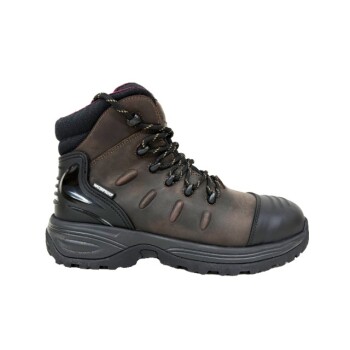
According to the salesperson's explanation, membrane-based boots work by allowing moisture from your foot to pass through a special membrane into a space between it and the outer shell. The boot then supposedly dries by having that same moisture flow back through the membrane and into the open air after you take the boot off.
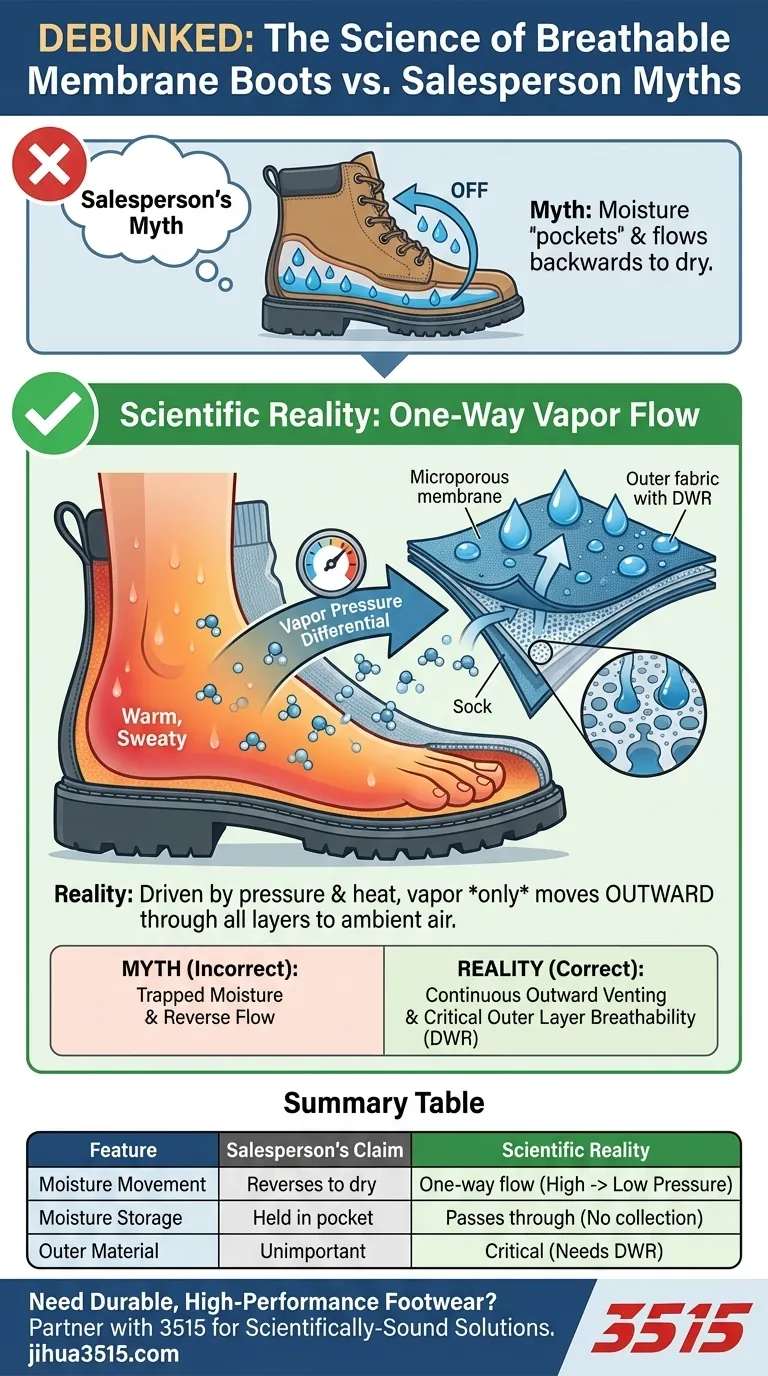
The core principle of a breathable membrane is that moisture must always move outward, away from your foot, driven by heat and vapor pressure. The salesperson's explanation of moisture collection and reverse-flow drying is fundamentally incorrect and misunderstands the physics involved.
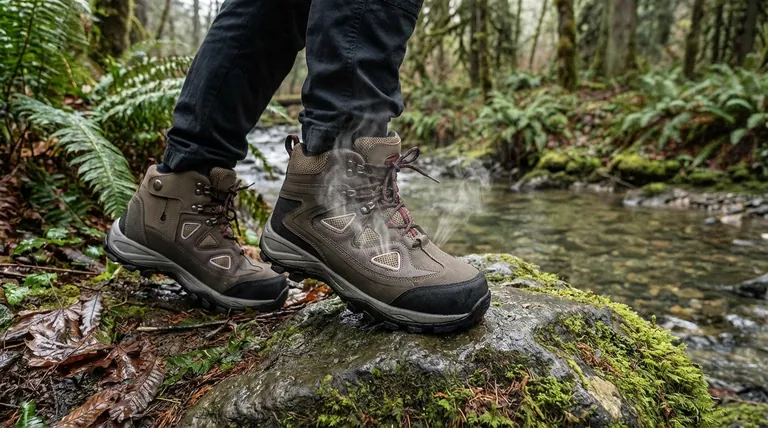
How Breathable Membranes Actually Work
To make an informed decision, it's crucial to understand the scientific principles that allow a boot to be both waterproof and breathable. The process is a one-way street for water vapor, not a holding tank.
The Core Principle: A Difference in Pressure
Your warm, sweaty foot creates a high-humidity, high-pressure microclimate inside your boot. The air outside is typically cooler and has lower humidity and pressure.
This difference, known as a vapor pressure differential, is the engine that drives the entire system. Water vapor naturally moves from an area of high concentration (inside the boot) to an area of low concentration (outside).
The Membrane as a Gatekeeper
The waterproof-breathable membrane, like those made by Gore-Tex, is an advanced material filled with microscopic pores.
These pores are about 20,000 times smaller than a water droplet, making them impenetrable to liquid water like rain or puddles. However, they are about 700 times larger than an individual water vapor molecule, allowing sweat to escape.
The Complete Moisture Pathway
For the system to function, every layer must work together. Moisture must travel from your foot to the outside air without being blocked.
The path is: Foot -> Sock -> Membrane -> Outer Fabric -> Atmosphere. If any layer in this chain is not breathable, the entire system fails.
Debunking the Salesperson's Claims
The explanation you received contains several critical inaccuracies that can lead to a poor understanding of the technology and potential dissatisfaction with your purchase.
The Myth of the "Intermediate Pocket"
There is no special "pocket" designed to hold moisture. The space between the membrane and the outer material is simply part of the boot's construction. Moisture passes through this space; it does not collect there to wait for the boot to be removed.
Why Moisture Doesn't Flow "Backwards"
Physics dictates that moisture vapor will not flow back through the membrane into a now-empty boot to dry it. The boot dries because the trapped moisture continues its journey outward into the ambient air, a process that happens whether the boot is on or off your foot.
The Critical Impact of the Outer Material
The claim that the outer material doesn't affect breathability is the most significant error. The outer fabric is typically treated with a Durable Water Repellent (DWR) finish that causes water to bead up and roll off.
When this DWR wears off, the outer fabric can become saturated with water, a state known as "wetting out." A waterlogged outer layer is no longer breathable and effectively suffocates the membrane, trapping your sweat inside and making your foot feel wet and clammy, even if no external water has leaked in.
Understanding the Trade-offs
No technology is perfect, and understanding the limitations of waterproof-breathable membranes is key to choosing the right boot.
Waterproofing vs. Breathability
There is an inherent trade-off between being fully waterproof and fully breathable. A rubber Wellington boot is 100% waterproof but has zero breathability. A mesh running shoe is highly breathable but offers no water protection.
Membrane-based boots are a sophisticated compromise, aiming to provide the best possible balance of both properties.
Environmental Conditions Matter
The effectiveness of a membrane is highly dependent on the external environment. In cool, dry conditions, the vapor pressure difference is large, and the boots feel exceptionally breathable.
In hot, humid conditions, the outside air is already saturated with moisture. This reduces the pressure differential, slowing down the transfer of vapor and making any membrane boot feel less breathable.
Making the Right Choice for Your Needs
By understanding the true mechanism, you can ignore misleading sales pitches and select footwear that genuinely matches your intended use.
- If your primary focus is maximum breathability for hot, dry conditions: Choose non-membrane boots with mesh panels or highly breathable uppers.
- If your primary focus is guaranteed waterproofing for wet, cool climates: A membrane boot is the correct choice, but pay close attention to the quality of the outer fabric and be prepared to re-apply DWR treatments.
- If your primary focus is all-weather versatility: A membrane boot is a strong contender, but accept that its breathability will be limited in very warm and humid weather.
Armed with an accurate understanding of how the technology works, you are now empowered to choose the right tool for the job.
Summary Table:
| Feature | Salesperson's Claim | Scientific Reality |
|---|---|---|
| Moisture Movement | Collects and reverses to dry | One-way flow from high to low pressure |
| Moisture Storage | Held in a special pocket | No collection; passes through layers |
| Outer Material Role | Unimportant for breathability | Critical; must be breathable with DWR |
| Drying Process | Moisture flows back when boot is off | Moisture continues to vent outward |
Need Durable, High-Performance Footwear? Partner with 3515.
As a large-scale manufacturer, 3515 produces a comprehensive range of footwear for distributors, brand owners, and bulk clients. Our production capabilities encompass all types of shoes and boots, including advanced membrane-based models built on the correct scientific principles for optimal performance.
We ensure your customers get the right balance of waterproofing and breathability. Contact our experts today to discuss your specific needs and benefit from our manufacturing expertise.
Visual Guide
Related Products
- High Performance Fire-Retardant Waterproof Safety Boots
- Factory Direct Wholesale Rain Boots Durable Waterproof & Fully Customizable
- Premium Flame-Retardant Waterproof Safety Boots and Shoes
- Durable Waterproof Rain Boots | Custom Manufacturer for Wholesale & Brands
- Lightweight Breathable Sneakers with Wet-Traction Grip for Wholesale & Private Label
People Also Ask
- Why are waterproof safety boots recommended for certain work environments? Essential Protection for Wet & Hazardous Jobs
- What roles do 3D vision systems and industrial robots play in the manufacturing of fire safety boots? Smart Automation
- What is a drawback of waterproof boots? The Hidden Cost of Trapped Sweat and Heat
- What should you look for to ensure boots are fully waterproof? The Essential 2-Part System
- What is the difference between waterproof and water-resistant boots? Choose the Right Footwear for Any Condition