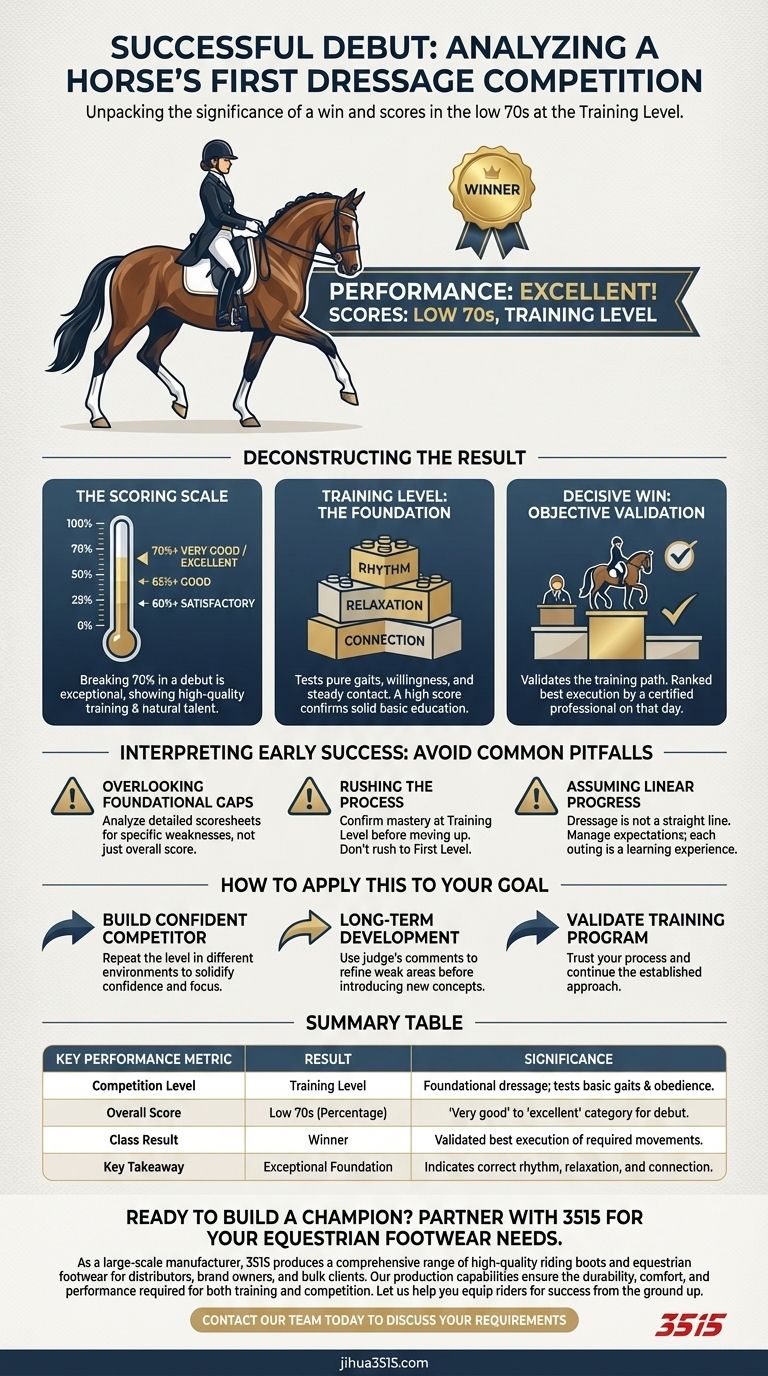
To put it directly, the horse's performance in its first dressage competition was excellent. The horse not only won its training level classes but did so with scores in the low 70s, which is a significant achievement for a debut performance.
A score in the low 70s at the Training Level is not just a win; it is a clear indicator of strong fundamentals and significant future potential. This result demonstrates a correct foundation in rhythm, relaxation, and connection, which are the building blocks of all future dressage work.

Deconstructing the Result: What This Performance Means
A win is straightforward, but the score provides a much deeper insight into the quality of the performance. Understanding the context of dressage scoring and levels is key to appreciating this achievement.
The Scoring Scale in Dressage
Dressage is scored on a percentage scale from 0% to 100%. A score above 60% is generally considered "satisfactory," and a score above 65% is "good."
Breaking the 70% barrier places a horse in the "very good" to "excellent" category. Achieving this in a horse's first-ever competition is exceptional and points to high-quality training and natural talent.
The Importance of the Training Level
The Training Level is the first and most fundamental level in dressage. Its purpose is to confirm that the horse demonstrates correct basics.
The tests at this level evaluate the purity of the gaits, the willingness to move forward, and a steady, elastic contact with the rider's hands. A high score here signifies that the horse's foundational education is solid.
Why a Decisive Win Matters
Winning a class means the judge ranked the horse's performance as the best execution of the required movements on that day.
Paired with a high score, this win isn't just a relative victory against the field; it is an objective validation from a certified professional that the horse is correctly on the path of its training.
Interpreting Early Success: Common Pitfalls to Avoid
Such a strong debut is exciting, but it's critical to interpret it correctly to ensure the horse's long-term development is not compromised. Perspective is essential.
Overlooking Foundational Gaps
A high overall score can sometimes mask lower marks on individual movements. It's crucial to analyze the detailed scoresheet to identify any specific areas—like a particular transition or circle—that may need more focus in training.
Rushing the Training Process
Success can create a temptation to quickly move up to the next level. This is often a mistake. True mastery at the Training Level must be confirmed before adding the more complex requirements of First Level.
Assuming Linear Progress
Dressage training is never a straight line of constant improvement. The next competition could have a different judge, a more distracting environment, or the horse could simply be having an off day. It is vital to manage expectations and view each outing as a learning experience, not a test of worth.
How to Apply This to Your Goal
This successful debut provides a clear mandate for the horse's future training. The next steps should be guided by your primary objective.
- If your primary focus is building a confident competitor: The key is to repeat the experience at the same level in different environments to solidify the horse's confidence and focus in the show ring.
- If your primary focus is long-term development: The key is to use the judge's detailed comments to refine the weaker aspects of the current work before methodically introducing the next level's concepts at home.
- If your primary focus is validating the training program: The key is to recognize this result as a strong confirmation of your approach and continue with the program, trusting the process you have in place.
This result is not an endpoint, but a powerful and promising start to a successful dressage career.
Summary Table:
| Key Performance Metric | Result | Significance |
|---|---|---|
| Competition Level | Training Level | The foundational level of dressage, testing basic gaits and obedience. |
| Overall Score | Low 70s (Percentage) | Places the performance in the 'very good' to 'excellent' category for a debut. |
| Class Result | Winner | Validated as the best execution of the required movements on the day. |
| Key Takeaway | Exceptional Foundation | Indicates correct rhythm, relaxation, and connection for future success. |
Ready to Build a Champion? Partner with 3515 for Your Equestrian Footwear Needs.
As a large-scale manufacturer, 3515 produces a comprehensive range of high-quality riding boots and equestrian footwear for distributors, brand owners, and bulk clients. Our production capabilities ensure the durability, comfort, and performance required for both training and competition. Let us help you equip riders for success from the ground up.
Contact our team today to discuss your specific requirements and discover how we can support your brand.
Visual Guide