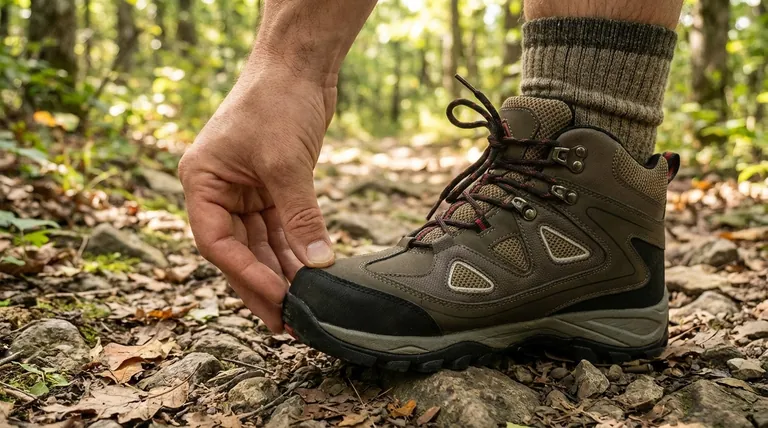
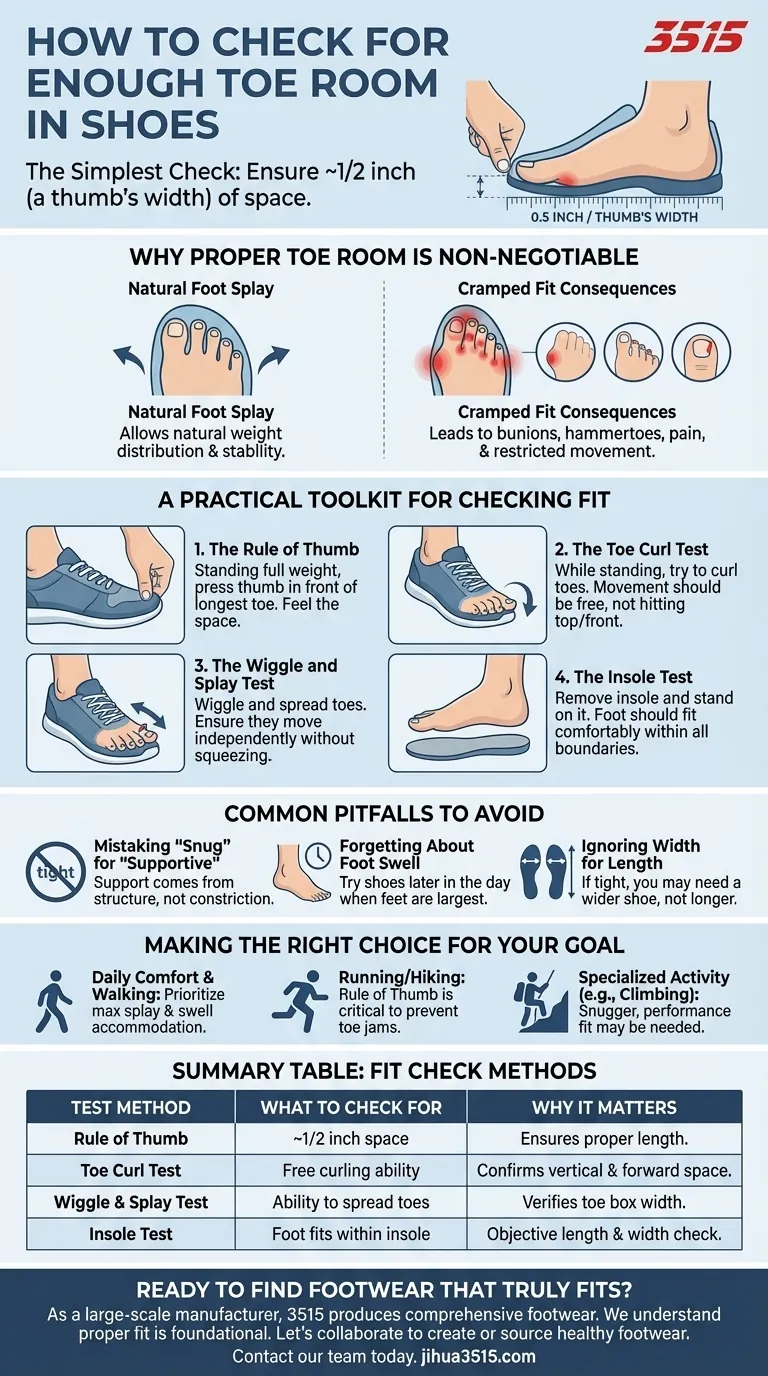
The simplest way to check for adequate toe room is to ensure there is about a half-inch (or a thumb's width) of space between your longest toe and the end of the shoe. While wearing the shoe, you should also be able to freely curl and spread your toes without them feeling cramped or hitting the top of the shoe.
The goal is not simply to avoid discomfort, but to allow for your foot's natural mechanics. Proper toe room permits essential movements like toe splay and flexion, which are critical for balance, shock absorption, and long-term foot health.
Why Proper Toe Room is Non-Negotiable
A shoe's toe box is more than just a cover for your toes; it's a crucial component for proper foot function. Ignoring the fit here can lead to significant issues over time.
The Principle of Natural Foot Splay
When you stand and walk, your toes naturally spread out, or "splay." This movement helps distribute your weight evenly and provides a stable base for balance.
A narrow or short toe box actively prevents this, forcing your toes into an unnatural, compressed position.
The Consequences of a Cramped Fit
Consistently wearing shoes with insufficient toe room can contribute to a range of painful conditions.
These include bunions, hammertoes, ingrown toenails, and general foot pain. The shoe is essentially molding your foot to its restrictive shape, rather than accommodating its natural form.
A Practical Toolkit for Checking Fit
Relying on a single test isn't enough. Use this combination of methods to get a complete picture of the fit, preferably at the end of the day when your feet are slightly swollen.
The Rule of Thumb
This is the classic test for length. While standing with your full weight in the shoe, press your thumb down on the material just in front of your longest toe (which may be your second toe).
You should feel a space roughly the width of your thumb between your toe and the shoe's end.
The Toe Curl Test
This simple test checks for vertical and forward space. Sit or stand and try to curl your toes downward, as if gripping the floor.
If your toes immediately press against the top or front of the shoe, it's too small. You should be able to perform this motion freely.
The Wiggle and Splay Test
Beyond curling, you need room to spread. Try to wiggle and spread your toes apart inside the shoe.
You should feel them move independently without being squeezed together by the sides of the toe box.
The Insole Test
For the most objective assessment, remove the insole from the shoe and stand on it.
Your foot should fit comfortably within the boundaries of the insole. If your toes or the sides of your foot hang over the edge, the shoe is definitively too narrow or short for you, regardless of the size on the label.
Common Pitfalls to Avoid
Choosing the right shoe involves sidestepping a few common misconceptions about what constitutes a good fit.
Mistaking "Snug" for "Supportive"
Many people buy shoes that are too tight, believing that a snug feel equates to better support.
True support comes from the shoe's structure (like the arch and heel counter), not from constricting your foot. Your toes need freedom to move.
Forgetting About Foot Swell
Feet naturally swell throughout the day due to activity and gravity.
Always try on shoes in the afternoon or evening to ensure they will still be comfortable when your feet are at their largest.
Ignoring Width for Length
Shoe size is two-dimensional: length and width. Focusing only on the number (the length) is a primary cause of poor fit.
If a shoe feels tight on the sides but has enough length, you likely need a wider version of that size, not a longer one.
Making the Right Choice for Your Goal
How you apply these tests depends on what you need the shoe to do.
- If your primary focus is daily comfort and walking: Prioritize a generous toe box that allows for maximum splay and accommodates foot swell throughout the day.
- If your primary focus is running or hiking: The rule of thumb is critical to prevent your toes from slamming into the front of the shoe, especially on downhills.
- If your primary focus is a specialized activity like rock climbing: You may need a much snugger, performance-oriented fit, but this is an exception for technical purposes, not a rule for general foot health.
Ultimately, ensuring proper toe room is a fundamental step in protecting your long-term foot health and comfort.
Summary Table:
| Test Method | What to Check For | Why It Matters |
|---|---|---|
| Rule of Thumb | ~1/2 inch of space in front of longest toe | Ensures proper length and prevents toe jamming |
| Toe Curl Test | Ability to freely curl toes downward | Confirms adequate vertical and forward space |
| Wiggle & Splay Test | Ability to wiggle and spread toes apart | Verifies the toe box is wide enough for natural movement |
| Insole Test | Foot fits within the insole's boundaries | Provides an objective check for both length and width |
Ready to find footwear that truly fits?
As a large-scale manufacturer, 3515 produces a comprehensive range of footwear for distributors, brand owners, and bulk clients. We understand that proper fit is the foundation of comfort and foot health. Our production capabilities encompass all types of shoes and boots, designed with the precise dimensions and quality construction your customers need.
Let's collaborate to create or source footwear that supports healthy feet. Contact our team today to discuss your requirements.
Visual Guide
Related Products
- Wholesale Durable Camouflage Canvas Shoes with High-Traction Cleated Rubber Sole
- Wholesale Modern Perforated Leather Derby Shoes with Chunky Sole for Custom Branding
- Wholesale Breathable Training Shoes Custom Athletic Footwear Manufacturer
- Wholesale Breathable Perforated Leather Derby Shoes with Modern Comfort Sole
- Wholesale Durable & Breathable Training Shoes for Custom Brands
People Also Ask
- Why is the selection of high-strength fabric materials necessary in the production of canvas shoes and training shoes?
- What are the properties of canvas as a shoe material? A Guide to Lightweight Comfort & Style
- Can canvas shoes be worn in rainy conditions? The Truth About Water Resistance
- What are some examples of vulcanized shoes? Discover the Flexibility and Board Feel of Classic Sneakers
- What are the characteristics of canvas as a shoe material? A Guide to Lightweight, Breathable Footwear