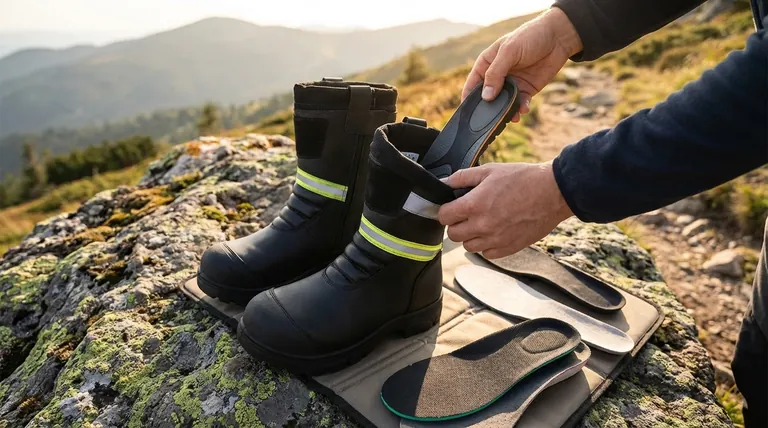
Insoles are the most effective tool for fine-tuning the fit of your hiking boots. They allow you to strategically reduce the internal volume of the boot, providing a more secure, customized fit. This is achieved by either replacing the flimsy stock insoles with more substantial aftermarket ones or by layering thin insoles underneath the primary one to take up excess space.
A perfect "out-of-the-box" boot fit is nearly impossible because every foot is unique and changes shape during a hike. Insoles transform your boot from a static container into an adjustable system, giving you the power to create a precise fit for your specific needs.
Why a Perfect Initial Fit is a Myth
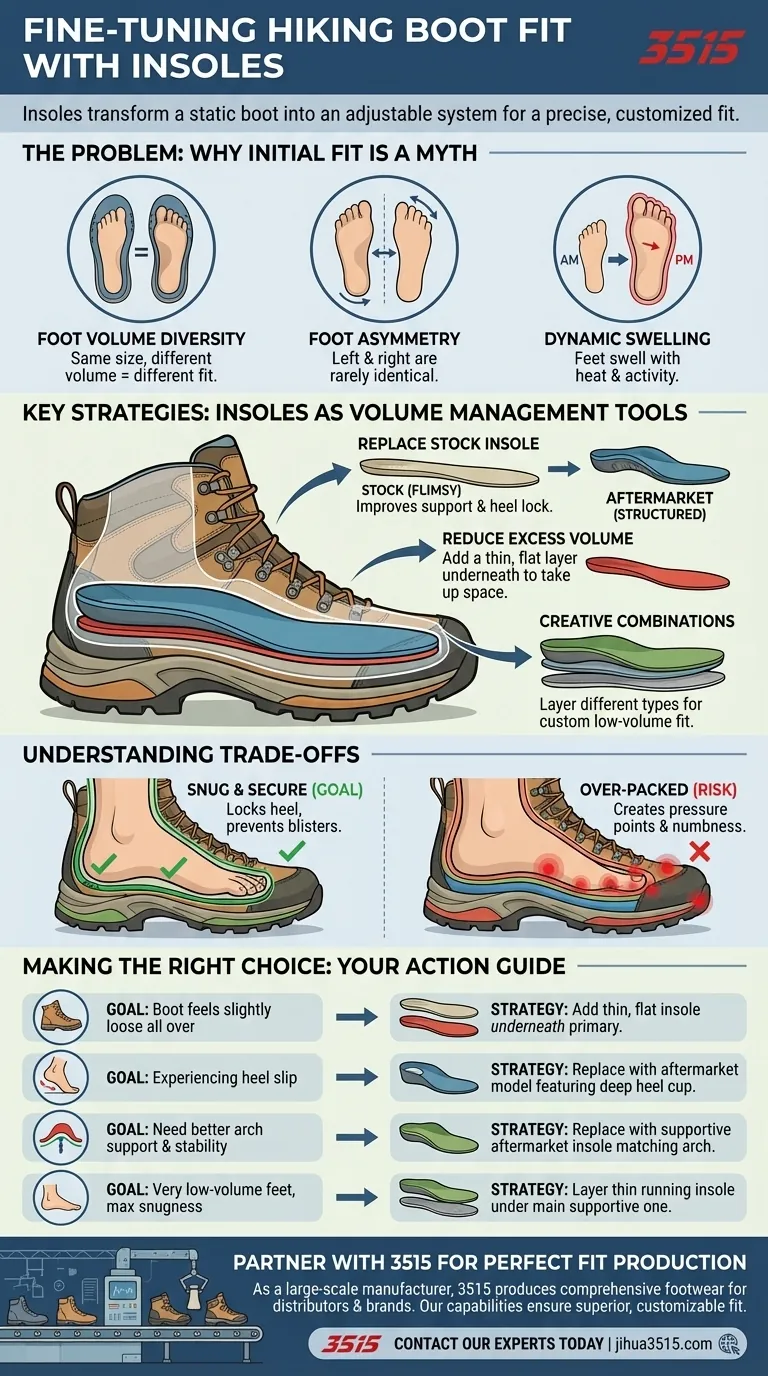
The Problem of Foot Volume
A boot's size reflects its length, but the critical factor for comfort is volume. Two people can wear the same size boot, but if one has a low-volume (thin) foot and the other has a high-volume (thick) foot, their experience will be completely different.
Insoles are primarily a volume management tool.
Your Feet Are Not Identical
Almost everyone has slight differences between their left and right feet. A boot that feels perfect on one foot may feel loose on the other.
This asymmetry is normal, and insoles allow you to make micro-adjustments for each specific foot.
The Dynamic Nature of Hiking
Your feet swell and expand from heat and activity throughout a day of hiking. A boot that felt perfectly snug in the morning can become painfully tight by the afternoon.
Because no static boot shape can account for this, an adjustable insole system is the key to all-day comfort.
Key Strategies for Using Insoles
Strategy 1: Replace the Stock Insole
The insoles that come with most boots are simple foam placeholders with little to no structure.
Replacing them with a high-quality aftermarket insole (like those from Superfeet, SOLE, or Oboz) is the most common upgrade. These provide superior arch support and a structured heel cup, which can fundamentally change how your foot sits in the boot, often locking your heel in place and solving issues like heel lift.
Strategy 2: Reduce Excess Volume
If your boot feels generally loose and your foot is sliding around, the goal is to reduce the overall internal volume.
The best method is to place a thin, flat insole underneath your primary insole (either the stock one or an aftermarket one). This uniformly raises your foot, creating a snugger fit throughout the entire boot without altering the supportive shape of your main insole.
Strategy 3: Creative Combinations
For a truly customized fit, you can mix and match insoles. A common technique for very low-volume feet is to use a thin insole from a running shoe.
By layering a flexible running shoe insole with a thicker, more supportive hiking insole, you can significantly reduce volume while maintaining proper support.
Understanding the Trade-offs
The Risk of Over-Packing
The goal is a snug, secure fit, not a constricted one. Adding too much volume-reducing material can create pressure points, cut off circulation, and cause numbness in your toes.
If your foot feels squeezed from the sides or top, you have added too much.
Changing Your Foot's Position
Adding insoles raises your foot, especially the heel, higher inside the boot. This is often beneficial, as it helps lock your heel into the back of the boot to prevent blisters.
However, it can also create new pressure points, particularly on the top of your foot (the instep), if the boot lacks sufficient vertical space.
Making the Right Choice for Your Goal
To solve your specific fit problem, you must apply the right insole strategy.
- If your boot feels slightly loose all over: Add a thin, flat insole underneath your primary insole to uniformly reduce volume.
- If you experience heel slip but the front feels okay: Replace the stock insole with an aftermarket model that has a deep, structured heel cup to lock your heel in place.
- If you need better arch support and stability: Discard the stock insole entirely and replace it with a supportive aftermarket insole that matches your arch profile.
- If you have very low-volume feet and need maximum snugness: Layer a thin running shoe insole underneath your main supportive insole to take up the most space.
By treating your insoles as an adjustable system, you gain complete control over your comfort and performance on the trail.
Summary Table:
| Goal | Recommended Insole Strategy |
|---|---|
| Boot feels slightly loose all over | Add a thin, flat insole underneath the primary insole |
| Experiencing heel slip | Replace stock insole with an aftermarket model featuring a deep heel cup |
| Need better arch support & stability | Replace stock insole with a supportive aftermarket insole |
| Very low-volume feet needing maximum snugness | Layer a thin running shoe insole underneath the main supportive insole |
Ready to manufacture perfectly fitting hiking boots for your customers?
As a large-scale manufacturer, 3515 produces a comprehensive range of footwear for distributors, brand owners, and bulk clients. Our production capabilities encompass all types of shoes and boots, ensuring you can offer the superior, customizable fit your market demands.
Contact our experts today to discuss your production needs and how we can help you deliver unmatched comfort and performance.
Visual Guide
Related Products
- Wholesale High-Traction Camo Boots - Custom Manufacturer for Brands
- Durable Rubber Sole Outdoor Shoes Wholesale & Custom Manufacturing
- Durable Spiked Camouflage Boots Wholesale & Factory Production
- Wholesale Lightweight Tactical Boots Custom Manufacturer for Desert & Combat Use
- Durable Goodyear Welt Leather Work Boots for Wholesale & Private Label
People Also Ask
- What are the key features of the new line of camo boots? Built for Extreme Cold & Rugged Terrain
- Are camo boots necessary for hunting success? Prioritize Performance Over Pattern
- What is the technical logic behind using closed-eye testing for tactical boots? Unlocking Peak Footwear Stability
- How does the Rank Score Test identify the primary causes of premature failure in tactical and work boots? Key Insights
- What shoes to wear for a security job? Durable, Protective Footwear for Long Shifts