A Tale of Two Boots
Imagine a construction site manager stopping a new hire. The worker is wearing a pair of rugged-looking boots from a discount store. They look the part—thick soles, heavy leather, a bulky toe. They seem safe.
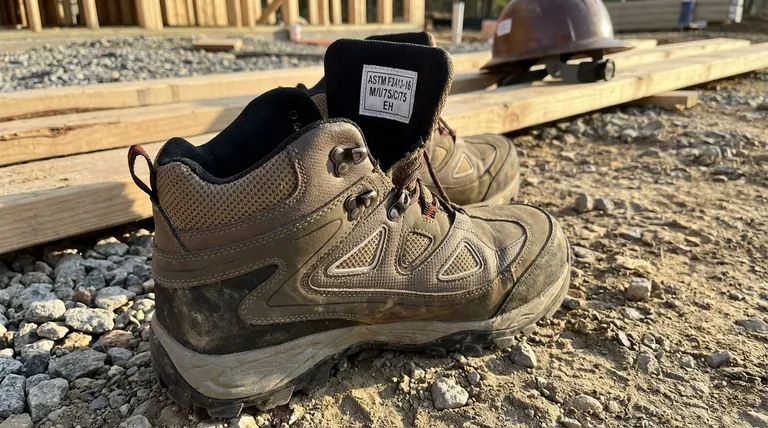
The manager asks a simple question: "Can I see the tag inside the tongue?"
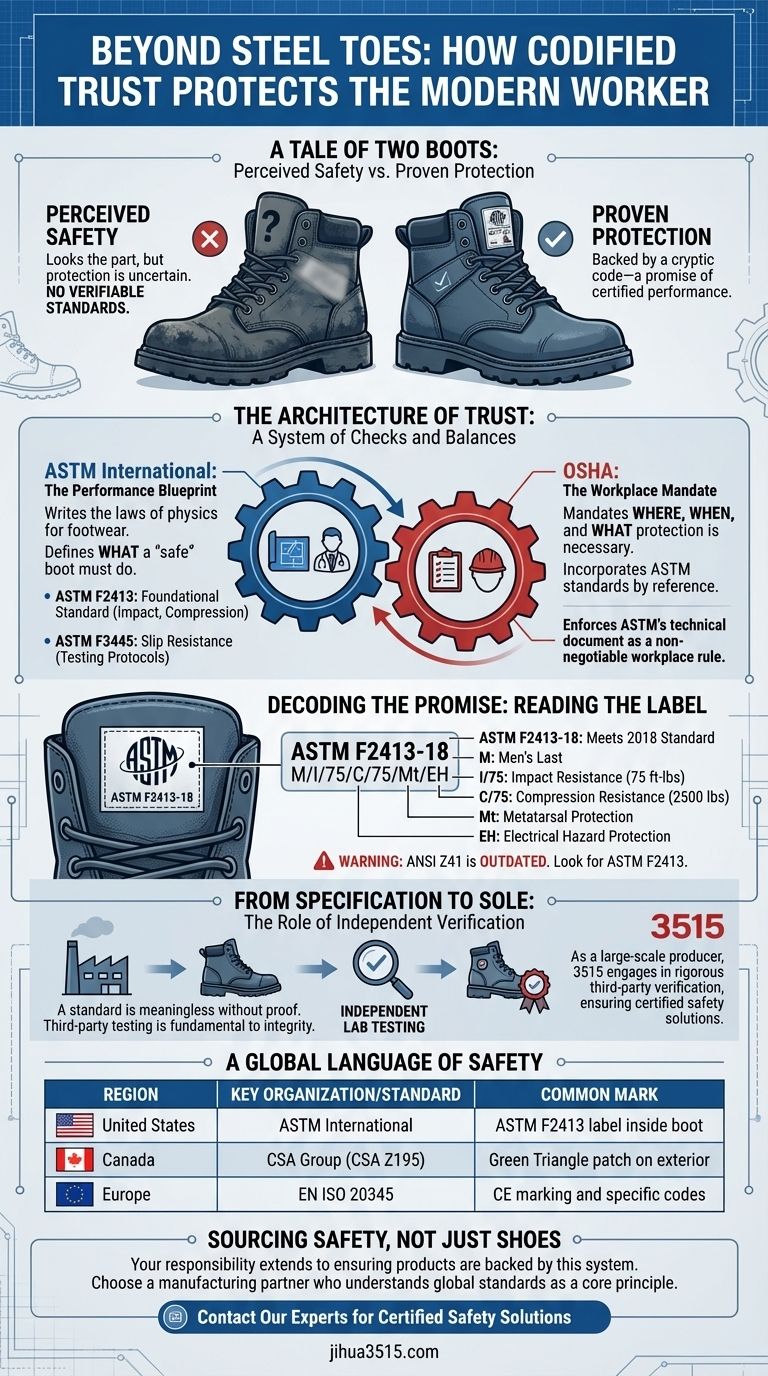
This small act is the critical juncture between perceived safety and proven protection. One boot has a cryptic line of code sewn inside; the other is blank. In that moment, one is a tool, the other a liability. The real protection in a work boot comes not from the leather or steel alone, but from the invisible system of standards that guarantees its performance under pressure.
The Architecture of Trust: A System of Checks and Balances
We place immense trust in our personal protective equipment. We trust a safety boot to shield our foot from a dropped power tool or a rolling cart. But this trust isn't blind faith in a brand. It's faith in a system.
In the United States, this system is a powerful partnership between two key organizations: ASTM International and OSHA. Think of them as the legislative and executive branches of workplace safety.
ASTM: The Performance Blueprint
ASTM International writes the laws of physics for footwear. They don't make boots; they create the consensus-based technical standards that define what a "safe" boot must be able to do.
- ASTM F2413: This is the foundational standard. It specifies the minimum performance requirements for protective footwear, covering everything from impact resistance (from falling objects) to compression resistance (from rolling objects).
- ASTM F3445: This standard is hyper-focused on one of the most common causes of workplace injury: slips and falls. It defines the testing protocols for slip resistance.
ASTM sets the benchmarks. They define, in excruciating detail, how to test a boot and what it must withstand.
OSHA: The Workplace Mandate
The Occupational Safety and Health Administration (OSHA) is the enforcer. They don't write the technical specifications, but they survey the landscape of the American workplace and mandate where, when, and what kind of protection is necessary.
Crucially, OSHA's regulations incorporate ASTM standards by reference. They require employers to provide footwear that meets the ASTM F2413 benchmark in any environment with a risk of foot injury. OSHA provides the context and the legal obligation, turning ASTM's technical document into a non-negotiable workplace rule.
Decoding the Promise: Reading the Label
A boot that conforms to this system carries its credentials with it. That cryptic line of code inside the tongue is a contract—a summary of the specific dangers it has been tested and certified to protect against.
The Anatomy of an ASTM Label
A typical label might read: ASTM F2413-18 M/I/75/C/75/Mt/EH.
This isn't just jargon; it's a resume.
- ASTM F2413-18: Meets the 2018 version of the performance standard.
- M: Made on a men's last (footwear mold).
- I/75: Withstands 75 foot-pounds of impact (the highest rating).
- C/75: Withstands 2,500 pounds of compression (the highest rating).
- Mt: Offers metatarsal protection for the top of the foot.
- EH: Protects against electrical hazards.
Understanding this code allows you to match the tool to the task precisely.
The Ghost of Standards Past
You might occasionally see a boot referencing an old ANSI Z41 standard. This is a red flag. The ANSI standard was withdrawn years ago and replaced by the more comprehensive ASTM F2413. A boot certified only to ANSI Z41 is built to an outdated promise.
From Specification to Sole: The Role of Independent Verification
A standard on paper is meaningless without proof. For a boot to be officially certified, it must be tested by an independent, third-party laboratory. This step is fundamental to the system's integrity. It removes bias and confirms that the product you hold actually performs as the standard demands.
This is where manufacturing expertise becomes paramount. As a large-scale producer of footwear, 3515 engages in this rigorous process for our clients. We don't just assemble boots; we manufacture certified safety solutions, ensuring each production run is validated against the exacting criteria of ASTM or other global standards. This commitment to third-party verification is what transforms a physical product into a reliable piece of protective equipment.
A Global Language of Safety
While the ASTM/OSHA system is dominant in the US, the principle of standardized, verifiable safety is global. For any brand owner, distributor, or multinational corporation, understanding the regional lexicon is key.
| Region | Key Organization / Standard | Common Mark |
|---|---|---|
| United States | ASTM International | ASTM F2413 label inside boot |
| Canada | CSA Group (CSA Z195) | Green Triangle patch on the boot's exterior |
| Europe | EN ISO 20345 | CE marking and specific rating codes |
Sourcing footwear requires not just meeting a price point, but meeting the correct standard for the intended market.
Sourcing Safety, Not Just Shoes
Ultimately, the choice of a safety boot is an investment in a system of trust. The markings on the boot are the visible evidence of an entire infrastructure of research, consensus, testing, and enforcement designed to prevent a catastrophic failure.
For distributors and brand owners, this means your responsibility extends to ensuring the products you provide are backed by this system. It requires a manufacturing partner who understands these global standards not as a checklist, but as a core principle of production.
Visual Guide
Related Products
- Premium Suede Sport Safety Shoes for Wholesale & Bulk Orders
- Premium Lightweight Safety Shoes for Wholesale & Bulk Orders
- Wholesale Anti-Smash & Puncture-Proof Safety Shoes Custom Manufacturing for Brands
- Premium KPU Injection Athletic Style Safety Shoes
- Premium Safety Shoes with Rotating Buckle Safety Sneakers
Related Articles
- The Ghost in the Machine: Why an Obsolete Footwear Standard Creates Modern Risk
- Beyond the Steel Toe: The Hidden Ergonomics of Workplace Safety
- Why Traditional Laces Are a Hidden Safety Risk—And What to Do About It
- The True Cost of Skipping Safety Shoes: Long-Term Risks and Smart Protection
- How Safety Shoe Engineering Prevents Workplace Injuries Across Industries