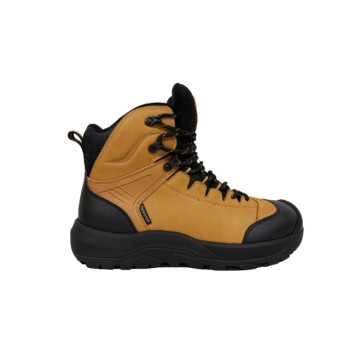
Including the thermal insulation (Clo value) of safety footwear is essential because these items act as a significant thermal barrier, hindering heat exchange between the worker's feet and the environment. By factoring in the Clo value, safety models can move beyond simple air temperature readings to accurately reflect the total heat load on the body, ensuring that the risk of heatstroke is not underestimated.
Safety footwear does more than protect against physical impact; its materials and structure actively trap heat. To prevent heatstroke in high-temperature environments, thermal models must factor in the footwear's Clo value to reflect the true physiological strain caused by hot asphalt and limited breathability.
The Unique Thermal Environment of Roadwork
The Discrepancy Between Air and Ground
Standard weather reports only tell half the story for road workers. In high-temperature environments, asphalt surface temperatures frequently rise significantly higher than the atmospheric temperature.
The Foot as a Heat Entry Point
Because workers are standing directly on this super-heated surface, their feet become a primary contact point for thermal energy. The ground acts as a massive radiator, directing heat upward into the body through the soles of the feet.
The Dual Role of Safety Footwear
Protection vs. Breathability
Safety footwear is a critical component of Personal Protective Equipment (PPE). It is engineered with robust materials and rigid structures designed to defend against physical hazards like crushing or punctures.
The Insulation Factor
However, these protective features come with a physiological cost: thermal insulation. The structure that stops a falling object also creates a barrier that hinders heat exchange. This traps heat generated by the foot and blocks the dissipation of heat absorbed from the hot asphalt.
Why the Clo Value is Critical for Modeling
Quantifying the Barrier
The Clo value is the metric used to quantify the insulating ability of clothing and footwear. It provides a specific number representing how much a shoe resists heat loss and limits breathability.
Calculating Total Body Heat Load
To predict heatstroke risk accurately, you cannot view the worker as simply "standing in hot air." You must account for the specific equipment they wear.
Incorporating the Clo value allows thermal models to calculate the total body heat load. This ensures the assessment reflects the reality of insufficient breathability and excessive heat retention inside the boot.
The Risks of Incomplete Data
The Danger of Underestimation
If an assessment ignores the Clo value of footwear, it inherently assumes the feet are cooling efficiently. In reality, the feet may be overheating significantly.
False Security
This omission creates a false sense of security. A safety manager might deem an environment "safe" based on air temperature, while the worker is experiencing dangerous levels of thermal stress due to heat accumulation at the ground level.
Implementing Accurate Safety Assessments
To protect road workers effectively, you must treat footwear as a variable in your thermal equation, not just a static piece of uniform.
- If your primary focus is accurate risk modeling: Ensure your thermal assessment software or calculations include the specific Clo value of the footwear currently in use, rather than generic clothing estimates.
- If your primary focus is heatstroke prevention: Monitor the difference between asphalt temperature and air temperature; as the gap widens, the importance of low-insulation (low Clo) footwear increases.
True safety relies on data that reflects the worker's complete reality, from the heat of the sun down to the insulation of their boots.
Summary Table:
| Factor | Impact on Road Workers | Why it Matters |
|---|---|---|
| Asphalt Temperature | Often 20-30°C higher than air | Direct heat source for the feet |
| Clo Value | Measures thermal insulation | Quantifies heat trapping in safety boots |
| Breathability | Reduced by PPE materials | Increases physiological heat stress |
| Heatstroke Risk | Underestimated without Clo data | Essential for accurate safety assessments |
Partner with 3515 for Advanced Safety Footwear Solutions
As a premier large-scale manufacturer serving global distributors and brand owners, 3515 delivers high-performance footwear engineered for the most demanding environments. Our flagship Safety Shoes series balances rigorous physical protection with thermal management, ensuring your workforce remains safe and comfortable even on extreme asphalt surfaces.
From tactical and work boots to outdoor, training, and formal dress shoes, our comprehensive production capabilities meet diverse bulk requirements with precision. Contact us today to learn how our technical expertise can add value to your product portfolio and protect your target customers.
References
- Hankyung Lee, Chaeyeon Yi. Estimation of Perceived Temperature of Road Workers Using Radiation and Meteorological Observation Data. DOI: 10.3390/rs15041065
This article is also based on technical information from 3515 Knowledge Base .
Related Products
People Also Ask
- What are the recommended insulation ratings for mild winter conditions? A Guide for Active & Stationary Workers
- How does insulation thickness correlate with temperature ranges? A Guide to Choosing the Right Warmth
- What insulation level is needed for severe cold and stationary work? 1200g or Higher is Essential
- What safety advantages do insulated boots offer beyond warmth? Dielectric Protection & Superior Grip
- How does fleece lining contribute to the warmth of insulated boots? Trapping Air for Superior Cold Protection