
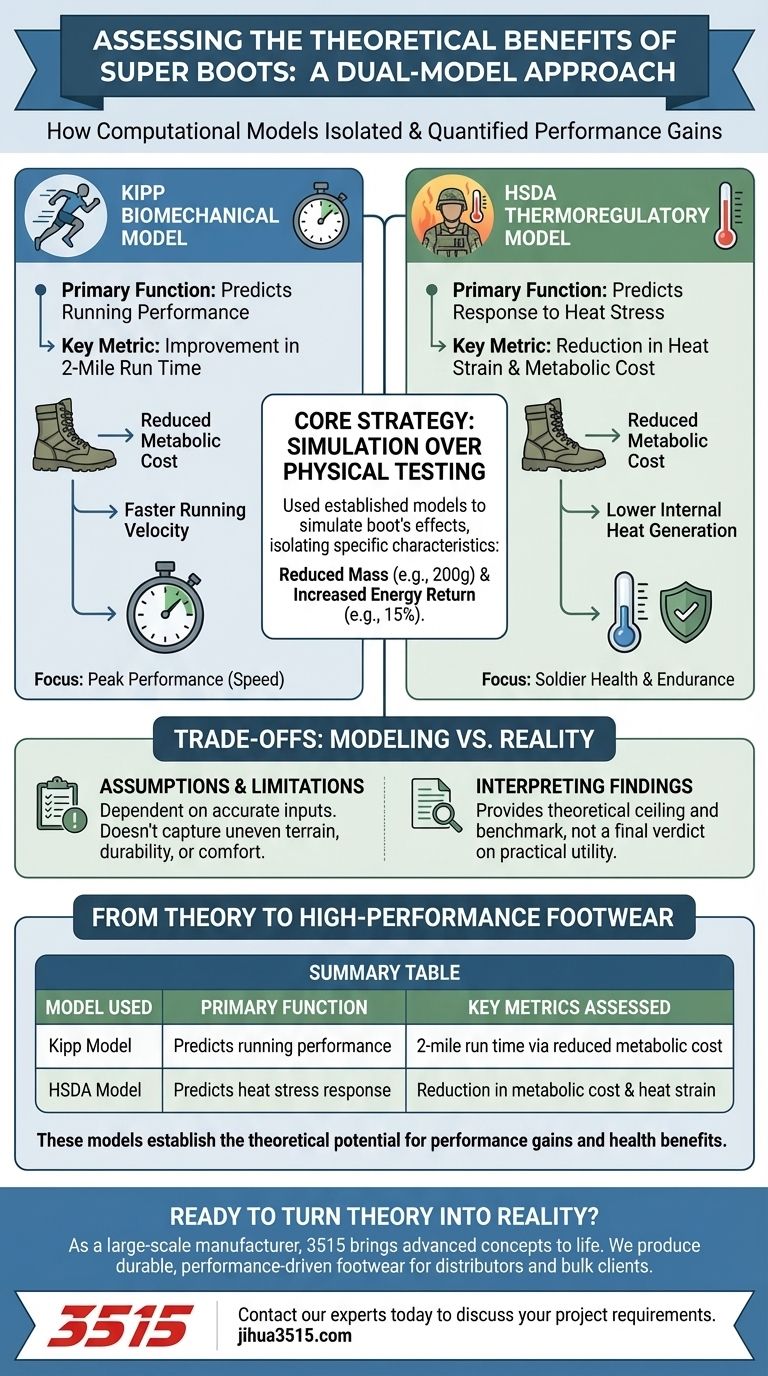
To assess the theoretical benefits of "super boots", researchers primarily relied on two specific computational models. They used a biomechanical model developed by Kipp and colleagues to predict improvements in running performance, specifically for a 2-mile run, and the Heat Strain Decision Aid (HSDA) thermoregulatory model to evaluate reductions in metabolic cost and heat strain.
The core strategy was not to physically test a new boot, but to use established biomechanical and thermoregulatory models to simulate its effects. This approach allowed researchers to isolate and quantify the theoretical benefits of specific boot characteristics—namely reduced mass and increased energy return—on soldier performance.
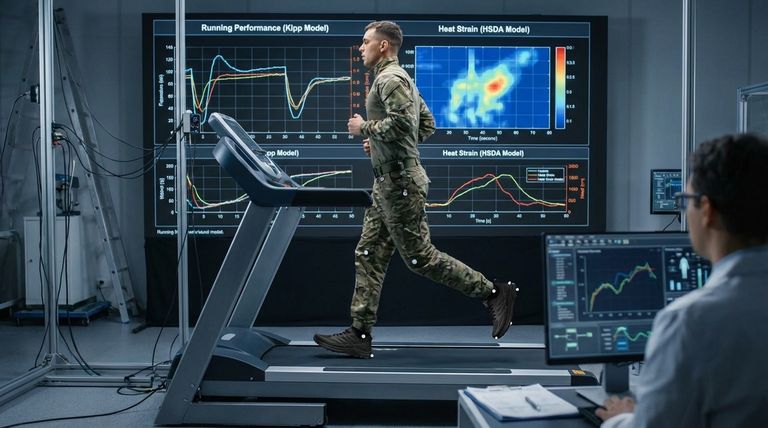
Deconstructing the Modeling Approach
To understand the study's conclusions, it's essential to understand the function of each model. These were not arbitrary choices; each was selected to answer a specific physiological or performance question relevant to military personnel.
The Kipp Model: Predicting Running Performance
The model developed by Kipp and colleagues is a biomechanical simulation designed to predict running performance. Its primary function is to translate changes in physiological inputs into tangible outcomes, like a faster run time.
The researchers used this model to simulate the impact of the super boot's two key features on a 2-mile run. This distance is a standard measure of aerobic fitness in military contexts, making the simulation directly relevant.
The model calculates how changes in factors like metabolic cost (the energy required to run) translate into changes in running velocity. By inputting the boot's theoretical energy savings, the model could forecast a specific improvement in the 2-mile run time.
The HSDA Model: Gauging Metabolic and Heat Strain
The Heat Strain Decision Aid (HSDA) is a thermoregulatory model. Its purpose is to predict how the human body will respond to heat stress, which is a critical concern for soldiers operating under load in various environments.
While running performance is one benefit, reduced metabolic cost has other crucial implications. Less energy expenditure means less internal heat is generated by the body's muscles.
The HSDA model was used to quantify this secondary benefit. By simulating the metabolic savings provided by the super boot, researchers could determine the corresponding reduction in heat strain, which translates to a lower risk of heat-related injuries and sustained performance over longer durations.
Understanding the Trade-offs of a Modeling-Only Approach
Using established models provides a powerful way to isolate variables and predict outcomes without costly and time-consuming physical trials. However, this theoretical approach has inherent limitations.
Assumption vs. Reality
Models operate on a set of assumptions. The predicted benefits are entirely dependent on the accuracy of the inputs—in this case, the assumed 200-gram mass reduction and 15% increase in energy return.
If a real-world boot fails to achieve these precise specifications, or if other factors like cushioning, fit, or stability negatively impact a soldier's gait, the actual performance benefits could be significantly different from the simulated ones.
The Limits of Simulation
A simulation cannot capture the full spectrum of real-world use. Factors like uneven terrain, durability, and soldier comfort are not accounted for in these specific models but play a massive role in the overall effectiveness and adoption of any new equipment.
The models provide a best-case scenario under controlled conditions, which serves as a valuable benchmark but not a final verdict on the boot's practical utility.
How to Interpret These Findings
The use of these two distinct models provides a focused, theoretical framework for evaluating the potential of new footwear technology. The key is to use the results for their intended purpose.
- If your primary focus is peak performance: The Kipp model provides a clear, quantitative estimate of how specific energy savings can directly improve speed over a set distance.
- If your primary focus is soldier health and endurance: The HSDA model demonstrates that the benefits extend beyond speed, potentially reducing heat strain and increasing operational readiness.
Ultimately, this modeling-based assessment serves as a critical first step, establishing the theoretical ceiling for performance gains and justifying further investment in physical prototype development and field testing.
Summary Table:
| Model Used | Primary Function | Key Metrics Assessed |
|---|---|---|
| Kipp Biomechanical Model | Predicts running performance | Improvement in 2-mile run time via reduced metabolic cost |
| HSDA Thermoregulatory Model | Predicts response to heat stress | Reduction in metabolic cost and heat strain for endurance |
Ready to Turn Theory into High-Performance Footwear?
The theoretical benefits of advanced footwear are clear. As a large-scale manufacturer, 3515 is equipped to bring these concepts to life. We produce a comprehensive range of durable, performance-driven footwear and boots for distributors, brand owners, and bulk clients. Our production capabilities encompass all types of shoes and boots, ensuring your designs meet the rigorous demands of the market.
Let's collaborate to develop the next generation of high-performance footwear. Contact our experts today to discuss your project requirements.
Visual Guide
Related Products
- Durable High-Ankle Tactical Boots for Wholesale & Custom Manufacturing
- High-Traction Suede Tactical Boots Wholesale & Custom Manufacturing
- Durable High-Ankle Tactical Boots Wholesale Manufacturer for Custom & Bulk Orders
- Wholesale Tactical Boots High-Traction & Reflective for Bulk & Brand Orders
- Premium Wholesale Tactical Style Safety Shoes Boots with Quick Lacing
People Also Ask
- How do tactical boots protect against injuries? Discover the Integrated Safety System
- How does additive manufacturing equipment reduce environmental risks? Sustainable Tactics for Modern Footwear Production
- How is the compatibility of polymer materials demonstrated in smart footwear? Enhancing Tactical & Training Performance
- What is the role of high-frequency acquisition hardware in technical skill analysis for outdoor and tactical boots?
- What are the main construction similarities between tactical boots and tactical sneakers? Built for Performance & Durability



















