At its core, the suitability of a hiker-style rubber outsole for work environments comes from its unique ability to blend aggressive, multi-terrain traction with specific industrial safety properties. It successfully adapts features from outdoor recreation for the demands of the modern workplace.
The key takeaway is that hiker-style outsoles are not just about grip on a trail; they provide a versatile platform that excels in work environments with unpredictable surfaces, from wet factory floors to muddy outdoor sites.
The Core Attributes of Hiker-Style Outsoles
To understand why this design is effective, we must look at its fundamental components. It’s a synthesis of three key characteristics that directly translate to workplace safety and performance.
Aggressive Tread and Traction
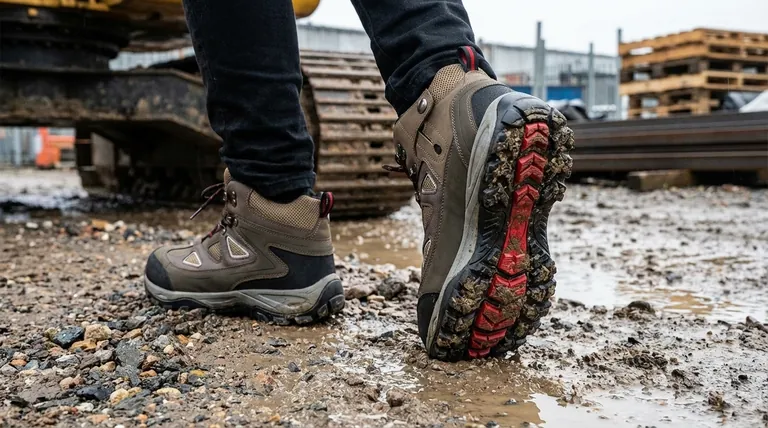
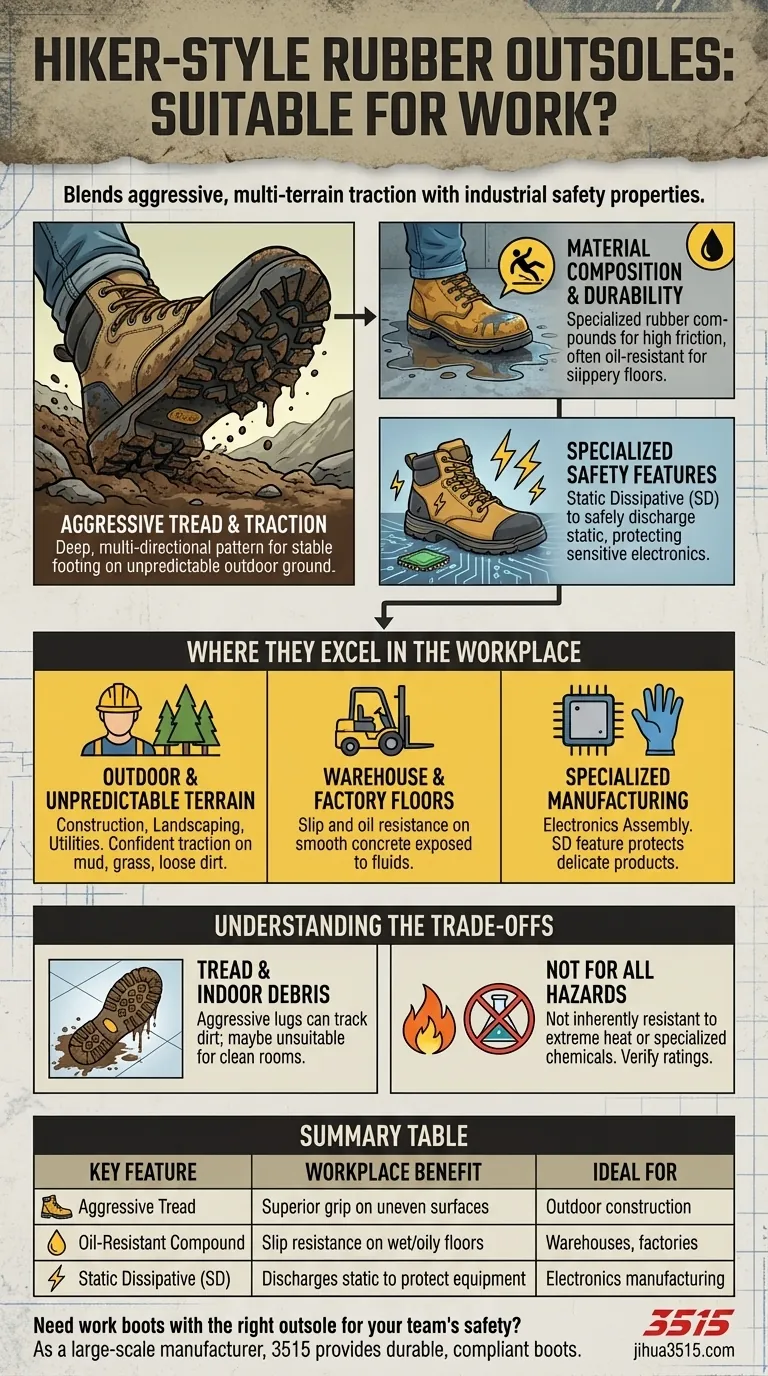
The most visible feature is the deep, multi-directional lug pattern. This design is engineered to bite into soft surfaces like mud and grass while also providing a large surface area to grip hard, uneven ground like rocks or gravel.
This aggressive tread is crucial for maintaining stable footing in dynamic, unpredictable outdoor environments.
Material Composition and Durability
These outsoles are made from specialized rubber compounds. This material is inherently effective at providing high friction, which is the basis for slip resistance on both wet and dry surfaces.
Furthermore, these compounds are often formulated to be oil-resistant, a critical safety feature for factory, warehouse, and mechanical settings where spills are a constant risk.
Specialized Safety Features
Beyond general grip, many hiker-style work outsoles incorporate advanced safety properties. A key example is Static Dissipative (SD) functionality.
This feature is designed to safely discharge static electricity from your body to the ground, which is essential in manufacturing environments that handle sensitive electronic components.
Where Hiker Outsoles Excel in the Workplace
The combination of these attributes makes the hiker-style outsole a strong contender for several specific job types, each leveraging a different aspect of the design.
Outdoor and Unpredictable Terrain
For any work involving landscaping, construction, or utilities, the primary benefit is clear. The outsole provides confident traction on wet grass, mud, and loose dirt, reducing the risk of slips and falls on natural ground.
Warehouse and Factory Floors
Inside a facility, the focus shifts to the rubber compound. The high-friction, oil-resistant properties offer excellent protection against slips on smooth concrete that may be exposed to water, oil, or other fluids.
Specialized Manufacturing Environments
For jobs in electronics assembly or other sensitive manufacturing, the Static Dissipative (SD) feature is non-negotiable. It protects delicate products from electrical damage, making footwear an integral part of the safety protocol.
Understanding the Trade-offs
While highly versatile, the hiker-style outsole is not a universal solution for every job. Understanding its limitations is key to making a safe and appropriate choice.
Tread and Indoor Debris
The same aggressive lugs that excel outdoors can become a liability in certain indoor settings. They can track in significant dirt and debris, which may be unacceptable in clean rooms or finished interior spaces.
Not for All Hazards
A hiker outsole's primary strengths are traction and, in some cases, static dissipation. It does not inherently provide protection against extreme heat (like a welder's boot) or specialized chemical hazards. Always verify the boot's full set of safety ratings.
Making the Right Choice for Your Role
Selecting the right outsole requires matching its specific benefits to the primary hazards of your job.
- If your primary focus is outdoor work on natural surfaces: The aggressive tread pattern is your most important feature for stability on mud, grass, and gravel.
- If your primary focus is indoor industrial work: Prioritize an outsole with certified slip and oil resistance to handle spills on smooth concrete floors.
- If your primary focus is electronics or sensitive manufacturing: You must select a model explicitly rated for Static Dissipative (SD) performance to protect products.
Ultimately, choosing a hiker-style outsole is about leveraging its proven design for environments that demand both ruggedness and specific safety compliance.
Summary Table:
| Key Feature | Workplace Benefit | Ideal For |
|---|---|---|
| Aggressive Tread Pattern | Superior grip on mud, grass, gravel, and uneven surfaces | Outdoor construction, landscaping, utilities |
| Oil-Resistant Rubber Compound | Slip resistance on wet or oily concrete floors | Warehouses, factories, mechanical shops |
| Static Dissipative (SD) Properties | Safely discharges static electricity to protect sensitive equipment | Electronics manufacturing, specialized industrial settings |
Need work boots with the right outsole for your team's safety?
As a large-scale manufacturer, 3515 produces a comprehensive range of hiker-style safety footwear with outsoles engineered for specific workplace hazards. We provide durable, compliant boots for distributors, brand owners, and bulk clients in industries from construction to electronics manufacturing.
Contact us today to discuss your requirements and get a quote on high-performance work boots tailored to your needs.
Visual Guide
Related Products
- Durable Rubber Sole Outdoor Shoes Wholesale & Custom Manufacturing
- Durable Rubber-Soled Utility Shoes for Wholesale & Custom Brand Manufacturing
- Durable Spiked Camouflage Boots Wholesale & Factory Production
- Wholesale Durable Camouflage Canvas Shoes with High-Traction Cleated Rubber Sole
- Wholesale Durable Camo Canvas Shoes with High-Traction Rubber Soles
People Also Ask
- What is the function of the sole in outdoor shoes? Find the Perfect Grip and Support
- What role do outdoor shoes and sneakers play in navigating external terrains? Engineered Stability for Every Surface
- How is AI utilized in the design of outdoor and safety footwear? Harnessing Big Data for Market-Driven Shoe Innovation
- Why is durability important when selecting outdoor shoes? A Guide to Safety & Long-Term Value
- What are the key components of outdoor shoes that affect comfort and sturdiness? A Guide to Durable, High-Performance Footwear