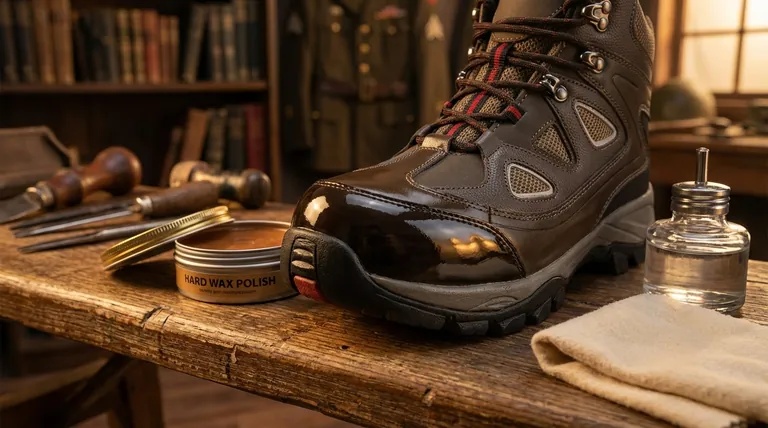
At its core, the high-gloss patina finish originates directly from military service. It is the modern, artisanal evolution of the "spit shine," a technique where soldiers were required to polish their boots and shoes to a flawless, mirror-like reflection as a symbol of discipline and attention to detail.
This finish is less about a specific product and more about a meticulous process. It was born from a culture of discipline and has evolved into a hallmark of high-end shoe care, signifying patience and craftsmanship.
The Military Roots of the "Spit Shine"
The mirror shine seen on the toes of fine dress shoes today has a direct and storied lineage tracing back to the barracks of armed forces around the world. Understanding this origin reveals why the finish is so highly regarded.
A Mandate for Discipline
For military personnel, the state of their uniform was a direct reflection of their personal discipline and readiness. A perfectly shined shoe, known as a "spit shine" or "mirror shine," demonstrated an individual's commitment to standards and meticulous attention to detail.
This was not simply about aesthetics; it was a fundamental part of military bearing and pride. The process itself—slowly building up layers of polish—was a methodical, almost meditative, exercise in patience.
From Barracks to Boardrooms
The sharp, defined look of a mirror-shined shoe was eventually adopted by civilians. It became a powerful, non-verbal cue in the professional world, signaling that the wearer was precise, detail-oriented, and respected tradition.
The technique transitioned from a requirement of uniformity to a mark of personal sophistication and an appreciation for classic style.
Deconstructing the High-Gloss Finish
While its roots are in simple polish and water, the modern high-gloss patina is a more refined art form. The fundamental principles, however, remain the same.
The Principle of Layering
The mirror effect is not achieved with a single, thick coat of polish. Instead, it is created by applying dozens of micro-layers of hard wax polish. Each thin layer fills the microscopic pores of the leather.
Water is used in tiny amounts to reduce friction during application, allowing the wax to be spread into an exceptionally thin and smooth layer. Over time, these layers build upon each other to create a perfectly flat, non-porous surface that reflects light like glass.
Localized Application
A true high-gloss finish is almost always restricted to the rigid parts of the shoe, primarily the toe cap and sometimes the heel counter.
These areas do not flex or crease during walking. Applying a thick, rigid wax finish to the flexible parts of the shoe (the vamp) would cause it to crack and flake almost immediately.
Understanding the Trade-offs
A mirror shine is impressive, but it comes with specific limitations that are critical to understand before you commit the time to creating one.
Prone to Scuffs and Cracks
The hard, glassy surface of a high-gloss finish is more brittle than a standard polish. It can show scuffs more easily and is susceptible to cracking if the shoe is flexed or struck.
Requires Significant Time
Achieving this finish is not a quick five-minute polish. It is a labor-intensive process that can take anywhere from 30 minutes to several hours of patient, focused work to build the necessary layers of wax.
High Maintenance
Once achieved, the mirror shine requires regular upkeep. Dust and minor scuffs must be managed with a soft cloth, and the finish may need to be touched up periodically to maintain its flawless reflective quality.
Making the Right Choice for Your Goal
Deciding whether to pursue a high-gloss finish depends entirely on your purpose and the occasion.
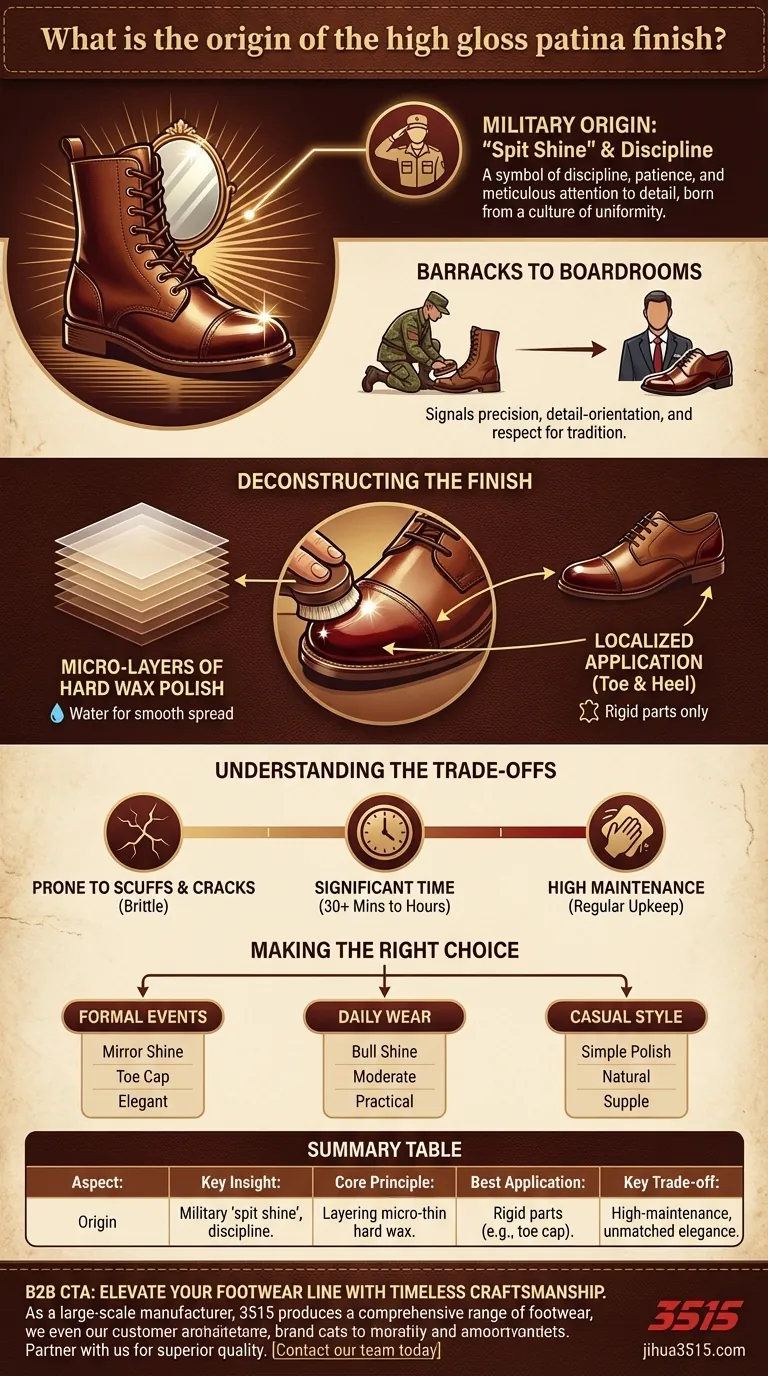
- If your primary focus is formal events or sartorial excellence: A perfectly executed mirror shine on the toe cap is the ultimate finishing touch for a classic, elegant look.
- If your primary focus is daily professional wear: A more moderate "bull shine" or high-gloss (but not a perfect mirror) is more practical and durable for regular use.
- If your primary focus is casual style: A simple polish or conditioning with a soft wax is more appropriate and keeps the leather looking natural and supple without being overly formal.
Ultimately, mastering this finish connects you to a long tradition of discipline, pride, and craftsmanship.
Summary Table:
| Aspect | Key Insight |
|---|---|
| Origin | Evolved from the military 'spit shine' for discipline and uniformity. |
| Core Principle | Built by layering micro-thin coats of hard wax polish. |
| Best Application | Rigid shoe parts like the toe cap that do not flex. |
| Key Trade-off | High-maintenance, prone to scuffs, but offers unmatched elegance. |
Elevate Your Footwear Line with Timeless Craftsmanship
As a large-scale manufacturer, 3515 produces a comprehensive range of footwear for distributors, brand owners, and bulk clients. Our production capabilities encompass all types of shoes and boots, including styles that are perfect for achieving a distinguished, high-gloss finish.
Partner with us to offer your customers superior quality and classic elegance. Contact our team today to discuss your manufacturing needs.
Visual Guide
Related Products
- Wholesale Durable Camouflage Canvas Shoes with High-Traction Cleated Rubber Sole
- Wholesale Durable Camo Canvas Shoes with High-Traction Rubber Soles
- Wholesale Durable & Breathable Training Shoes for Custom Brands
- Durable High-Traction Canvas Sneakers Wholesale & Custom Manufacturing
- Wholesale Perforated Comfort Dress Shoes | Custom Derby Shoe Manufacturer
People Also Ask
- Why is the selection of high-strength fabric materials necessary in the production of canvas shoes and training shoes?
- What are the properties of canvas as a shoe material? A Guide to Lightweight Comfort & Style
- Can canvas shoes be worn in rainy conditions? The Truth About Water Resistance
- What are some examples of vulcanized shoes? Discover the Flexibility and Board Feel of Classic Sneakers
- What are the characteristics of canvas as a shoe material? A Guide to Lightweight, Breathable Footwear