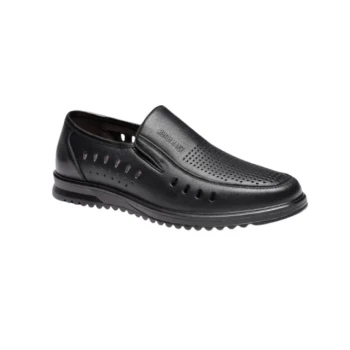
Industrial RFID readers serve as the active communication bridge between physical safety gear and digital monitoring systems. Functioning as microprocessor-controlled transceivers, they are strategically positioned at monitoring points, such as barn entrances, to automate the verification of personal protective equipment (PPE). By emitting radio frequency signals via external antennas, these devices energize passive tags embedded in items like safety shoes, capture their unique IDs, and transmit the data for immediate compliance checks.
The core function of the industrial RFID reader is to convert radio frequency induction into digital verification, ensuring that a worker’s identity and safety equipment are validated before they enter a hazardous zone.
The Mechanics of Detection
Generating Induction Energy
The fundamental task of the reader is to power the system. Because the PPE tags—such as those in safety shoes—are "passive," they do not have their own battery source.
To overcome this, the reader emits radio frequency signals through its external antennas. This creates an electromagnetic field that provides induction energy to the tag. This energy is what activates the tag, allowing it to "wake up" and communicate.
Capturing Unique Identifiers
Once the passive tag is energized, it responds by transmitting a unique identification code. The reader acts as a receiver in this phase, listening for these specific feedback signals.
The microprocessor within the reader processes this signal to extract the distinct ID associated with that specific piece of equipment.
Data Relay to Management Systems
The reader does not store this data in isolation. Its final technical function is to transmit the captured unique IDs to a centralized management system.
This transmission enables the system to cross-reference the data. It verifies the identity of the worker and confirms that the specific PPE detected complies with the safety requirements for that area.
Operational Limitations and Considerations
Proximity Dependencies
The reliance on induction energy creates a physical constraint regarding range. Because the reader must wirelessly power the tag, the PPE must pass relatively close to the external antennas.
If a worker bypasses the specific monitoring point or moves too far from the antenna source, the induction energy may be insufficient to activate the tag.
Infrastructure Integration
These readers are not standalone "magic wands"; they are fixed infrastructure components. They are designed to operate at specific "monitoring points" like barn entrances.
This means the efficacy of the system depends heavily on the physical installation. The reader must be mounted where traffic flow is predictable to ensure consistent detection.
Deploying for Maximum Safety
To utilize industrial RFID readers effectively within your farm facility, align your implementation strategy with your specific safety goals.
- If your primary focus is compliance assurance: Ensure antennas are positioned to create an unavoidable "induction zone" at every barn entrance to guarantee tag activation.
- If your primary focus is system efficiency: verifying that the reader's data transmission protocols integrate seamlessly with your existing management software to prevent logging delays.
Reliable PPE monitoring depends on the seamless transfer of energy and data at the exact moment a worker crosses the threshold.
Summary Table:
| Component | Primary Function | Role in Farm Facilities |
|---|---|---|
| RFID Reader | Active Transceiver | Energizes passive tags and processes unique IDs at entry points. |
| External Antenna | Signal Transmission | Creates the induction zone to wake up tags via electromagnetic fields. |
| Passive Tag | Data Carrier | Embedded in safety gear (e.g., shoes) to store unique compliance IDs. |
| Central System | Data Verification | Cross-references worker IDs with safety requirements for area access. |
Secure Your Workforce with 3515 High-Performance Safety Solutions
In the demanding environment of modern farm facilities, automated PPE compliance is non-negotiable. As a large-scale manufacturer serving distributors and brand owners, 3515 offers comprehensive production capabilities for all footwear types, anchored by our flagship Safety Shoes series. Our advanced manufacturing ensures that our work and tactical boots, outdoor shoes, and training sneakers are ready for seamless RFID integration to meet your technical monitoring needs.
Whether you need bulk supplies of rugged safety boots or sophisticated dress & formal footwear, 3515 delivers the quality and scale your business requires. Contact us today to discuss how our footwear solutions can enhance your safety infrastructure!
References
- Maria Verde, Giampaolo Raimondi. A smart combination of IoT and blockchain enabling technologies to measure and improve workplace safety in dairy farm. DOI: 10.21014/actaimeko.v12i4.1634
This article is also based on technical information from 3515 Knowledge Base .
Related Products
- Wholesale Durable Safety Boots Manufacturer Customizable Steel Toe Work Boots
- Lightweight Breathable Sneakers with Wet-Traction Grip for Wholesale & Private Label
- Wholesale Modern Business Shoes with Dial Closure System for Bulk Orders
- Wholesale Durable Camouflage Canvas Shoes with High-Traction Cleated Rubber Sole
- Lightweight Breathable Training Shoes for Wholesale & Custom OEM Manufacturing
People Also Ask
- What are the pros and cons of steel toe work boots? A Guide to Maximum Protection vs. Comfort
- What are the different types of steel toe work boots? Choose the Right Boot for Your Job
- What is the history of steel toe work boots? From German Invention to Modern Safety Standard
- How much weight can steel toe work boots withstand? Unpacking the 3,372 lb. Safety Standard
- What are some common myths about steel toe work boots? Debunked for Modern Workers