
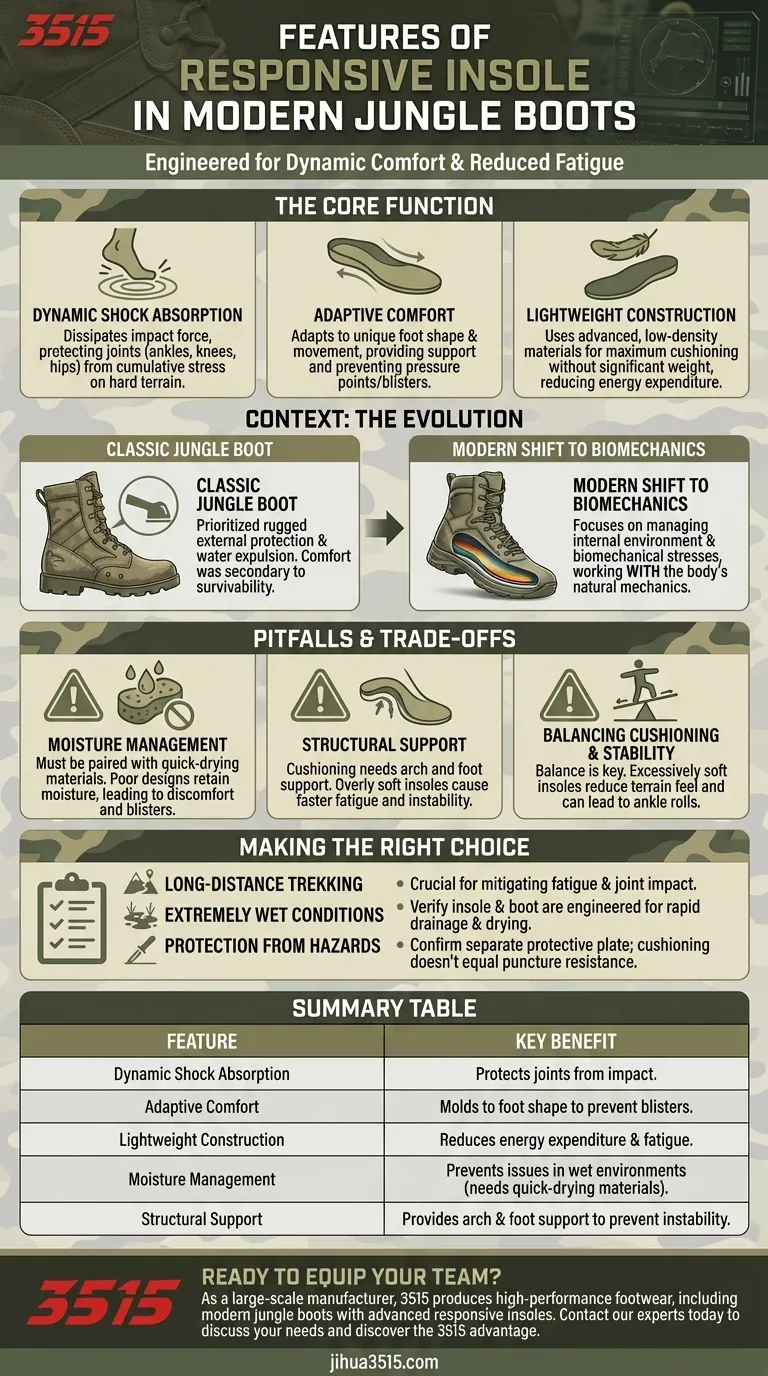
At its core, the responsive insole found in modern jungle boots is engineered to provide dynamic comfort and reduce fatigue. Its key features are superior shock absorption, adaptive cushioning that conforms to the foot's natural movement, and a lightweight construction that minimizes energy expenditure during prolonged use.
The shift to a responsive insole represents a fundamental change in boot design philosophy. While classic jungle boots prioritized rugged external protection and water expulsion, modern designs focus on managing the internal environment and biomechanical stresses on the foot itself.
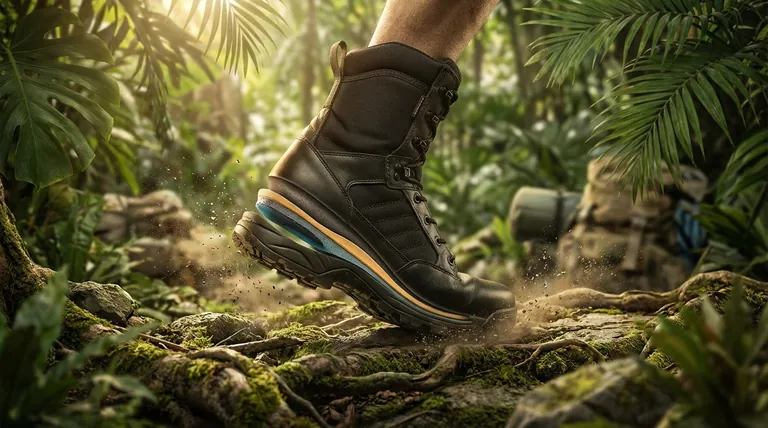
The Core Function of a Responsive Insole
A responsive insole is not merely a piece of foam; it is an active component designed to work with your foot. Its effectiveness comes from three primary characteristics.
Dynamic Shock Absorption
The material is specifically designed to dissipate the force of impact with the ground. This constant cushioning protects your joints—ankles, knees, and hips—from the cumulative stress of walking or running on hard, uneven terrain.
Adaptive Comfort
The term "responsive" refers to the insole's ability to adapt to your foot's unique shape and movement. As you walk, it flexes and molds, providing support where needed and preventing the pressure points that often lead to discomfort and blisters.
Lightweight Construction
Every ounce matters on a long march. These insoles use advanced, low-density materials that provide maximum cushioning without adding significant weight to the boot, directly contributing to reduced fatigue over time.
Context: The Evolution from Classic to Modern Boots
Understanding the value of a responsive insole requires knowing what came before it. The design philosophy for jungle footwear has evolved significantly.
The Classic Jungle Boot Philosophy
Traditional jungle boots, famous for their Panama sole, focused on durability and environmental management. They featured a rigid steel plate for puncture protection and drainage holes to quickly shed water after being submerged. Comfort was secondary to survivability.
The Modern Shift to Biomechanics
Modern boots treat the foot as a complex system. The responsive insole is part of this approach, aiming to improve endurance and reduce injury by working with the body's natural mechanics rather than simply encasing the foot in a rigid shell.
Understanding the Pitfalls and Trade-offs
A "responsive insole" is not a guarantee of performance. Poorly executed designs can introduce new problems, and even well-designed ones have inherent trade-offs.
The Critical Role of Moisture Management
The single greatest failure of a poor insole is moisture retention. A cushioned material that acts like a sponge can lead to severe discomfort, blisters, and fungal infections—a critical failure in a jungle environment. A high-quality responsive insole must be paired with quick-drying, breathable materials.
The Necessity of Structural Support
Cushioning alone is not enough. An effective insole must also provide proper arch and foot support. An overly soft, unsupportive insole can cause your foot to fatigue faster as it struggles to stabilize itself, defeating the entire purpose.
Balancing Cushioning and Stability
There is a fine line between soft cushioning and unstable footing. On highly uneven or slippery ground, an excessively thick or soft insole can reduce your feel for the terrain and lead to ankle rolls. The best designs balance shock absorption with a stable, supportive base.
Making the Right Choice for Your Environment
The ideal boot depends entirely on your specific needs and the challenges you expect to face.
- If your primary focus is long-distance trekking on varied terrain: A boot with a well-designed responsive insole is crucial for mitigating fatigue and joint impact.
- If your primary focus is extremely wet or swampy conditions: Verify that the insole and the entire boot system are engineered for rapid drainage and drying, not just cushioning.
- If your primary focus is protection from ground hazards: Do not assume a cushioned insole includes puncture resistance; confirm that the boot has a separate protective plate if required.
Ultimately, understanding the responsive insole allows you to look beyond the boot's exterior and evaluate how it will support your body's performance from the inside out.
Summary Table:
| Feature | Key Benefit |
|---|---|
| Dynamic Shock Absorption | Protects joints from impact on hard, uneven terrain. |
| Adaptive Comfort | Molds to the foot's shape to prevent pressure points and blisters. |
| Lightweight Construction | Reduces energy expenditure and fatigue during prolonged use. |
| Moisture Management | Must be paired with quick-drying materials to prevent issues in wet environments. |
| Structural Support | Provides arch and foot support to prevent instability and fatigue. |
Ready to equip your team with superior footwear?
As a large-scale manufacturer, 3515 produces a comprehensive range of high-performance footwear for distributors, brand owners, and bulk clients. Our production capabilities encompass all types of boots, including modern jungle boots engineered with advanced responsive insoles for dynamic comfort and endurance.
We can help you source or develop the perfect footwear solution for demanding environments. Contact our experts today to discuss your needs and discover the 3515 advantage.
Visual Guide
Related Products
- Wholesale Breathable Perforated Leather Derby Shoes with Modern Comfort Sole
- Wholesale Durable Camouflage Canvas Shoes with High-Traction Cleated Rubber Sole
People Also Ask
- What are the features and appropriate occasions for wearing derby shoes? A Guide to Versatile Style
- What is the main difference between Derby Shoes and Oxford Shoes? It's All in the Lacing.
- How do Derby shoes fit into business casual attire? Master the Perfect Balance of Professional Style
- What historical figure is associated with the Derby shoe? The Earl of Derby's Comfort Revolution
- How do Derby shoes differ from Oxford shoes? A Guide to Formality, Fit & Style

