
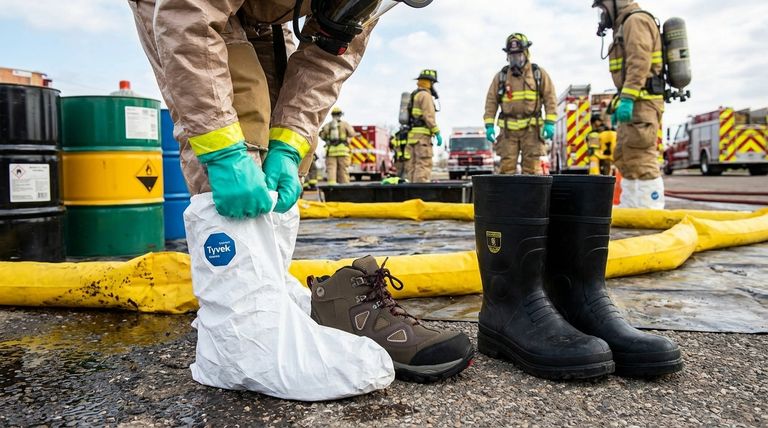
For protecting expensive leather boots during hazmat responses, the most common and effective alternatives are to use either dedicated rubber boots or disposable Tyvek overboots. These solutions allow first responders to preserve their primary structural firefighting boots, which are costly and difficult to decontaminate, for their intended purpose.
The core issue is risk management, both for personnel safety and equipment cost. Leather is an excellent material for structural firefighting but is impractical for hazmat scenes due to its high replacement cost and difficulty in ensuring complete decontamination.
The Challenge with Leather in Hazmat Scenarios
While essential for structural firefighting, leather boots present significant challenges when exposed to hazardous materials. The decision to use an alternative is driven by two main factors: cost and safety.
High Replacement Cost
Your primary leather boots are a significant investment, often costing between $250 and $300. Exposing them to unknown or corrosive substances risks irreversible contamination, forcing a costly replacement.
Decontamination Uncertainty
Unlike non-porous materials, leather can absorb chemicals, making complete decontamination difficult to verify. This creates a potential long-term exposure risk if the boots are worn again.
Analyzing the Primary Alternatives
To mitigate these risks, departments and individuals adopt more practical and cost-effective solutions specifically for hazmat calls.
Solution 1: Dedicated Rubber Boots
Keeping a separate pair of rubber boots is a common strategy. These are significantly less expensive, often around $100 per pair.
Rubber is non-porous, making it far easier to decontaminate thoroughly. In cases of gross contamination, replacing them is a much smaller financial loss than replacing primary leather boots.
Solution 2: Disposable Overboots
Tyvek (or similar material) overboots offer a lightweight and disposable layer of protection. They are designed to be worn directly over your existing leather boots.
This is often the most convenient option, as it doesn't require changing footwear on-scene. After the incident, the overboots are simply removed and disposed of according to protocol.
Understanding the Trade-offs
Choosing between rubber boots and overboots involves balancing protection, durability, and operational logistics. There is no single perfect solution for every scenario.
Cost vs. Reusability
Disposable overboots have a very low per-incident cost but offer no long-term use. Rubber boots require a higher initial investment but can be decontaminated and reused for many calls, making them more cost-effective over time.
Protection Level vs. Convenience
Rubber boots generally offer a higher level of integrated, durable protection against liquids and physical hazards. Overboots are exceptionally convenient but are more susceptible to tearing or punctures, potentially compromising the barrier.
Making the Right Choice for Your Goal
Your decision should be based on your department's budget, the frequency of hazmat calls, and your standard operating procedures.
- If your primary focus is minimal cost and convenience for infrequent calls: Disposable overboots are an excellent choice to protect your primary boots without a large upfront investment.
- If your primary focus is durable, reusable protection for frequent calls: Investing in dedicated rubber boots offers a more robust and cost-effective long-term solution.
Ultimately, using a dedicated alternative for hazmat response is a critical step in protecting both your health and your essential equipment.
Summary Table:
| Solution | Key Feature | Best For |
|---|---|---|
| Dedicated Rubber Boots | Durable, reusable, easier to decontaminate | Frequent hazmat calls, long-term cost savings |
| Disposable Overboots (Tyvek) | Lightweight, convenient, low per-use cost | Infrequent calls, maximum convenience |
Protect your team and your budget with the right footwear solution. As a large-scale manufacturer, 3515 produces a comprehensive range of durable and cost-effective footwear, including dedicated rubber boots perfect for hazmat response. We work directly with distributors, brand owners, and bulk clients to deliver the right gear for your specific operational needs. Contact our experts today to discuss your requirements and protect your essential equipment.
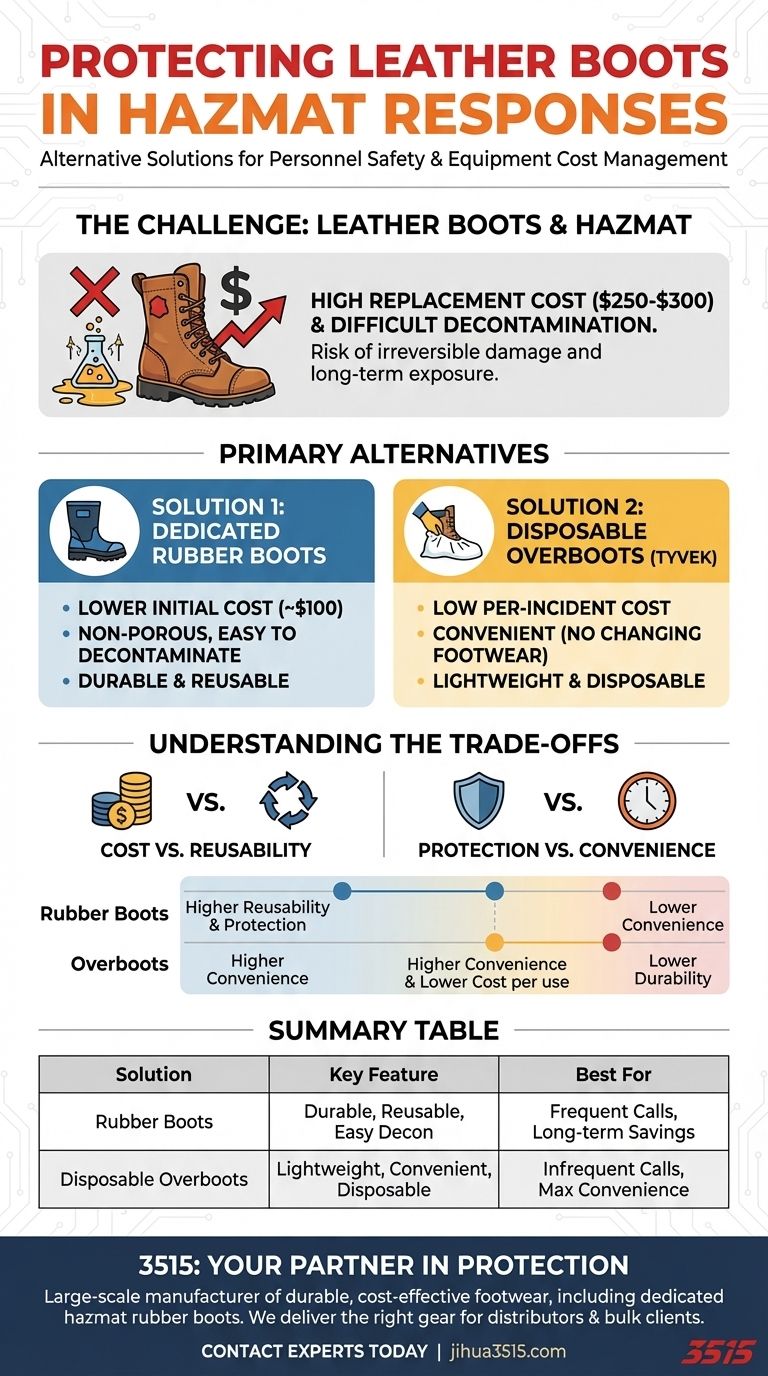
Visual Guide
Related Products
- Factory Direct Wholesale Rain Boots Durable Waterproof & Fully Customizable
- Durable Rubber Sole Outdoor Shoes Wholesale & Custom Manufacturing
- Wholesale Durable Camouflage Canvas Shoes with High-Traction Cleated Rubber Sole
- Durable Leather Work Boots for Wholesale & Custom Manufacturing
- Wholesale Durable Leather Work Boots | 8-Inch Goodyear Welt Manufacturer
People Also Ask
- What are the characteristics of rain boots? A Guide to Waterproof Footwear for Every Need
- What factors should be considered when choosing rain boots? Find the Perfect Boot for Your Needs
- What are the main differences between rain boots and snow boots? Choose the Right Boot for Your Climate
- How should one decide between PVC and rubber for rain boots? A Guide to Choosing the Right Material
- Why are rain boots more flexible and comfortable than snow boots? The Key Differences Explained















