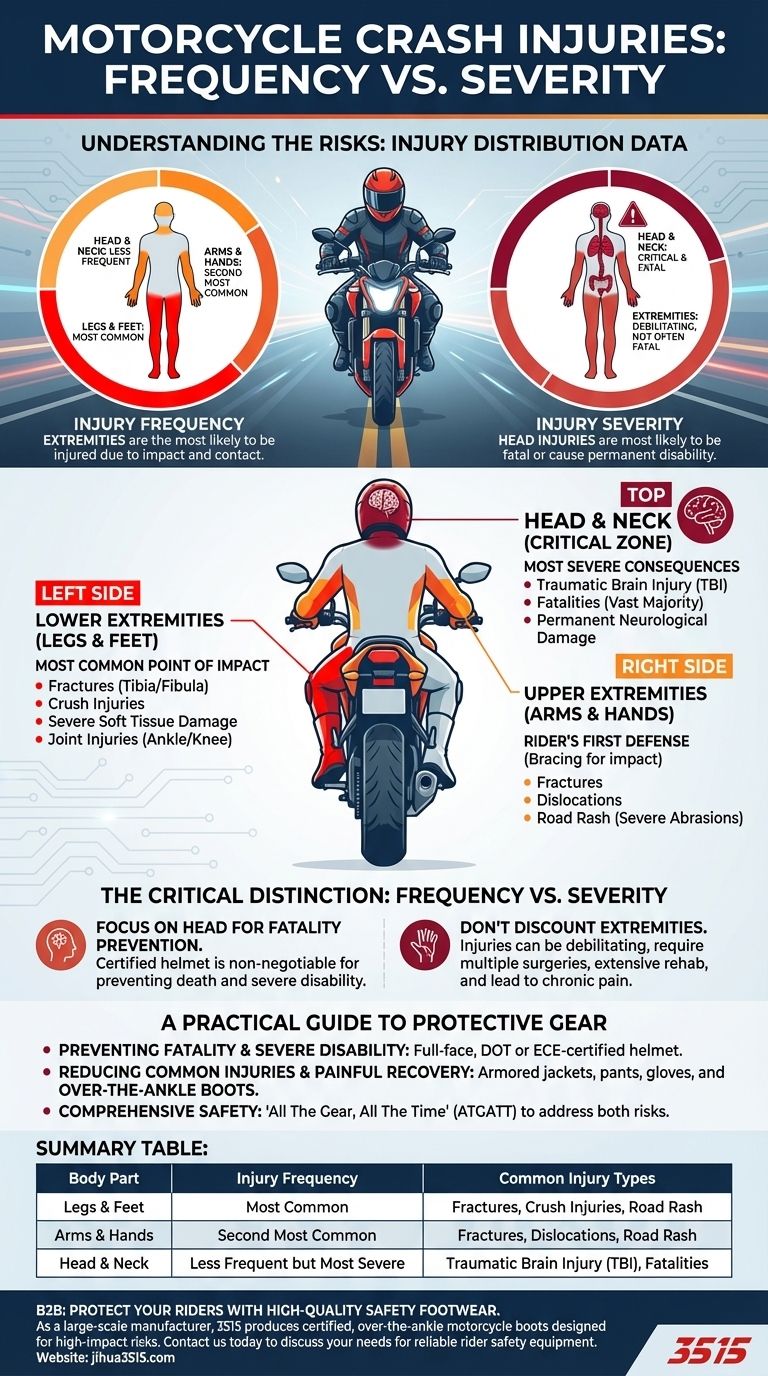
When a motorcycle crash occurs, the most commonly injured body regions are consistently the extremities—the legs and arms—followed by the head. Data shows that these three areas bear the brunt of the impact and subsequent contact with the ground or other vehicles.
Understanding the risks of motorcycle riding requires looking at two different metrics: injury frequency and injury severity. While your arms and legs are the most likely to be injured, it is a head injury that is most likely to be fatal or cause permanent disability.
A Data-Driven Look at Injury Distribution
In nearly any motorcycle accident scenario, the rider is separated from the vehicle, exposing the entire body to impact. However, injury patterns are not random, and specific areas are far more vulnerable than others.
The Lower Extremities: The Most Common Point of Impact
Your legs and feet are the single most frequently injured body part in a motorcycle crash. This is due to their position on the bike, making them susceptible to initial side impacts and crushing forces.
Common injuries include fractures of the tibia and fibula, as well as significant soft tissue damage and joint injuries to the ankle and knee.
The Upper Extremities: A Rider's First Defense
The arms, wrists, and hands are the second most commonly injured region. This is often a result of a rider's natural instinct to use their arms to brace for impact.
This defensive action leads to a high rate of fractures, dislocations, and severe abrasions, commonly known as "road rash," when skin makes contact with the pavement at speed.
The Head and Neck: The Critical Zone for Severity
While injured less frequently than the arms or legs, the head and neck are the most critical areas to protect. The vast majority of fatalities in motorcycle crashes are a direct result of traumatic brain injuries.
Even non-fatal head injuries can lead to permanent neurological damage and life-altering disability, making this the single most important area to shield.
The Critical Distinction: Injury Frequency vs. Severity
A common mistake is to focus only on what happens most often. For a rider, the key to safety is understanding that the most frequent injuries are not the same as the most dangerous ones.
Why We Focus on the Head
The overwhelming evidence linking head injuries to motorcycle fatalities is why helmet use is so heavily emphasized in laws and safety courses. A certified helmet is the single most effective piece of gear for preventing death or severe disability. It manages impact forces and protects the brain from catastrophic injury.
The Hidden Dangers of Extremity Injuries
Do not discount the seriousness of injuries to your arms and legs. While less likely to be fatal, these injuries can be incredibly debilitating, often requiring multiple surgeries, extensive rehabilitation, and long periods away from work. They can result in chronic pain and a permanent loss of function.
A Practical Guide to Protective Gear
Understanding these risks allows you to make informed decisions about your protective gear. Your gear is the only thing between your body and the road.
- If your primary focus is preventing fatality and severe disability: A full-face, DOT or ECE-certified helmet is the non-negotiable foundation of your safety.
- If your primary focus is reducing the most common injuries and avoiding painful recovery: Armored riding jackets, pants, gloves, and over-the-ankle boots are essential to protect your vulnerable limbs.
- If your primary focus is comprehensive safety: Adopt an "All The Gear, All The Time" (ATGATT) mentality, which combines a helmet with full-body protection to address both high-frequency and high-severity risks.
Ultimately, protecting yourself effectively means preparing for both the most likely and the most dangerous outcomes of a crash.
Summary Table:
| Body Part | Injury Frequency | Common Injury Types |
|---|---|---|
| Legs & Feet | Most Common | Fractures, Crush Injuries, Road Rash |
| Arms & Hands | Second Most Common | Fractures, Dislocations, Road Rash |
| Head & Neck | Less Frequent but Most Severe | Traumatic Brain Injury (TBI), Fatalities |
Protect Your Riders with High-Quality Safety Footwear
As a large-scale manufacturer, 3515 produces a comprehensive range of certified, over-the-ankle motorcycle boots designed for the high-impact risks identified in this article. We provide durable, protective footwear for distributors, brand owners, and bulk clients seeking to equip riders with gear that mitigates the most common and severe lower extremity injuries.
Contact us today to discuss how our production capabilities can meet your needs for reliable rider safety equipment.
Visual Guide