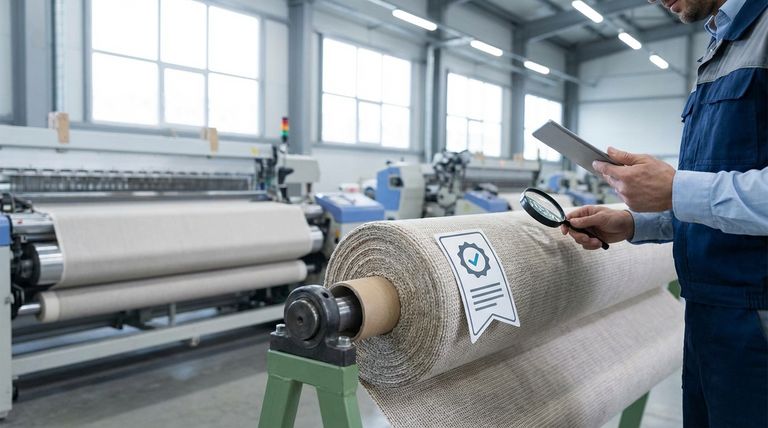
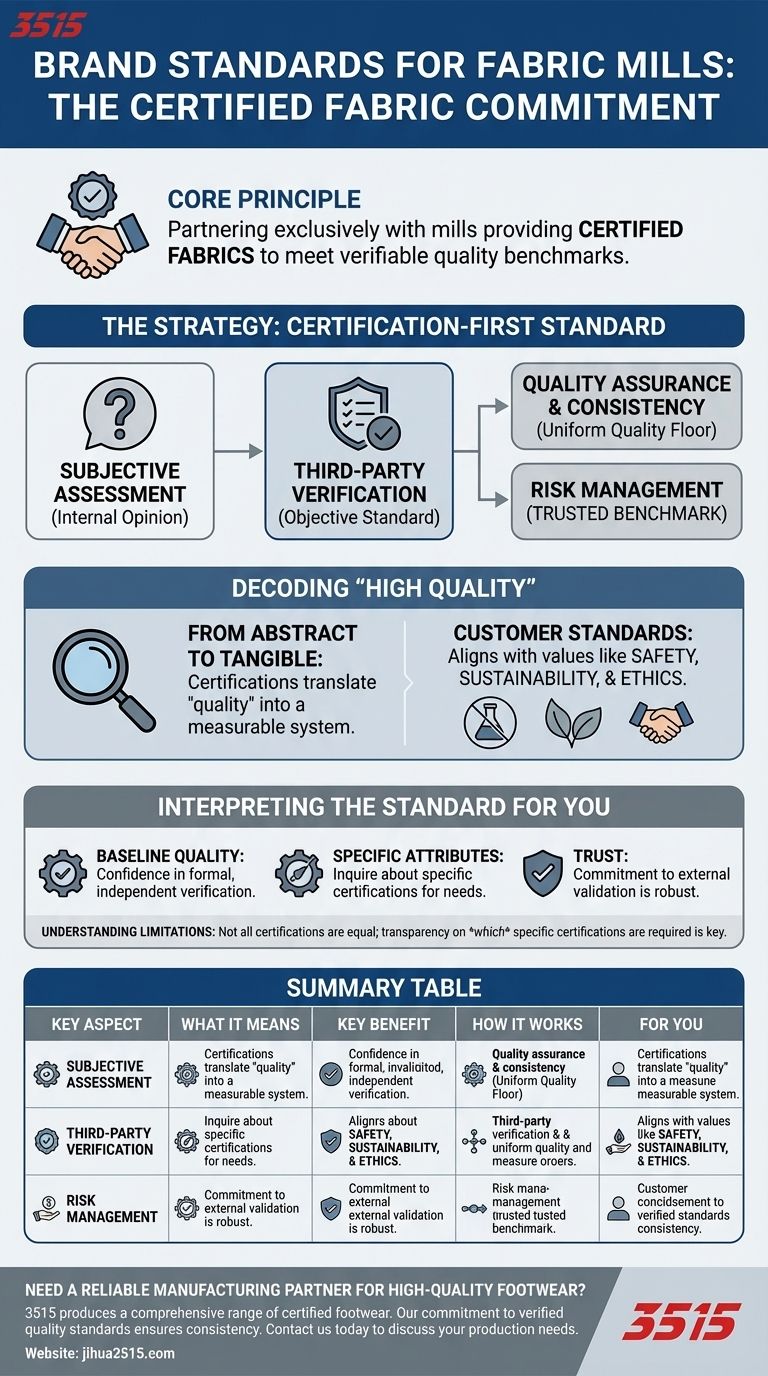
To put it simply, the brand's standards for fabric mills center on a core principle: partnering exclusively with mills that provide certified fabrics. This strategy ensures that all materials meet a verifiable benchmark for quality that satisfies both internal criteria and customer expectations.
The fundamental standard is a commitment to third-party verification. Instead of relying solely on internal assessments, the brand requires its mill partners to offer fabrics that have been officially certified, ensuring a consistent and trusted level of quality.
The Strategy Behind a Certification-First Standard
A brand's decision to mandate certified fabrics is a deliberate choice about quality assurance and risk management. It shifts the burden of proof from a subjective assessment to an objective, third-party standard.
What "Certified Fabrics" Implies
A certified fabric has been independently tested and verified by an external organization to meet specific criteria. This process provides a guarantee that the material adheres to a defined standard.
These standards can cover a wide range of attributes, creating a baseline of quality that is both repeatable and reliable across different suppliers.
The Goal: Ensuring Consistency
By requiring certification, the brand creates a uniform quality floor for all its material sourcing. It simplifies the selection process by establishing a clear, non-negotiable requirement for any potential mill partner.
This ensures that whether a fabric comes from a mill in one country or another, it meets the same fundamental benchmarks for performance and quality.
Decoding the "High-Quality" Claim
The term "high quality" can be subjective. The use of certifications is a method to translate this abstract goal into a tangible, measurable system.
Moving from Subjective to Objective
Relying on certifications means the brand's standard is not just an internal opinion. It is tied to an external, public benchmark that can be reviewed and understood.
This provides a clear answer to the question of what "quality" means to the brand. It means meeting the specific criteria laid out by the certifying body.
The Role of Customer Standards
The mention of meeting "customers' standards" is key. Certifications often align with consumer values, such as safety (e.g., free from harmful chemicals), sustainability, or ethical production.
This approach demonstrates an awareness of customer expectations and uses certifications as a shorthand to communicate that those expectations are being met.
Understanding the Limitations
While a certification-based standard is a strong indicator of quality, its meaning depends entirely on the specifics of the certifications themselves.
Not All Certifications Are Equal
Different certifications focus on different things. One might certify organic content, another might focus on the absence of hazardous substances, and a third could verify fair labor practices.
The Need for Transparency
The effectiveness of this standard relies on transparency. Stating that fabrics are "certified" is a good first step, but a truly rigorous standard would involve disclosing which specific certifications are required.
Without this detail, it is difficult to fully assess the scope and impact of the brand's quality criteria.
How to Interpret This Standard
For you, the customer or partner, this information provides a framework for understanding the brand's approach to material quality.
- If your primary focus is baseline quality: You can be confident that the fabrics have passed a formal, independent verification process, not just an internal check.
- If your primary focus is a specific attribute (e.g., sustainability): The next logical step is to inquire which specific certifications the brand relies on to meet its standards.
- If your primary focus is trust: This standard shows a commitment to external validation, which is generally a more robust and trustworthy approach than purely internal quality claims.
Ultimately, a standard based on certified fabrics provides a strong foundation for ensuring material quality and consistency.
Summary Table:
| Key Aspect | What It Means |
|---|---|
| Core Standard | Partnering with mills that provide certified fabrics. |
| Key Benefit | Ensures consistent, verifiable quality and reduces risk. |
| How It Works | Relies on third-party verification against specific criteria (e.g., safety, sustainability). |
| For You | Provides a clear, objective benchmark for material quality and trust. |
Need a reliable manufacturing partner for high-quality footwear?
As a large-scale manufacturer, 3515 produces a comprehensive range of certified footwear for distributors, brand owners, and bulk clients. Our commitment to verified quality standards ensures the consistency and reliability your business depends on.
Contact us today to discuss your production needs and discover how we can be your trusted partner.
Visual Guide
Related Products
People Also Ask
- What historical figure is associated with the Derby shoe? The Earl of Derby's Comfort Revolution
- What are the features and appropriate occasions for wearing derby shoes? A Guide to Versatile Style
- What is the main difference between Derby Shoes and Oxford Shoes? It's All in the Lacing.
- How do Derby shoes fit into business casual attire? Master the Perfect Balance of Professional Style
- What are Derbies and how do they differ from Oxfords? A Guide to Lacing and Formality