The Inspector's Checklist vs. The Manager's Conscience
A safety manager once described the feeling of an unannounced OSHA inspection. It wasn't fear of fines, he said, but the sudden, stark realization that his entire safety program was about to be judged by an outsider. Every procedure, every piece of equipment, every training record—all reduced to a series of checkboxes.
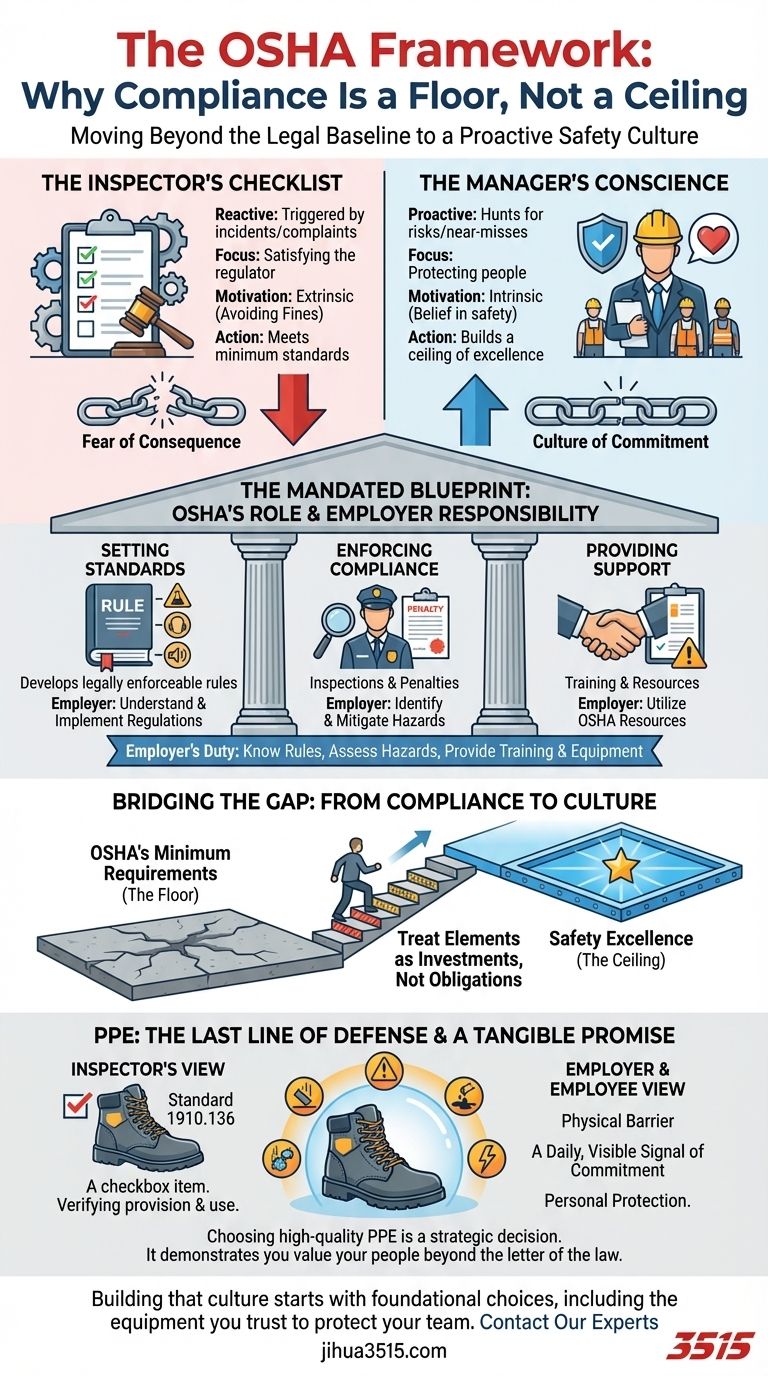
This scenario reveals a fundamental truth about workplace safety. There is the system you build to satisfy the regulator, and there is the culture you build to protect your people.
They are not always the same thing.
The Occupational Safety and Health Administration (OSHA) provides the essential, non-negotiable blueprint. But a blueprint is not the building. The real structure of safety is built daily, through commitment, not just compliance.
The Mandated Blueprint: Understanding OSHA's Role
OSHA's mission is to ensure every worker has a right to safe and healthful working conditions. To achieve this, its function rests on three clear pillars.
- Setting Standards: OSHA develops the legally enforceable rules of the game. These standards dictate everything from the permissible exposure limits for chemicals to the requirements for Personal Protective Equipment (PPE), such as safety footwear.
- Enforcing Compliance: A rule without consequence is merely a suggestion. OSHA enforces its standards through workplace inspections and investigations. Citations and penalties provide a powerful economic incentive to follow the blueprint.
- Providing Support: Beyond enforcement, OSHA is a resource. It offers training, educational materials, and assistance to help employers and employees understand their responsibilities and proactively improve safety.
This framework places the legal and practical responsibility for safety squarely on the employer. It is their duty to know the rules, assess hazards, provide training, and supply the necessary equipment.
| OSHA's Core Function | Employer's Core Responsibility |
|---|---|
| Setting Standards | Understand and implement all applicable regulations. |
| Enforcing Compliance | Proactively identify and mitigate hazards to pass inspection. |
| Providing Support | Utilize OSHA's resources for training and education. |
The Psychological Gap: From Compliance to Commitment
Here lies the critical distinction. An organization driven purely by compliance operates out of a fear of consequence. Its safety efforts may spike before an audit and wane afterward. It does the minimum required.
This is the "floor" of safety. It's the legal baseline you cannot fall below.
A true safety culture, however, treats this floor as the foundation. It aims to build a ceiling of excellence far above OSHA's minimum requirements. This shift is psychological. It moves from an extrinsic motivation (avoiding fines) to an intrinsic one (a genuine belief that every employee deserves to go home safe).
OSHA, with its limited resources, is inherently reactive. Inspections are often triggered by a complaint or, tragically, a serious incident. A culture of commitment is proactive. It hunts for risks and addresses near-misses with the same urgency as an actual accident, knowing that prevention is the only true measure of success.
Bridging the Gap: The Tangible Elements of a Safety Culture
How does an organization move from a compliance mindset to a cultural one? It starts by treating the elements of the safety program not as obligations, but as investments.
Personal Protective Equipment: The Last Line of Defense
Consider the simple safety boot.
For an OSHA inspector, it's a checkbox item under Standard 1910.136, verifying that appropriate foot protection is provided and used.
For the employee on the floor, it is the physical barrier between them and a 50-pound falling tool, a chemical spill, or an electrical hazard. It is personal.
For the employer building a safety culture, the boot is a tangible promise. It is a daily, visible signal to the workforce that their well-being is the top priority. Choosing high-quality, certified PPE is one of the most direct ways to demonstrate that commitment. It shows you value your people beyond the letter of the law.
This is why selecting the right equipment partner is a strategic decision, not just a procurement task. A manufacturer like 3515, producing a comprehensive range of footwear for bulk clients and distributors, isn't just selling a product. They are providing a critical component for building a robust safety system—one that protects your people and proves your commitment.
Building that culture starts with foundational choices, including the equipment you trust to protect your team. Contact Our Experts
Visual Guide